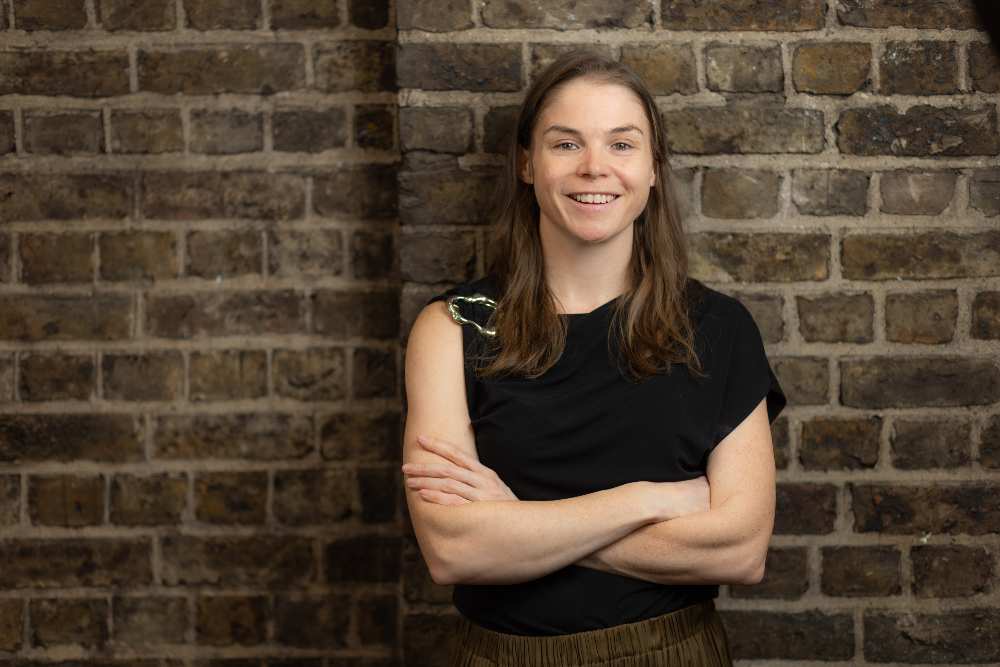
Podcast Ep 332: Alvina Antar, F5’s first-ever chief digital officer, argues that anxiety about artificial intelligence reflects inner insecurity rather than any real threat to jobs or careers. The answer, she says, is curiosity and courage.
When Alvina Antar joined F5 a little over a year ago, she became the first person to hold the title of chief digital officer in the company’s 30-year history.
For an organisation whose technology secures the vast majority of the world’s applications and APIs, from the network edge to the cloud, the appointment might seem overdue. Altar sees it differently. The timing, she argues, could not be better.
“We should be fearless and excited. Instead of embracing it with fearlessness, people are worrying about what happens to their job”
“The evolution of information technology and enterprise technology, especially in the AI age, has transformed” F5, she told The ThinkBusiness Podcast ahead of her appearance at the Dublin Tech Summit. “We started as a gaming company 30 years ago. Now we’re securing every app, every API, every component across from the edge to the cloud.”
It is a remarkable journey for a company whose original product, Big IP, grew out of the need to manage the routing and load-balancing demands of an online gaming platform. Antar herself came full circle to join it: she was a customer of Big IP in 1997, during a 17-year stint at Dell. “Dell is still a huge F5 customer,” she notes with quiet satisfaction.
Building the AI-first organisation: People before platforms
-
Listen to the ThinkBusiness Podcast for business insights and inspiration. Latest episodes are here. You can also listen to the Podcast on:
-
Spotify
-
SoundCloud
-
Apple
Her mandate now is to build what she calls “the new F5” – an organisation that is AI-first in everything it does, not just in the products it sells. That means transforming how 6,500 employees work, think and learn, at the same time as the company reshapes its security portfolio around the demands of the AI era.
Ask Antar where digital transformation actually begins and the answer is not a server rack or a software stack. “It starts with our people. It is a people transformation first and foremost,” she says. “Then our processes. In this new agentic AI world, we are not just automating manual processes, we are redefining them, re-engineering them. And then ultimately using the latest technology to reshape how we do things.”
The goal she has set for F5 is to make every single employee what she calls “AI fluent” – equipped with the platforms, models and confidence to change the way they work, both individually and collectively. That ambition extends well beyond the engineering teams who might be expected to take to new tools most naturally. “Now everyone is an engineer,” she says. “It is equal opportunity, and that is what makes it so exciting.”
She is aware that the mood in many organisations is closer to anxiety than excitement. AI has become a convenient reason cited when jobs disappear, whatever the underlying cause. “It is a nice excuse,” she says of businesses that blame AI for headcount reductions driven by poor strategy. “The reality is we need to train, upskill and drive fluency with individuals who are hungry, eager and fearless to adopt new capability.”
‘The fear is coming from inner insecurity’
“We should be fearless and excited. Instead of embracing it with fearlessness, people are worrying about what happens to their job.”
Overcoming AI anxiety
She finds the anxiety surrounding AI adoption genuinely surprising, particularly among people who have lived through previous technology revolutions.
“Employees who are looking for their manager to tell them what to do and when to do it are not going to be successful in this world”
“If you think about the evolution we have seen in technology, from the internet to the cloud to now AI, we should be embracing it with fearlessness,” she says. “We should be fearless and excited about the advancements. We are all technologists who grew up in technology and have continued to see its evolution. We should take it with full optimism and excitement, and be fearless in really learning, adopting and embracing, as opposed to worrying about what happens to your job.”
She traces that fear to something more personal than economics. “That fear is coming from deep inner insecurity about whether you can actually learn the new capabilities to evolve what you have already learned.” Her own career illustrates the point. She began in engineering writing COBOL, quickly moved away from mainframe systems, and has spent three decades adapting as the technology landscape shifted beneath her. “Learning to code in a compiler is foundational capability that does not make you irrelevant.”
The broader narrative of a job apocalypse, she argues, is simply wrong. “The jobs will change dramatically. They will be cooler than ever.” The drudgery that once consumed skilled workers’ time will be absorbed by AI, freeing people to focus on the parts of their work that actually require human judgment, creativity and collaboration. “It is allowing the artists to focus on the art, their craft, their gift, as opposed to the mundane things required before they can exercise those gifts.”
Governing the tools, not just using them
At F5 itself, translating that philosophy into practice has meant building what Antar describes as a central AI function responsible for governing which tools the company uses, how they are deployed, and what guardrails surround them. The risk of leaving employees to find their own AI solutions, she points out, is a proliferation of ungoverned shadow capabilities that could expose a security company to exactly the kinds of vulnerabilities it exists to prevent.
“We built an AI marketplace,” she explains, “the same way we have an app marketplace. Everyone can see all the sanctioned AI tools that are secure and appropriately governed. You can request licensing, training and enablement there. You can also view agents that people have built, which can then move from pilot or individual use to widespread adoption across 6,500 employees.”
The company has just rolled out Gemini Enterprise to all staff, integrated with F5’s own AI Guardrails product, itself built on the Calypso technology F5 acquired from a Dublin-founded company. F5 acquired Calypso last year for $180m in a deal aimed at strengthening F5’s enterprise AI security capabilities.
Antar’s team is customer zero for the product. “We are using our own guardrails to protect our AI workloads, through red teaming and remediation of vulnerabilities. It is a lot of fun to not only leverage new technology but also secure ourselves with our own products.”
Alongside the AI marketplace, she has invested in embedding AI champions across every function. “It should not just be one organisation driving the AI agenda. There should be champions in marketing, sales, customer success, finance, engineering and product. Every part of the organisation should have someone accountable for the metrics, outcomes and governance.”
The manager who enables rather than instructs
The culture Antar is trying to build at F5 draws heavily on the leadership philosophy she encountered when she first met the company’s chief executive, Francois Locoh-Donou. “He shared about human-first, purpose-driven leadership, and told me he wanted to make F5 a platform for each employee to achieve their greater purpose. That is special in this day and age.”
“Every role is being disrupted. The need to challenge and motivate each other, to make each other uncomfortable in the best sense, that is what growth looks like right now”
In practice it means dismantling the kind of top-down management structure where employees wait for instruction. “Employees who are looking for their manager to tell them what to do and when to do it are not going to be successful in this world,” she says. “We need people who are able to drive decisions, learn on their own, and then share their learnings in a collegiate environment.”
The manager’s role, in her vision, shifts from directing to cultivating. “Gone are the days where people management means your entire role is to manage people — to provide instruction and performance reviews. It is to support, embrace, empower, cultivate and inspire. To provide the space and grace to do magical things.”
She draws an analogy with the holacracy experiments that companies like Zappos once pursued, or with the flat structures increasingly common in AI-native organisations. “Look at the individuals joining Anthropic. Does it matter what their titles are? They went from CEO to member of technical staff because who cares about titles? This is an opportunity for everyone to be a digital officer, for everyone to be an engineer. We are all on the same playing field.”
Curiosity as the defining skill
If there is a single capability Antar would want a future F5 employee to demonstrate above all others, it is not a technical certification or a computer science degree. It is curiosity, paired with what she keeps returning to as fearlessness.
“I do not know how to overemphasise that,” she says. “This is a day and age where we should be hungry and curious and not fearful. That ties into the importance of EQ, which is critical right now. We need people who see this as an opportunity to embrace new technologies and be comfortable failing. You will create a pilot that may not fly, and that is okay. That is part of innovation. If you are not failing, if you are not making mistakes, then you are not learning.”
The vision she paints of the workplace of the near future sounds less like a production line and more like an academic seminar: a place where colleagues have a stimulating debate, try something, discover it does not work, and treat the day as valuable for what was learned rather than what was delivered.
“What I am looking for is someone who is hungry, motivated, self-driven, and has the inner confidence to continue challenging themselves and inspiring their teams. To me, that is the biggest skill.”
For the companies still wrestling with where to start, Antar’s message is stripped back to its essentials: get the governance right, embed the champions, provide the tools, then get out of the way. And above all, be fearless.
“Every role is being disrupted,” she says. “The need to challenge and motivate each other, to make each other uncomfortable in the best sense, that is what growth looks like right now.”
-
Bank of Ireland is welcoming new customers every day – funding investments, working capital and expansions across multiple sectors. To learn more, click here
-
For support in challenging times, click here
-
Listen to the ThinkBusiness Podcast for business insights and inspiration. Latest episodes are here. You can also listen to the Podcast on:
-
Spotify
-
SoundCloud
-
Apple