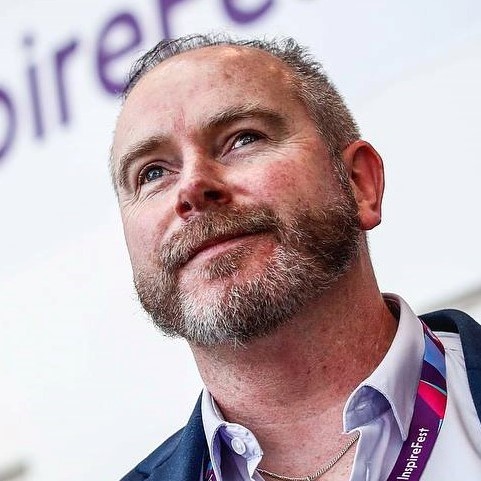
Podcast Ep 327: A new government study warns that close to 200,000 Irish jobs could be displaced by artificial intelligence. Ian Dodson, who built one of the world’s largest digital marketing certification bodies, says the window for workers to act is narrowing.
New research from the Economic and Social Research Institute (ESRI) and Ireland’s Department of Finance warns that AI could displace close to 200,000 Irish jobs – nearly 7% of the workforce – in the short to medium term. But according to Ian Dodson, the answer isn’t panic; it’s upskilling.
The co-founder of the Digital Marketing Institute, which trained over 75,000 professionals before being acquired by BPP Education Group, Dodson is now applying that same playbook to AI with AICertified – a university-accredited, industry-validated standard for professional AI competence.
“The idea that a job is a fixed point you can rely on for your entire career is a comfort we can no longer afford”
Backed by €1m from Oyster Capital and Enterprise Ireland, he joins us to explain why those who invest in AI literacy today will be the ones who thrive tomorrow.
The jobs AI will take are already going
The morning that the report from ESRU was published with its stark forecast of 200,000 jobs being displaced, Dodson read the number and though it had been too cautious.
“My first reaction was that 7% was a low estimate,” said Dodson, who co-founded the Digital Marketing Institute in 2009 and grew it to more than 130,000 graduates before its eventual sale. “If you spend any part of your day sitting at a computer, a great chunk of what you’re doing can already be replaced by AI.”
The ESRI study, produced jointly with Ireland’s Department of Finance, represents one of the starkest official assessments of AI’s potential labour market impact in the Republic. It found that roughly 7% of the Irish workforce, across sectors ranging from legal services to financial administration, faces displacement in the short to medium term, with lower-income workers at heightened risk. Senior officials who typically avoid alarming language chose, in this instance, not to soften the conclusion.
Dodson, now chief executive of AICertified, a university-accredited professional AI qualification he launched earlier this year, pointed to what he sees as the most telling early indicator: a legal firm he knows well has not hired a single junior recruit in two years.
“They used to take on five new people every summer,” he said. “All those junior roles, the research, the drafting, the preliminary analysis, that work is now being done by AI. That’s ten recruits who simply were not hired.”
Displacement, not destruction
Dodson is careful to draw a distinction between jobs lost and jobs changed. The ESRI itself used the word “displacement” advisedly, and he argues the choice of language matters. Travel agents, he noted, were widely expected to disappear when airlines moved online. Instead, the sector was restructured and expanded, with lower fares creating an entirely new category of consumer. Ryanair, now among the largest airlines in the world by passenger numbers, is the result.
“The real question is not whether your job will be replaced by AI,” he said. “It is whether your job will be replaced by someone who knows AI, while you do not.”
That framing shapes the commercial logic behind AICertified. The company employs eight people and expects to grow to fifteen within its first year. It is modelled on the structure Dodson and his co-founder Anthony Quigley used to build the Digital Marketing Institute into a global standard, with the American Marketing Association’s 300,000-strong membership now formally accredited through the DMI framework.
The parallel he draws to 2008 is deliberate. When the global financial crisis struck, digital marketing accounted for just 5% of global advertising budgets. The combination of economic pressure and an emerging technology created the conditions for rapid professional reskilling. Today, digital channels account for the vast majority of advertising spend worldwide. Dodson sees the same structural moment arriving again.
“Global economic uncertainty, a new technology, and a large skills gap. I watched the same confluence of events unfold once before,” he said. “When I started seeing it again with AI, I knew what it meant.”
The literacy gap
At a recent business breakfast in Dublin’s Sandyford district, Dodson asked a room of around 110 professionals to identify which category applied to them: dabbling with AI, deploying it in parts of their business, or running operations entirely on AI. Three people raised their hands for the last category. Three more for the second. The remaining hundred described themselves as dabbling.
The exercise illustrated what he considers the defining problem. Ireland, like most economies, is a nation of AI dabblers at precisely the moment when the gap between dabbling and deploying is starting to determine commercial outcomes.
A separate exercise at a technology conference revealed that raising the question of large language model usage produced four hands. Rephrasing it as ChatGPT or Microsoft Copilot produced a forest of them. The gap between the usage and the understanding of what is being used, Dodson argues, is where Ireland’s immediate vulnerability lies.
“We don’t yet have AI literacy as a society,” he said. “We need to know enough of the language to function in it, the way you need a few thousand words to be considered literate in English. We have not reached that point.”
The ESRI report found that workers with higher existing skill levels are better placed to benefit from AI adoption, a finding Dodson regards as unsurprising but important. He rejects the suggestion that informal skill-building is a substitute for structured credentials. In a market being flooded with AI-generated course content of dubious quality, he says, recognised qualifications serve as the clearest signal of genuine competence.
“Content is not certification. You can generate enormous quantities of content. What you cannot generate is a properly validated, industry-recognised standard,” he said. “The accounting profession did not leave it to individuals to self-certify their competence. The AI industry has to grow up in the same way.”
Ireland’s exposure
Dodson grew up in Limerick at a time when Dell directly employed around 3,000 people in the city and supported perhaps twice as many jobs indirectly. When the company moved manufacturing to Poland in search of lower costs, the effect on a city of 55,000 was severe. He draws on that memory when assessing the structural risks that AI poses to an economy built largely on foreign direct investment.
“The idea that a job is a fixed point you can rely on for your entire career is a comfort we can no longer afford,” he said. “We are a small, open economy, halfway between Europe and America. A huge part of our prosperity depends on decisions made elsewhere.”
He argues that continuous learning is not a lifestyle choice but a structural necessity, and that Ireland has in fact a stronger tradition to draw on than is often recognised. The European Computer Driving Licence, a certification standard that spread across the continent from the 1990s, was developed at Trinity College Dublin by Dudley Dolan. The Digital Marketing Institute, built by two people at a pair of hot desks, eventually became the world’s most widely taught digital marketing qualification.
Enterprise Ireland, which supported both, is backing AICertified through its high-potential start-up programme. Dodson is assembling an industry advisory council drawing on government, universities, employer groups and professional bodies, with the aim of defining what AI competence should actually mean at each level of qualification.
Summon your AI agents
He is also, characteristically, thinking about what comes next. The emerging concept of “identity AI”, in which a model learns enough about an individual to draft communications and take decisions on their behalf, raises questions that neither regulators nor employers have fully confronted: if an employee’s AI identity is built within a company’s systems, who owns it when they leave?
On regulation, he is blunt. Governments, he said, largely chased the wrong problem with social media, focusing on data privacy while the more damaging issue, online anonymity and the harm it enabled, went largely unaddressed. He hopes AI does not follow the same path, though he is not entirely confident it will not.
“We have AI companies essentially self-certifying their own safety. It is a bit like builders self-certifying their own construction standards,” he said. “At some point, that has to change.”
For now, his attention remains on the more immediate problem. The ESRI’s report did not cause him undue alarm. What unsettled him was the response to it, or rather the absence of one.
“People are still mostly dabbling,” he said. “The window to move from dabbling to deploying is not going to stay open indefinitely. The people who act now are the ones who will set the standard. Everyone else will be catching up to them.”
Or, as Scott Galloway recently opined on the Diary of a CEO podcast, do not fear AI taking your job. It is the person who skilled themselves up in AI who will take your job.
-
Bank of Ireland is welcoming new customers every day – funding investments, working capital and expansions across multiple sectors. To learn more, click here
-
For support in challenging times, click here
-
Listen to the ThinkBusiness Podcast for business insights and inspiration. All episodes are here. You can also listen to the Podcast on:
-
Spotify
-
SoundCloud
-
Apple