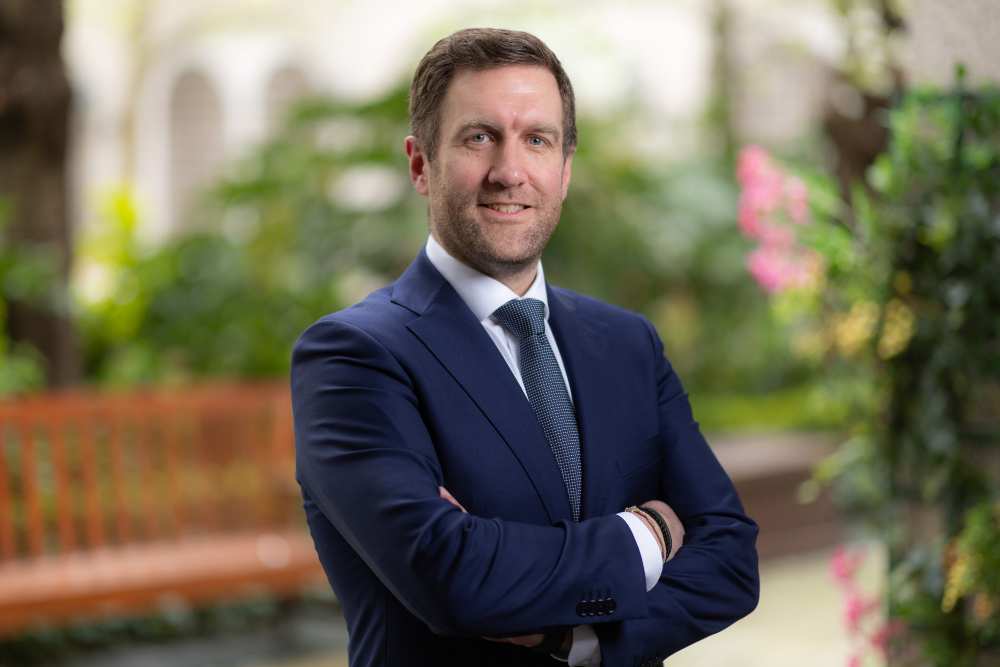
John Corley, the CEO of scaling Irish tech firm Spanish Point and an EY Entrepreneur of the Year finalist for 2026, warns that Ireland has a funding gap for scaling tech firms and calls for Irish capital to back Irish ambition.
In June, fast-growing Irish tech firm Spanish Point took on its first outside investment after 20 years of organic growth, selling a stake to Apiary Capital following a competitive private equity process. CEO and co-founder John Corley retained a significant shareholding in the business.
The process was an interesting but surprisingly poignant one for Corley because he noticed that after meeting what seemed like legions of investors, the money behind the deal came from US and European pension funds. None of it came from Ireland. Not one Irish pension fund was among the backers.
“All of Ireland’s pension funds really are invested in US tech companies and other US companies. Actually, none of them, as far as I know, are invested in Irish tech companies”
To Corley’s mind this exposed a major anomoly in Ireland’s investment landscape. He argues there is insufficient domestic investment available once businesses in Ireland reach a certain size. His view is that successful Irish tech companies are frequently pushed towards either selling or moving their headquarters abroad, most likely to the US.
KEY NUMBERS: Spanish Point’s growth story
- $1.2bn in music royalties expected to be distributed across 13 markets this year
- 13 markets served by the AI-powered Matching Engine
- 30% annual organic growth over the past three years
- Nearly 50% of revenue now generated outside Ireland
- 20 years of largely organic growth before taking outside investment
- 2005 marked Spanish Point’s strategic move into Microsoft technologies
- Zero Irish pension funds among the investors cited in recent fundraising
- Acquisitions now on the agenda following Apiary Capital’s investment
Editorial takeaway: Spanish Point’s international growth highlights Corley’s wider concern: successful Irish technology businesses are scaling, while much of the capital backing them comes from overseas.
Ireland’s investment landscape is missing a trick
Corley met many of those investors in London. They represented groups such as teachers and public sector workers from different US states.
“I’m over here in London talking to all these Americans who are essentially investors in Spanish Point, and there’s no other Irish investor in Spanish Point, apart from me,” he said.
Corley, a finalist in this year’s EY Entrepreneur of the Year awards, sees his company’s cap table as a symptom of how Irish savings are deployed. “All of Ireland’s pension funds really are invested in US tech companies and other US companies,” he said. “Actually, none of them, as far as I know, are invested in Irish tech companies.”
👉 No tech background needed to bring your business into the AI age! Secure your Google AI Professional Certificate to complete the certification at no cost. Apply now and get started!
His own deal does not fit a story of founders starved of capital. Spanish Point ran a competitive process among private equity bidders. “Thankfully, we were in demand,” Corley said, and “from a founder perspective, there wasn’t really a negative there.” His complaint concerns who shares in the returns from Irish companies, and what happens to the many firms that reach a certain size with fewer options than his.
Corley’s points echo those of Scale Ireland chair Brian Caulfield in September. “In the US, pension funds invest about 2% of assets into venture capital, while European pension funds invest just 0.02%,” Caulfield said. “Even 1% of Irish pension fund savings going into indigenous tech companies would have a very significant impact on the availability of capital, and it will not cost the Exchequer.”
A bet on Microsoft before the cloud
Corley spent 10 to 15 years at Mentech, an Irish systems integration company, where he was head of software development. He left in 2005 with Conal Cullen who ran sales there to start Spanish Point. “In retrospect, it seems like a bigger risk than it was,” he said.
The pair’s reasoning was that “if we weren’t successful in the company that we were in, in both selling and delivering these kind of projects, then we wouldn’t have had much of a future in the company anyhow. So why not do it ourselves?”
The founding bet was on Microsoft’s prospects in enterprise software, at a time when, Corley said, “SQL Server was viewed as a kind of lesser database”. Spanish Point built business systems from Microsoft components and declined to resell hardware. Within about three years, by Corley’s account, the company won Microsoft’s worldwide Partner of the Year award with fewer than 15 staff, for a system built for the Irish Music Rights Organisation.
The second phase came with cloud computing, where Corley said Microsoft was then well behind AWS. For a company that only wrote software, the shift removed a recurring obstacle. Business teams would back a proposal, and the IT department would respond: “Oh, well, that’s going to take six months to get the infrastructure.
“What the cloud really did was it let you define infrastructure through software,” Corley said. “The cloud allowed us to bypass all of that.” He said Spanish Point was and remains the largest reseller of Microsoft Azure in Ireland.
Specialisation pays abroad
The third phase, building its own intellectual property, is the one Corley credits with opening export markets. The company repeatedly found itself building similar custom systems for customers in the same sector. “Why don’t we productise that and bring that to the market?” he said.
He believes that developing its own intellectual property has helped unlock international growth.
For example, Smart AIM, a product for setting up DevOps pipelines, serves software companies, mostly in northern Europe. Matching Engine, which grew out of the music rights work, serves collective management organisations. Corley said a similar product for financial services is in development.
Just under half of revenue now comes from outside Ireland, he said, and the international business is “growing far faster than what we do domestically”.
Corley draws a direct line between that growth and narrowing the company’s focus. “In Ireland, it’s hard to be too specialised a company because the country’s so small,” he said. To compete internationally, “you have to really focus on things that you’re really good at, and that you’ve got really solid proof points that you’re good at”.
He is also positive about the home market as a proving ground. “Ireland is a great market to try things out in because people are open to new ideas in Ireland,” he said, adding that “Ireland is intensely competitive” and “if you can succeed in Ireland, I think in general you’ll do well internationally.”
Growth with its own risks
Corley said the company has grown “about 30% a year for the last three years. Just pure organic growth.” He flagged the cost of that pace: “growth is good, but has its risks and its downsides too.”
AI expertise was among the reasons he gave for the timing of the investment. The Matching Engine is, in his words, “100% based on AI”. “This year, that product is going to distribute $1.2 billion in royalties across the 13 different markets that we operate in,” he said. “The business users using it don’t really think of it as being an AI system. They just view it as the system.”
Corley is measured about AI more broadly. He worked on e-commerce sites during the dot-com boom and recalls the claim that “if you weren’t an internet company, you weren’t going to exist.”
He calls AI “undoubtedly transformational” and also says “the hype far exceeds the reality”. In his view, “it’s the software that enables the core LLMs underneath to deliver something that’s really useful and usable.”
That argument favours companies like his own, which sell the software layer. It also matches the lesson he draws from the dot-com era: “You couldn’t really claim that Ryanair is an internet company unless you were very myopic about the role of technology.”
Where Irish companies stop growing
Corley lists Ireland’s advantages as its universities, its highly educated young workforce and its position between the US and Europe.
He identifies one main weakness. “There’s not enough investment to scale companies beyond a certain size,” he said. “Nearly always the kind of impetus for a successful Irish tech company is to sell out once they get [to] 100 people.”
The alternative, he said, is relocation. Founders who pass that size are told they must move. “You have to have your headquarters there, otherwise, you know, you’re not going to attract the type of investors,” he said, describing the advice to base companies in the US.
He believes policymakers see the exposure. “I think the Government understands the risk of being too dependent, and I think the Irish people understand the risk of being too dependent,” he said, referring to reliance on foreign direct investment and large technology companies.
His own experience of the funding system leaves him unconvinced it is set up well. “It doesn’t really make sense the way the industry is organised.”
The Apiary money gives Spanish Point a new role as a buyer. “We’re looking at some acquisitions. That’s the other part of the investment at the moment,” Corley said. It is something he has not done before. “I find it fascinating.”
Whether the next Irish company at Spanish Point’s stage finds domestic investors at the table is the question Corley leaves open.
He hopes the next phase for the country is “figuring out how to do it indigenously without the companies having to move outside of Ireland”. On the pension funds, he is cautiously confident. “I think that’s a maturity that will come to Ireland, hopefully. I think it has to.”
FAQ: Spanish Point, scaling and Irish tech investment
What does Spanish Point do?
Spanish Point is a Dublin software engineering company specialising in Microsoft technologies and its own software products, including Smart AIM and the AI-powered Matching Engine.
How quickly is Spanish Point growing?
Spanish Point has recorded organic growth of around 30% annually over the past three years.
How much of Spanish Point’s business comes from outside Ireland?
Just under 50% of Spanish Point’s revenue now comes from international markets, with overseas operations growing faster than its Irish business.
Why is John Corley concerned about Irish pension fund investment?
Corley says Apiary Capital’s investors include US and European pension funds but no Irish pension funds, raising questions about Irish savings participating in home-grown technology growth.
How will Spanish Point use its new investment?
The investment from Apiary Capital will support Spanish Point’s next phase of growth, with the company now considering acquisitions after two decades of largely organic expansion.
👉 No tech background needed to bring your business into the AI age! Secure your Google AI Professional Certificate to complete the certification at no cost. Apply now and get started!
-
Bank of Ireland is welcoming new customers every day – funding investments, working capital and expansions across multiple sectors. To learn more, click here
-
For support in challenging times, click here
-
Listen to the ThinkBusiness Podcast for business insights and inspiration. All episodes are here. You can also listen to the Podcast on:
-
Spotify
-
SoundCloud
-
Apple