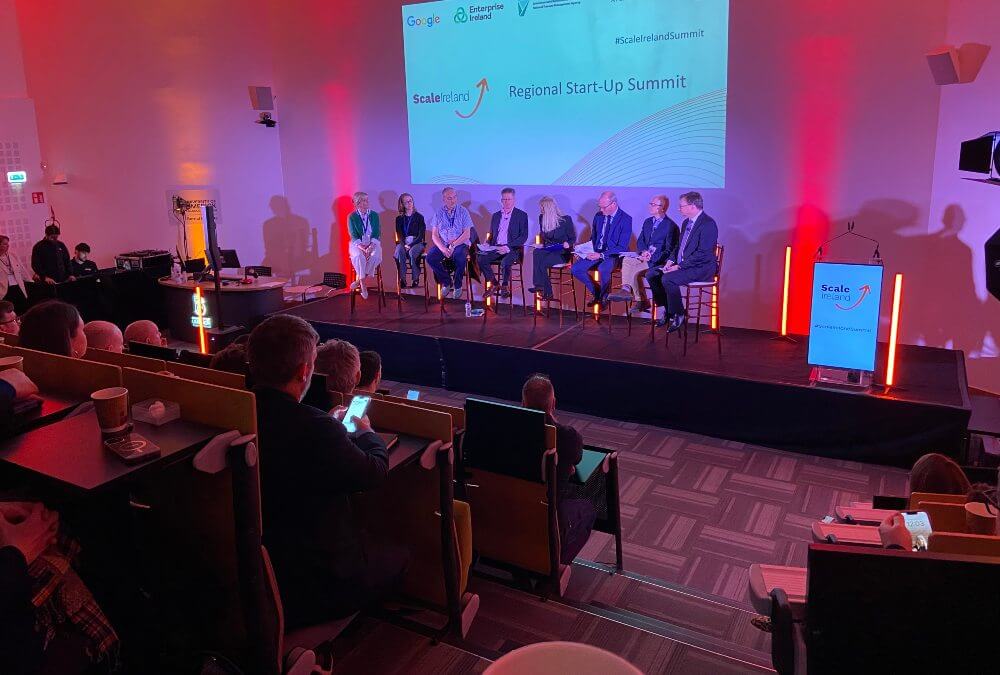
Founders and investors used Scale Ireland’s sixth annual Autumn Gathering to press Tánaiste Simon Harris on a €1.1 billion funding gap, capital gains tax and public procurement from indigenous firms.
Tánaiste and Finance Minister Simon Harris, TD, was in listening mode at the Scale Ireland Autumn Gathering last week. It was an important event for Harris; Scale Ireland is the representative organisation for Irish tech start-ups and scaling companies with 800 members across the land.
The message from Ireland’s scaling companies was stark: the funding gap holding back the country’s fastest growing indigenous businesses has widened and existing supports are not enough to close it.
“A stronger base of globally successful Irish companies will make our economy more resilient in an increasingly uncertain world”
While he wouldn’t give anything away in terms of his plans for Budget 2027 in five weeks’ time, Minister Harris told the assembled entrepreneurs and investors at Avolon’s Dublin headquarters that he gets it.
He said collaboration between Government and industry is critical. He said it is part of a much broader debate about Ireland’s long-term economic future. While day-to-day political discussions often focus on immediate spending decisions, Harris said the more significant issue is ensuring the country builds sufficient economic resilience to maintain and improve living standards over coming decades.
“A stronger base of globally successful Irish companies will make our economy more resilient in an increasingly uncertain world,” the Tánaiste told founders and investors.
“This is no longer a nice to do or a nice to have or a discretionary conversation at the margins,” Minister Harris said. “It actually becomes fundamental to Ireland’s insurance policy, if you like, in terms of economic security into the future.”
The fact that the gathering continues to take place at Avolon’s impressive D4 headquarters is a reminder of what is possible when Irish firms make it on the world stage. CEO Andy Cronin reminded the audience that Avolon was just a start-up itself in 2009. Now it is one of the world’s foremost aviation players with $3 billion in revenues last year and $591 million in profits.
Scale Ireland chair Brian Caulfield summed up the significance. “I think the story of Avolon highlights two things for us. Firstly, it shows what can be achieved by an Irish company scaling internationally and becoming a genuine global leader in its field. Secondly, it highlights how a policy intervention from Government can have a real impact in making Ireland a leader in an industry, and Ireland is literally a global leader in the aviation leasing industry, and a large part of that came down to a policy intervention. So there aren’t many better places to advocate for the indigenous sector than here in Avolon because it highlights that global potential.”
A gap too big to ignore
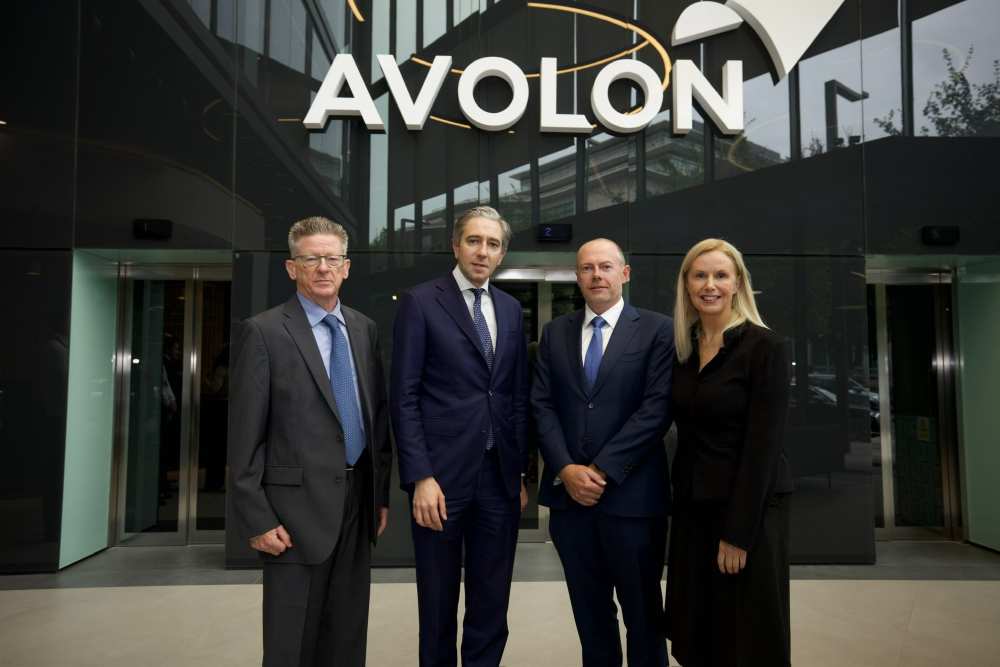
Pictured: Scale Ireland chair Brian Caulfield; Tánaiste and Finance Minister Simon Harris, TD; Avolon CEO Andy Cronin; and Scale Ireland CEO Martina Fitzgerald
Scale Ireland CEO Martina Fitzgerald opened proceedings by citing a report commissioned last year by the Department of Enterprise, which put the funding gap facing scaling Irish companies at around €1.1 billion over the next three to five years.
Brian Caulfield, chair of Scale Ireland, told the gathering that figure likely undersells it. “My view is that that’s actually a significant underestimate,” he said, pointing to the gulf between pension fund participation in the United States and in Europe.
“In the US, pension funds invest about 2% of assets into venture capital, while European pension funds invest just 0.02%,” he said. “Even 1% of Irish pension fund savings going into indigenous tech companies would have a very significant impact on the availability of capital, and it will not cost the Exchequer.”
Fitzgerald said that Scale Ireland wants the Government to establish a task force to incentivise pension fund and institutional investor participation in scaling equity funds, modelled approaches take in France and Denmark.
“We need the Government to spearhead it because we don’t believe it will happen if you don’t,” she said.
Minister Harris told the gathering that he would be meeting Minister for Enterprise Peter Burke, TD, to discuss the proposal.
“I think Scale Ireland’s proposal around the Task Force is a very sensible one,” he said. “We’ll look at this between colleagues at the Department of Finance and see if there’s a piece of work that can be done over that pension issue.”
The cost of scaling, according to founders
Three founders addressed the gathering on a panel. They were Fabien Payaud of livestock and veterinary software company Herdwatch; Ríona Ní Ghriallais of medical device firm ProVerum, and Fergal O’Connor of advertising technology platform Buymedia.
Payaud, who started Herdwatch 15 years ago in Tipperary, said the business now employs an international team of more than 100 people and serves more than 20,000 farmers in Ireland and the UK. He said the company’s expansion into veterinary practice management software followed a partnership with a Dublin-based private equity firm roughly four years ago.
Payaud used his opportunity to press Harris directly on the issue of capital gains tax (CGT) and proposals to cut the rate to 20% for indigenous business owners and investors. “It isn’t really about necessarily how much tax a founder or an investor would take,” he said. “It’s what happens to the capital after. Successful founders and investors are the next generation of major investors. They will back another start-up, or maybe multiple start-ups. Their capital and experience is recycled through that ecosystem.”
Ní Ghriallais, co-founder and CTO of ProVerum, described a year of milestones for the Trinity College Dublin spin-out, which has raised more than €100 million in private equity and ISIF funding since 2017.
“We closed our Series B funding round last year, and since then we got approval from the FDA to commercialise our product in the US, and we actually launched the product at the ned of last year.”
Proverum’s device is a stent designed to treat benign prostatic hyperplasia. “It goes into the prostrate and opens p a channel to allow a normal urinary flow for men who have symptoms,” she said. “We have an opportunity with this device to help millions of men globally, and that’s our ambition.”
Recalling her own company’s journey, Ní Ghriallais said that early-stage capital remained the biggest constraint. “Starting that initial fundraising journey is really, really difficult. Without that early stage funding, you really can’t unlock what’s ahead of you.”
The founder and chief executive of Galway firm Buymedia Fergal O’Connor traced his company’s path from a Local Enterprise Office client in Mayo to a Deloitte Fast 50 business now expanding in Manchester. The business last year came 73rd in the Deloitte EMEA Fast 500.
He used his time to press for change in how Government evaluates tenders. “We’ve won five of the last seven tenders that have gone from Government. But the way that we had to win those was against the innovation we’re building. The tender comes out and says ‘we’re looking for an advertising agency’, it’s not looking for a technology, it’s not looking for a solution.”
O’Connor called for an innovation score to be built into public procurement evaluations, pointing to the UK’s use of social value scoring. He also raised employee share ownership as a retention tool against larger competitors.
“We’re competing against large multinational businesses for salary,” he said. “The way for us to incentivise the employee to stay is to give them skin in the game as the business is scaling.”
Minister Harris told the panel that he accepted the case for change on procurement. “Let me talk to colleagues in relation to that,” he said. “That idea of having an innovation score or recognising disruptive technology, I think, is really important.”
However, on the capital gains tax issue, Harris was more guarded. “Would I like to see progress on CGT in the lifetime of this Government? Would I like to see significant progress in CGT in the lifetime of this government? My sense is anything we do on this we should look at how we target it, because we should try and fix the problem that we have.”
Investors call for patient capital
The next panel included Rebekah Brady, director of Future Ireland Funds and interim director of the Ireland Strategic Investment Fund (ISIF), and John O’Sullivan, general partner at Act Venture Capital.
Brady said ISIF has now invested in more than 500 Irish companies, with €1.6 billion committed. Interestingly, she said returns were already beginning to flow back into the fund.
“We have started to see over €250m come back inside the last year and a half from a small number of hugely successful companies.”
She said the fund has had to move into earlier, riskier stages of company development than a typical institutional investor because of gaps elsewhere in the market. Widening the pool of investors, she said, is now essential.
“We do need a greater diversification of the LPs that are there,” she said, whether it’s family offices, pension funds or insurance companies.”
But she said that accession pension capital is not as straightforward as it might seem. “Pension funds have fiduciary responsibilities to their members. That they don’t have double bottom lines, triple bottom lines. So they need to see good reporting. They need to be able to see a line to commerciality. They need to be able to see a line to liquidity, to money coming back. They don’t have the patience that maybe private capital might have. So I think there’s lots of work to be done on all sides to reach a solution, but there’s a definite need there.”
Act Venture Capital’s John O’Sullivan told the gathering that domestically managed funds, including ISIF and related vehicles, are on course to surpass €1 trillion under management over the next decade, a figure he said should draw far greater private institutional participation.
On the proposed pension task force, O’Sullivan pressed for urgency. “Can we put a timeline on it?” he asked. “Can it be charged with coming up with answers and not describing the problem, because we can describe the problem, and it’s not good. Unfortunately, it’s the same problem.”
Ireland, he said, needs someone in the public service and at a political level to stay on the issue permanently. “There’s a lot of people who study problems. The number of people who want to fix it is the problem.”
Fixing a plan
Minister Harris used his closing remarks to praise ISIF and the Future Ireland Fund as among the more consequential decisions taken by Government in the past decade, and said he agreed such a task force sought by Scale Ireland should be established without setting a timeline.
“We should establish a task force. “We need to deliberate as how to do that correctly. But I take the point, what’s the output as we go from A to B, to actually a document that changes and fixed the challenge that we face in Ireland.”
He said that in Budget 2027 the Government will present its plans for a new Savings and Investment Scheme to the Dáil with an initial simple product that is aimed at drawing more Irish savings into investment.
“My priority, absolute clear-eyed priority this year, is to introduce a simple product that be set up with minimum funds next year. Am I open to them having a phase 2 where we look at other versions of a product. I very much am.”
With all eyes on Budget 2027, Scale Ireland said it will continue to press for capital gains tax reform, pension fund participation in scaling equity and changes to public procurement rules.
The pressing issue for the next three to five years that should focus everyone’s minds is, however, that scaling funding gap of more than €1.1 billion.
As ACT’s John O’Sullivan put it bluntly: “We don’t have time.”
-
👉 No tech background needed to bring your business into the AI age! Secure your Google AI Professional Certificate to complete the certification at no cost. Apply now and get started!
-
Bank of Ireland is welcoming new customers every day – funding investments, working capital and expansions across multiple sectors. To learn more, click here
-
For support in challenging times, click here
-
Listen to the ThinkBusiness Podcast for business insights and inspiration. All episodes are here. You can also listen to the Podcast on:
-
Spotify
-
SoundCloud
-
Apple
-