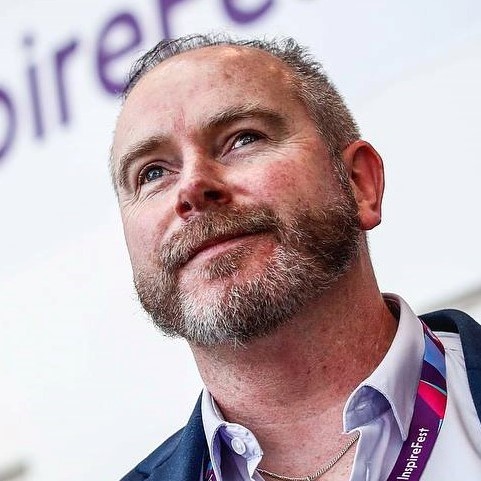
Podcast Ep 333: With one-in-five Irish people living with a disability and fewer than half of working age disabled in employment, the CEO of the Open Doors Initiative Jeanne McDonagh urges businesses to treat inclusion as a strategic priority.
Ireland is at near full employment – but beneath that headline success lies a stark contradiction.
A group of more than a million people remains locked out of this prosperity – those living with a disability.
“We have one of the largest disability employment gaps in Europe, and at a time of full employment, I find that quite hard to believe”
For Jeanne McDonagh, chief executive of the Open Doors Initiative, this gap isn’t about talent or ambition. It’s about how our systems, workplaces and policies have been designed. In short, she views it as a systemic failure hiding in plain sight.
Embedding inclusion at the core
-
Listen to the ThinkBusiness Podcast for business insights and inspiration. Latest episodes are here. You can also listen to the Podcast on:
-
Spotify
-
SoundCloud
-
Apple
A new report from the Open Doors Initiative, From Awareness to Action, argues that closing this gap isn’t just a social issue – it’s an economic and leadership imperative. It calls for a shift away from traditional corporate social responsibility toward what it terms Corporate Social Justice: embedding inclusion into the very core of how organisations hire, manage, and lead.
“Ireland alone isn’t doing the walk of shame,” says McDonagh. “We have one of the largest disability employment gaps in Europe, and at a time of full employment, I find that quite hard to believe. Employers are constantly searching for new employees, and yet this whole talent pool has been ignored.”
The Open Doors Initiative brings together businesses, government and people with lived experience to build a more inclusive workforce.
The scale of the opportunity, McDonagh argues, is being systematically underestimated. People with disabilities and their families represent an estimated $18tn in global spending power, a figure that would make any consumer business sit up. Yet most companies have historically treated disability inclusion as a compliance obligation or a charitable gesture, rather than a market reality.
The prize is significant – not just for individuals in Ireland facing an additional €8,000–€12,000 a year in the cost of disability – but for businesses too, with research showing more inclusive organisations are more productive and more profitable.
McDonagh describes this cost of disability as a “structural disadvantage” that compounds poverty and exclusion before a single working day begins. On the morning of our interview McDonagh had attended a Government cost-of-living forum that focused on this very problem.
“The cost of disability is one of the key priorities in the programme for government,” she says. “It’s really important that when you’re creating an equitable base, everyone starts from the same level. If you’re down €12,500 a year before you even start, that is not equitable.”
Forget CSR, make way for Corporate Social Justice
The Open Doors Initiative report introduces a concept McDonagh says is gaining traction among progressive businesses: Corporate Social Justice.
Where traditional corporate social responsibility often amounts to donations and awareness days, Corporate Social Justice asks companies to redesign their hiring, management and leadership structures so that inclusion is embedded in how the organisation actually operates.
“Just by existing, a company isn’t an island,” McDonagh says. “It causes ripple effects through all the communities and stakeholders it works with. Businesses need to choose to be a positive effect and make a positive difference. It’s more than charity work. It’s honing in on the experiences of people who’ve been disadvantaged and building trust with them and with the wider community.”
Research consistently shows that organisations with higher diversity perform better on productivity and profitability measures. Open Doors itself serves as a small-scale illustration: a team spanning multiple nationalities, languages, refugees, LGBTQ+ members and people with disabilities that has, through partnerships including one with Bank of Ireland, helped more than 130,000 people access pathways to education, employment and entrepreneurship.
“For such a small group, it makes us incredibly powerful in what we do,” McDonagh says. “We can see the difference it makes.”
The retreat from inclusion
Open Doors is making its case at an awkward moment. Across the Atlantic, the political climate in the United States has turned sharply against diversity, equity and inclusion (DEI) programmes. The tremors have been felt in Europe. McDonagh says her organisation has been tracking a withdrawal among some businesses from public commitments to inclusion: events scaled back, funding reduced, what had been outward-facing advocacy quietly moved behind closed doors.
The data, she says, tells a different story about where the competitive advantage lies. “Businesses that have stood their ground, that have remained diverse and remained inclusive, have done better economically and on the bottom line than those who have, how would you put it politely, bent to a lesser way of being.”
She is wary of the appeal of populist pressure but sceptical it reflects majority opinion. “The vast majority of people are centrist. If you were given a choice between a life that’s peaceful and happy, where everyone rises at the same time, I think most people would choose that. Businesses that fall into line with the far-right narrative are doing themselves a dreadful disservice. People have long memories.”
To underline the point, she reaches for an Irish precedent: the boycott of South African goods by workers at Dunnes Stores in the 1980s, a campaign of conscience that remains part of the national memory. “That’s seared in the Irish psyche,” she says. “I think that will happen with other companies as well, both here and in other countries. People will remember those who stood firm and those who toed the line.”
Visibility at the top
One of the starkest indicators of the problem, McDonagh argues, is the near-invisibility of disability at leadership level. She is a chief executive who lives with a disability. She can count the number of other such CEOs she knows on less than one hand.
“If 22% of the population, more than one million people in the last census, have a disability, there are a lot more out there. But they’re not being overt, they’re not standing up, they’re not creating role models for other people. Without that, there’s nothing to aspire to. There’s no way of seeing the art of the possible.”
Asked whether the answer lies in new legislation, McDonagh is measured. The legal framework, she says, is broadly adequate. What is missing is the will to implement it. “I don’t think we need new legislation. I think the change is there. It just needs to be implemented. It is leadership that is key. Leadership has to charge from the front.”
Looking abroad for answers
Ireland is not short of models to learn from. McDonagh points to Switzerland, the Nordic countries, Australia and the United Kingdom as jurisdictions that have made more meaningful progress on disability employment and on the wider transparency agenda. A new EU pay transparency directive, which will require employers to justify pay differentials, is bringing Ireland closer to practices that some peers have long taken for granted.
“Why reinvent the wheel if something’s working really well in another country?” she says. “Adapt and apply, and see how it works here. Anything has to be better than where we are now. The only way is up.”
She ends on a note of careful optimism. The Taoiseach’s personal ownership of the disability agenda, she says, is significant precisely because disability touches so many policy areas at once: transport, social protection, housing, health. A whole-of-government response, if sustained, could shift things in ways that piecemeal initiatives never have.
“I’m very hopeful that there will be some positive change,” McDonagh says. “It’s really interesting that the Taoiseach is leading on this and owning this subject. Disability isn’t siloed just in transport or in social protection. A whole-of-government response is what’s really important.”
-
Bank of Ireland is welcoming new customers every day – funding investments, working capital and expansions across multiple sectors. To learn more, click here
-
For support in challenging times, click here
-
Listen to the ThinkBusiness Podcast for business insights and inspiration. Latest episodes are here. You can also listen to the Podcast on:
-
Spotify
-
SoundCloud
-
Apple