
Businesses call for broader innovation incentives as AI and digital transformation reshape priorities.
Irish companies are significantly increasing investment in research, development and innovation, with fresh evidence that recent enhancements to the State’s R&D tax credit are influencing spending decisions.
That’s according to the 2026 Ireland Innovation Index published by the Industry Research & Development Group and KPMG.
“Ireland’s innovation economy continues to demonstrate resilience and ambition despite global turmoil”
The annual survey, now in its fourth year, gathered responses from a record 587 innovation-active companies.
It shows that 69% of businesses have raised R&D expenditure over the past three years, while 77% expect to increase spending further over the next three years as they respond to geopolitical pressures, international tax changes and intensifying global competition.
The report points to a clear response to last year’s increase in the R&D tax credit from 30% to 35%. Among those surveyed, 58% said the additional support is being channelled into existing projects, while 57% reported it is enabling entirely new R&D activity. A further 39% indicated that the uplift is helping them hire or retain specialised R&D talent.
Multinational companies in particular emphasised the importance of the incentive in determining where research activity is located. More than half said that, without the credit, only a small portion of their R&D work would take place in Ireland.
The scale of the scheme is reflected in Revenue data, which shows that 1,804 companies claimed the credit in 2023. Of these, 225 large firms accounted for more than €764 million, while SMEs claimed a further €213 million. Companies benefiting from the incentive also made a substantial contribution to the public finances, with total corporation tax liabilities of €10.53 billion.
Shift in innovation priorities
Alongside increased spending, the survey highlights a rapid shift in innovation priorities. Artificial intelligence and disruptive technologies are now a focus for 67% of respondents over the next one to three years, up sharply from 45% in 2024. Businesses report that AI is moving quickly from early experimentation into operational deployment, productivity gains and new product development.
Despite this momentum, the report argues that Ireland’s current incentives framework does not fully capture the breadth of modern innovation activity. Many commercially valuable areas such as digital transformation, design-led innovation, advanced process development and new business models fall outside the traditional scientific and technological criteria required to qualify for R&D tax relief.
This gap is reflected in strong support for a broader policy approach. Some 71% of companies surveyed said a dedicated Innovation Tax Credit would enable more innovation work to take place in Ireland, while 67% believe it would drive new product and service development. In addition, 45% said such a measure would support greater creation and protection of intellectual property.
Ireland’s performance in these areas remains a concern for industry. The report notes comparatively low levels of indigenous innovation output, with weak rankings for trademark and design applications.
Dermot Casey, chief executive of IRDG, said the findings underline both resilience and the need for further policy action.
“Ireland’s innovation economy continues to demonstrate resilience and ambition despite global turmoil. The recent R&D tax credit reforms are working, with 77% of the 587 companies surveyed planning to increase R&D spend over the next three years,” he said.
He added that gaps remain in the wider system. “Public R&D investment is half the EU average. On non-R&D innovation, Ireland ranks 26th of 27 in the EU for design applications and last for trademarks.
Seventy-one per cent of companies back an Innovation Tax Credit designed for AI, digitalisation and design, areas the current credit cannot reach. With 67% now ranking AI and disruptive technologies among their top priorities, the case for the new credit is urgent. Combined with a doubling of public R&D over three years, these investments will build long-term resilience, competitiveness and growth.”
Damien Flanagan, partner and head of R&D incentives at KPMG, said the report highlights the effectiveness of recent reforms while pointing to the next stage of development. “This year’s findings show meaningful progress,” he said. “The increased rate of R&D tax credit is actively stimulating additional innovation investment, new project activity and employment.”
He said ongoing refinement of the framework will be needed to maintain competitiveness. “Continuous evolution is required to ensure Ireland remains best in class. One such area is a specific Innovation Tax Credit to support commercially valuable activity that falls outside the current regime. This should be designed to ensure that Ireland’s incentives framework properly reflects the modern realities of AI-led, digital and technology-driven innovation.”
The survey also identifies practical barriers that continue to affect companies, particularly smaller firms. While SMEs are more likely to be aware of available supports, they are also more likely not to use them. Respondents highlighted dissatisfaction with the timing of R&D tax credit refunds, which can create cashflow challenges for early-stage and scaling businesses.
The findings suggest that, while Ireland has built a strong foundation to support research and innovation, further adjustments will be required to ensure that incentives align with the evolving nature of innovation and are accessible to the firms driving future growth.
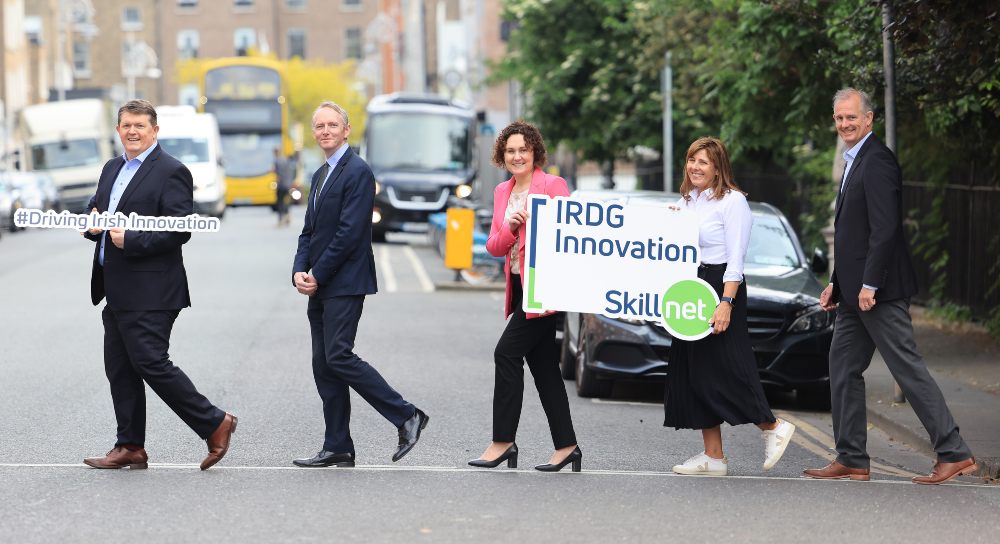
Image at top: Dermot Casey, CEO of the Industry Research & Development Group (IRDG) and Damien Flanagan, Partner and Head of R&D Incentives at KPMG. Photo: John Ohle
-
Bank of Ireland is welcoming new customers every day – funding investments, working capital and expansions across multiple sectors. To learn more, click here
-
For support in challenging times, click here
-
Listen to the ThinkBusiness Podcast for business insights and inspiration. Latest episodes are here. You can also listen to the Podcast on:
-
Spotify
-
SoundCloud
-
Apple