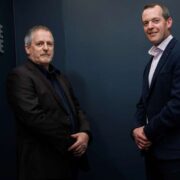
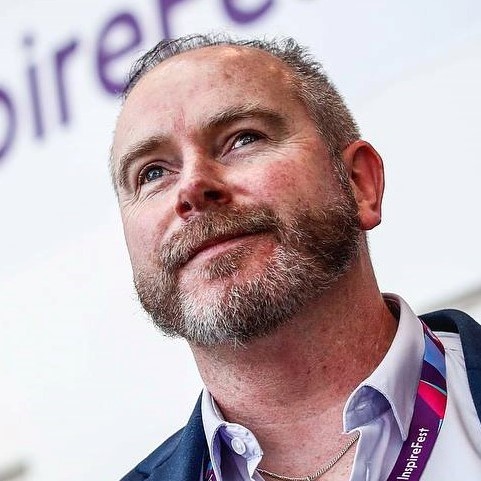
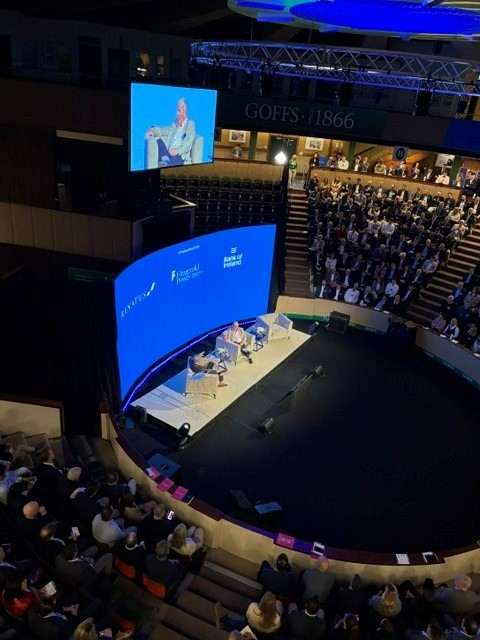
The founder of ESW Tommy Kelly gave a masterclass in the rollercoaster ride that is running a business at the Real Deal Conference 2026. Having successfully established not one but two multi-billion euro businesses, he is now focusing on a new chapter as an investor in Irish businesses.
Growing restless on the family farm in 1980s Ireland was all the propulsion that Tommy Kelly needed to set forth on perhaps one of the most remarkable careers in recent Irish business history.
Kelly founded logistics business Two Way Forwarding & Logistics which he sold to Aramex in 2006 for an undisclosed sum. After selling Two Way he founded eShop World and scaled it to a €1bn entity before stepping back to become co-chair in 2023.
“I knew it was a really strong business but it was broken right then. It provided me with a life lesson that I just had to step up. I was responsible for fixing it”
Through his family office Castlegate he invests almost exclusively in Irish businesses, including Gym & Coffee, and notably Castlegate’s ownership of auctioneer Sherry Fitzgerald.
Starting from scratch
Kelly told more than 1,000 delegates at the Real Deal 2026 how in the bleak economic backdrop of 1980s Ireland he had few options. The family farm’s equipment was primitive and emigration was the obvious next step for him and his friends.
“I was in my mid 20s and I needed to take a step change, I had an understanding that I needed to do something different.”
That something different took him from the world of livestock and fencing to boardrooms of Nike and Victoria’s Secret. His story is one of accidental beginnings, near disaster and the accumulation of insights that no business school could provide. It is also a case study in what Irish entrepreneurship can produce at global scale.
As Kelly was pondering his future, a group of haulage operators in his areas had been running trucks to Europe under the umbrella of a freight company that soon went into liquidation. The drivers owned their vehicles but had no commercial infrastructure. Kelly saw an opportunity to step in to generate work and coordinate operations. Over time the business called Two Way grew and grew.
But the growth was almost the undoing of the business. TwoWay grew through acquisitions to add air freight capacity to serve the growing multinational sector in Ireland to support companies like Dell and its supply chain. “We were able to provide warehousing and airfreight services, which were the predominant need of the multinational sector at the time.”
He realised that the money wasn’t in trucks, it was the freight companies that were making the money and he transitioned the business to be a pureplay freight management business.
Know your business thoroughly
It was around this time that he learned a fundamental lesson in business. His accountant told him that the business was profiting by more than IR£1 million – but jubilation turned sour when a a more realistic assessment revealed that it was actually losing more than IR£1m at the time. In effect, the financial controls the business needed weren’t in place or near adequate to support the scale the company had reached.
“I knew it was a really strong business but it was broken right then. It provided me with a life lesson that I just had to step up. I was responsible for fixing it.”
He replaced the financial team and brought in a chief financial officer with serious institutional knowledge and experience and they stripped back the business to focus on what was actually working.
“It wasn’t pretty. It made us really focus on timing, on cash, on what not to do. We probably reduced the headline business by 40%.”
The crisis proved formative and when the opportunity had come to later sell TwoWay in 2006, Kelly had developed a clearer sense than most about the difference between a business that looks healthy and one that actually is healthy. Asked if he secured a Celtic Tiger price for the business, he paused and said “I would probably say yes at this point.”
Even after selling the business Kelly remained with TwoWay as its CEO and gained valuable experience of running a $1 billion business with Aramex. “It gave me a lot of the thought process of how I would run the next business.”
Spotting angles
The seed of what became eShop World was planted while at an Aramax business called Shopmanship where he was overseeing the shipment of 10,000 packages a day – predominantly US goods – being shipped to consumers in the Middle East, particularly Saudi Arabia.
He realised that while the volumes were staggering, the model was fundamentally broken and major American retailers like Victoria’s Secret and Nike had no proper mechanism for international sales. Buyers would by through US websites and have parcels forwarded through an array of ad hoc duties and carrier fees. A shirt bought in the United States would cost a European buyer far more once informal import costs were added and there was no transparent or legal framework governing the process.
Kelly spotted the regulatory angle that others and missed and identified an obscure provision in Irish tax law that allowed goods to enter the country in free circulation if the process was fully transparent and taxes fully accounted for. After persuading the Revenue Commissioners to let him test the model, for two years eShop World was the only company that could bring goods into Europe under that special licence. “I was able to go to customers in the US and say: at a fully transparent price, here is how this works.”
But it was not plain sailing. Victoria’s Secret literally blacklisted him. The turning point came with footwear giant Nike and a meeting that stretched over two days as 38 executives including the CEO robustly challenged Kelly and his team. “We had a very clear agenda,” Kelly recalled. “We told them what we believed and we actually achieved what we said we would.”
The technology underpinning eShop World was built from scratch: a software layer that manged the customer experience on retailer websites; a payment solution that handled multi-currency pricing; and a supply chain operation that ensured compliant delivery. The proposition was that a shopper anywhere in the world would visit a brand’s website, see pricing in their local currency inclusive of all duties and taxes, and receive their goods without unpleasant surprises at customs.
eShop World grew and grew and by 2019 it was processing millions of parcels and working with some of the world’s biggest consumer brands. An IPO was even considered.
Then Covid-19 happened. Having absorbed valuable lessons on scaling during his time with Aramex, Kelly was prepared and ESW was on the right side of the consumer shift. Volumes surged but it also revealed constraints. “We were doing about two million transactions a day. It was an existential moment. We even had a war room.”
The IPO was set aside and Kelly decided the best route was to reinvest in the business, increasing his own stake as the business hurtled towards a $1bn valuation.
Gradually Kelly began to step back from the CEO role and in 2023 he became co-chair, a move he described as a natural transition rather than a departure.
The logical investor
Today through his investment vehicle Castlegate he is focused on being a significant investor in a portfolio of Irish companies that spans digital brands, care homes and businesses ready for disruption in sectors that have been slow to modernise.
He invests with deliberate logic and is not trying to back everything. “We want to play deeper in certain areas,” he said, like digital brands. “It’s an area we have strong knowledge.”
Other opportunities include real estate which he believes can provide better digital experiences and the care home sector where he sees a structural mismatch between demand driven by an ageing population and the supply of high quality services.
Careful to avoid defining his philosophy around investing in disruption, he recalled an experience of his daughter processing paperwork with a government department that took 12 weeks, even with the help of a professional services body. “A digital journey should have the least possible resistance.” That’s what disruption means to Kelly. Removing the things that slow people down.
Asked from the audience about the importance of having a strong CFO to sense check and support decision-making based on his earlier experiences, Kelly reflected on the importance of humility and the ability to listen to others in decision making. “You need all of your executives at a level where they can challenge you. Everyone has a role to play.”
Having spent the best part of four decades building businesses, Kelly relishes being in a position where he can back other people’s convictions with his own capital and his experience.
“You need a reason to get up every morning.”
-
Bank of Ireland is welcoming new customers every day – funding investments, working capital and expansions across multiple sectors. To learn more, click here
-
For support in challenging times, click here
-
Listen to the ThinkBusiness Podcast for business insights and inspiration. All episodes are here. You can also listen to the Podcast on:
-
Spotify
-
SoundCloud
-
Apple