
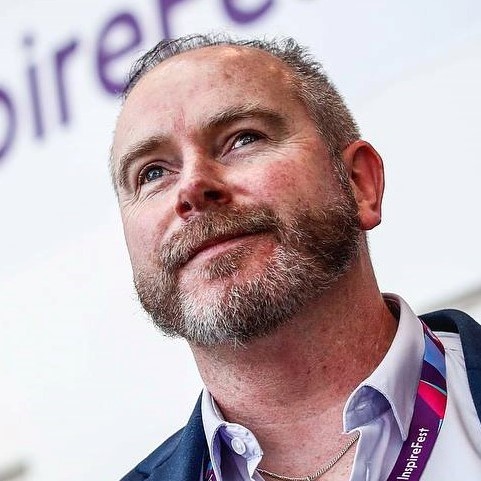
Podcast Ep 347: Neil Bowden, EMEA AI lead at Dell says Irish businesses must stop chasing use cases for AI and focus on outcomes instead.
There is a bit of an AI pilot graveyard building up in Ireland and elsewhere in the world. By now every business has an AI story of some sort to tell, but few can point to an actual return on investment from it.
While there is no doubt that AI is going to be engrained in every business and every career, things are happening at lightspeed. Workers are concerned about their careers, even the almighty tech giants who should know better are drowning in rising token costs, and yet whether you like AI or loathe it, it’s pretty much here to stay.
“I’m more of the opinion that we need to think carefully about information and false information than to worry about the Terminator”
From an enterprise IT perspective, it gets even more confusing when you hear about things such as neo clouds and data sovereignty.
That’s why it was refreshing to chat with Neil Bowden, EMEA AI lead at Dell Technologies about this pilot graveyard, the rising token costs, and who wins the next phase of enterprise AI.
Bowden works across two very different customer bases. “I’ve been working with large neo clouds who are building data centre scale systems purely for AI in Europe. On the other hand, it’s with the enterprise, primarily in Ireland where I live, about how they can build systems to deliver AI solutions for their operations.”
Keep the overall goal in mind
Bowden’s central argument is that businesses are approaching AI backwards. “I’m not a huge fan of the term use cases, I think it’s overused,” he says. “If you start off with, we can build this chat assistant, where do we now use it, you’re coming at it from the wrong point of view. It should be, what are we doing in our business, and what area, if we make an improvement, is going to impact us overall?”
That discipline matters because he has seen plenty of spending with no clear payoff. “I’ve talked to a bunch of companies who say we’ve deployed X, Y, Z, we now have AI, and you’re going, what’s the return on investment from this,” he says. “The answer in many cases is, well, we’re not sure. At scale, you’ve got to think about the outcome first.”
On how Irish businesses compare internationally, Bowden is measured. “I wouldn’t say you’re miles ahead, and I wouldn’t say they’re miles behind,” he says. “Businesses in general are still at relatively early stages. I haven’t yet seen a real large scale transformational project, but I think that’s coming with agentic systems.”
As adoption scales, Bowden says cost and control of data are becoming boardroom issues. “Your token cost can run away with you if you’re just paying for tokens,” he says. “Sovereignty and security of data is massive. I was talking to a large bank, and they had their over reliance on a particular provider under their risk register.” He points to how fragile some AI infrastructure still is. “We’ve seen challenges, for example with Claude Fable, it just turned off. If you were relying on that, you were in trouble.”
Focus on the fundamentals: Safety and security
His advice is to own the fundamentals first. “If you wrap your arms around your data, all of your data, your databases, your files, your knowledge base, and even the more ephemeral data, then you can bring in a model from cloud, from an on premise environment, from a third party, and use it in a safe and secure way.”
For smaller businesses looking at infrastructure for the AI age, Bowden says the challenge can vary. And this is where return on investment is paramount.
“If you’re a small organisation with 10 people, an electrical contractor say, it probably doesn’t make sense for you to go and build a big data centre for AI inference. If you just need Copilot or ChatGPT or Claude set up for your team, do it, pay for it, get a nice private environment, monitor your costs, and don’t use the most expensive model when all you want is a simple chat assistant.
“As you scale a little, the number you always see is something like 80% of enterprise data is still created in on premise environments, if you’re a retailer, your data is at the checkout, your data is coming from your stores. So you want to make decisions and do AI inference where the data is being created, and then you start thinking about bringing some AI capabilities close to where your data is, so it’s happening in real time, and you end up with more of a hybrid setup.”
On the wider economic picture, Bowden remains upbeat. “I’m generally optimistic. I’ve been through a bunch of these cycles, I remember the dot-com bubble, I still see that. Certainly what I’m seeing in my business day to day, I think we’re still at early stages. I think it was earlier this year Gartner released a report saying that this year there should $2.25 trillion spent on AI solutions, and I expect that’s probably just going to continue to grow.
“I think there are some guardrails and rules we need to think about. I’m more of the opinion that we need to think carefully about information and false information than to worry about the Terminator. There is evidence of what can happen when people are fed bad information on an ongoing basis, in their own little bubble, and that’s probably the area we need to think about addressing.”
Listen to the full conversation for more from Bowden on world models, the AI Act, and why Dell believes the next few years belong to agents.
👉 No tech background needed to bring your business into the AI age! Secure your Google AI Professional Certificate to complete the certification at no cost. Apply now and get started!
-
Bank of Ireland is welcoming new customers every day – funding investments, working capital and expansions across multiple sectors. To learn more, click here
-
For support in challenging times, click here
-
Listen to the ThinkBusiness Podcast for business insights and inspiration. All episodes are here. You can also listen to the Podcast on:
-
Spotify
-
SoundCloud
-
Apple