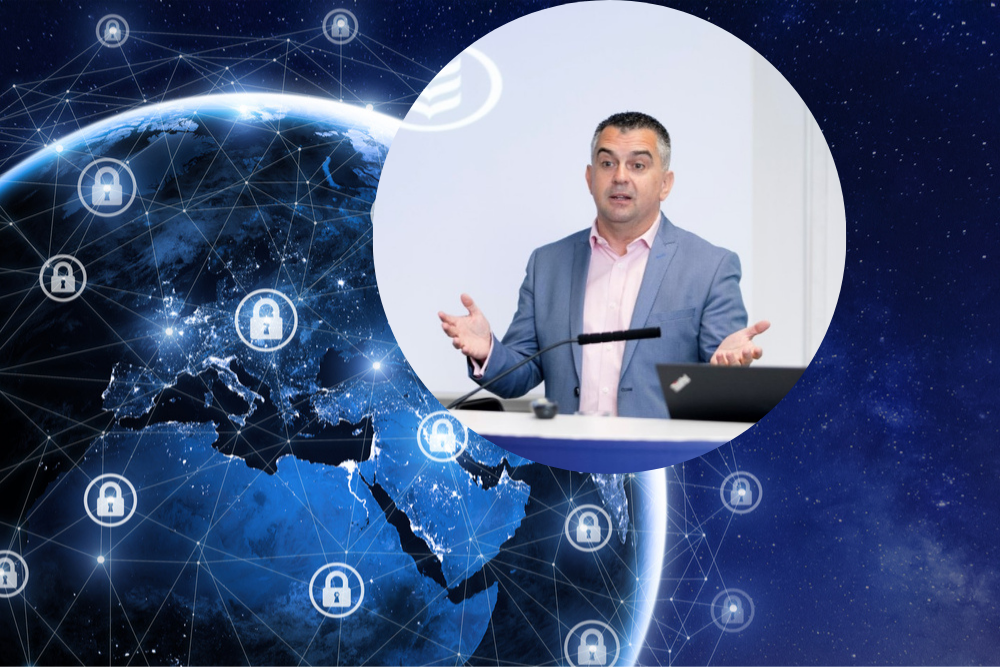

From hiring strategies to digital discovery, businesses pivot to embed artificial intelligence at the core of operations, writes Paul Swift, head of Tech, Media and Telecoms Sector at Bank of Ireland.
Artificial intelligence (AI) is moving from experimentation into everyday business practice across Ireland’s technology, media and telecoms (TMT) sector, driving changes in how companies operate, hire and compete.
New analysis from Bank of Ireland’s latest sectoral report shows that AI adoption in Ireland has now overtaken the EU average, with 43% of private sector organisations and 36% of public bodies already using AI tools in active workflows.
“AI adoption has moved from intention to execution”
Adoption rates are broadly consistent across company sizes, suggesting the technology has become embedded across the wider business ecosystem.
“It is clear from the survey findings that AI adoption has moved from intention to execution,” the report’s author Paul Swift noted, highlighting how businesses are shifting from pilot projects to real deployment.
However, the pace of adoption is not being matched by governance. Fewer than half of organisations have a formal AI policy in place, pointing to a gap between capability and oversight that may become more pressing as use cases expand.
Hiring shifts as AI reshapes workforce needs
The impact of AI is being felt most clearly in recruitment and skills development. Rather than leading to widespread job losses, the report points to a rebalancing of roles and a growing emphasis on new capabilities.
A notable 60% of organisations have already adjusted graduate hiring strategies to prioritise AI-related skills, signalling a structural shift in workforce planning.
“Workforce impact is likely to be more about role rebalancing and evolving skills needs than job losses,” Swift added, reflecting a broader recalibration underway across the sector.
This shift is expected to accelerate as companies seek to embed AI deeper into core processes, with productivity gains increasingly tied to how widely tools are adopted across organisations rather than confined to specialist teams.
A new digital battleground: from SEO to GEO
Beyond internal operations, AI is also redefining how businesses are discovered online. Traditional search engine optimisation is giving way to what the report describes as generative engine optimisation, where content is structured to be understood directly by AI systems.
“Businesses need to be alert to this generational shift,” Swift warned, noting that AI assistants are increasingly interpreting user intent rather than relying on keyword searches.
This evolution creates new opportunities for Irish media and content firms, particularly those able to adapt quickly to AI-driven discovery models.
“This presents a significant opportunity for media content creators to become expert in optimising content to ensure their client brands can be discovered in this new era,” Swift said.
Energy costs and cyber risk weigh on outlook
While the TMT sector has limited direct exposure to geopolitical shocks, indirect pressures are building. Rising energy prices are feeding through to higher operating costs, especially for data centres, telecom networks and digital infrastructure providers where electricity is a core input.
“Energy costs are not a peripheral, but a core cost input,” Swift said, noting that sustained increases are eroding margins and influencing investment decisions.
At the same time, geopolitical instability is contributing to a heightened cyber risk environment. The report points to growing concern among Irish organisations, with 38% reassessing the location of critical infrastructure and 41% increasing cyber insurance coverage.
This shift reflects a broader move towards resilience planning, as companies adapt to a more complex threat landscape.
Investment holds firm despite global uncertainty
Despite these pressures, investment activity in Ireland’s TMT sector remains resilient. Telecoms and tech services recorded 15 deals in the first quarter of 2026, while overall venture capital investment reached $212.3m across 19 deals.
Investor appetite is particularly strong in AI-led businesses, with a clear tilt towards larger, later-stage funding rounds. The quarter’s standout transaction was a $60m raise by quantum computing firm Equal1.
The media segment is also attracting capital, supported by international demand and policy incentives. Production spending reached a record €544m in 2025, aided by tax supports and a strong pipeline of international projects filming in Ireland.
Execution becomes the key differentiator
Looking ahead, the report suggests that success in the TMT sector will depend less on awareness of AI and more on execution.
“Organisations that successfully embed these tools into core processes are likely to see sustained productivity gains,” Swift pointed out, adding that delays in adoption may lead to widening competitive gaps.
Key priorities for companies include strengthening cyber resilience, investing in workforce skills and maintaining flexibility in strategy and capital allocation.
There is also a growing emphasis on creating structured environments for experimentation, with evidence suggesting that benefits are greatest when adoption is broad-based across organisations.
A shifting landscape for Irish business
The themes emerging in the TMT sector reflect wider changes across the Irish economy, according to Paula Feehan, Head of Sectors at Bank of Ireland.
“Irish businesses are facing an ever-changing economic and trading environment, particularly in the wake of enduring global events, supply chain disruptions, increased costs and changing consumer behaviours,” she said in the report’s foreword.
Feehan emphasised the importance of sector-specific insight and adaptability as companies navigate the year ahead.
“Our sector specialists work closely with key industry stakeholders and have a deep understanding of the challenges and opportunities that businesses face,” she said, adding that tailored strategies will remain essential as conditions evolve.
As AI adoption accelerates and external pressures persist, the message from the sector is clear. The next phase of growth will be defined not by access to technology, but by how effectively businesses put it to work.
Read the full report on the various sectors including Retail, Agriculture, Manufacturing, Healthcare, Technology & Telecoms and Food & Drink:
Image at top: Photo by Immo Wegmann on Unsplash
-
Bank of Ireland is welcoming new customers every day – funding investments, working capital and expansions across multiple sectors. To learn more, click here
-
For support in challenging times, click here
-
Listen to the ThinkBusiness Podcast for business insights and inspiration. All episodes are here. You can also listen to the Podcast on:
-
Spotify
-
SoundCloud
-
Apple