
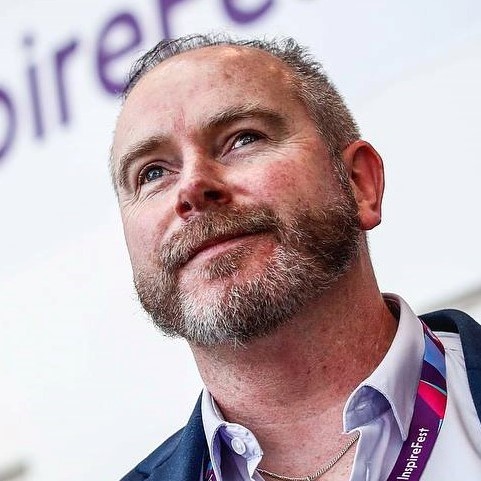
Podcast Ep 341: Accountant turned entrepreneur Teddy Murphy has built a business that helps CFOs manage €100bn worth of aviation. He’s now turning the same instinct for data to elite football.
One of Ireland’s most valuable export industries has wings. And Teddy Murphy, CEO founder of Miagen, plays a key role in helping aviation firms manage these assets.
His business has become particularly influential in Ireland’s aircraft leasing sector, supporting financial modelling for around one-in-five of the global leased aircraft fleet, representing approximately €100 billion in assets.
“The worst thing is no decisions. That’s what paralyses an economy”
And now he’s about to embark on a whole new valuable asset class: professional footballers.
As Murphy recalls the entire aviation leasing sector in Ireland was born almost by accident. The sector grew out of Tony Ryan’s search for something productive to do with idle Aer Lingus aircraft during the winter months. That experiment morphed into GPA and eventually into a cluster of aircraft leasing companies that gives Ireland today control over more than 60% of the world’s leased aircraft fleet.
Murphy has spent the last two decades building technology for the finance teams operating in the aircraft leasing industry. The former management accountant started his career by building spreadsheets and models to support decision-making for boards under serious time pressure.
Modelling a better future for CFOs
“If there’s a problem in sales in an organisation, it’s dealt with immediately because it’s the revenue earner. But if it’s on the finance side it’s really kind of like ‘let’s put more pressure on, or throw more people at it.’”
“Decision-making is one of the key skills human beings have innately, so I think it will always exist. Maybe we’ll call the CFO the Chief Decision Officer instead!”
This realisation led to him establishing Miagen – an amalgamation of his daughter and his wife’s names – in 2003, with a mission to bring better technology to financial decision-making.
His pathway into aviation finance had an unlikely starting point. A chance meeting in London with an executive from Etihad Airways led to an online demonstration and an unexpected summons. “He said: ‘Our CFO said that if you’re serious you’ll be here tomorrow’,” Murphy recalled. He flew to Abu Dhabi that night, landed the next morning and spent two weeks proving that Miagen’s models could perform better against every other system the airline was considering.
Today Miagen’s products are the models that many airline finance teams use for aircraft leasing, airline network planning and more, allowing finance teams to run live scenarios rather than relying on static reports to make decisions. He likens this to satellite navigation for business.
This metaphor had a poignant meaning when the Covid pandemic complicated the flight paths of the most battle-hardened airliners. The sudden global lockdown meant airlines had no income yet still carried full fleets and fixed lease obligations. Miagen’s technology was pivotal to the financial engineering that was required to sustain businesses.
“All of a sudden there were no aircraft flying, no performance happening in the business, and it was really about how you protect what you have. Airlines were potentially going to go out of business, and governments were stepping in to support them.
“We were looking at scenarios with our clients: what if we took a haircut on our lease rates, what’s the impact on cash flow, how long can we sustain that. It’s financial engineering of your business. What happens if all these levers move and there’s no income, how long can you sustain it. Having the information to make decisions is one of the critical things, because we’ve all been in a stage where you have a hunch but you need something to back it up.”
Asked if he sees parallels and pitfalls for the sector given the current situation in the Straits of Hormuz, he said: “It’s a very tough one. We work outside aviation as well, in construction and other areas, and there are material impacts to all businesses based on one leader’s decision in one moment.”
The worst thing businesses can do in these situations, he says, is to make no decisions. “That’s what paralyses an economy. People will wait, and you realise for a while people don’t make any decisions, until they realise they have to and things have to move on. You have to be more of an agile business, able to adapt, because you can’t make commitments you aren’t willing to change quickly. Some amazing innovations have come out of the last ten years because businesses have had to ask what happens if they can’t do this, what happens if they have to cease trading, and how do they evolve.”
Unlikely teammates: AI and soccer
One of those landmark innovations is AI and he believes industries that obsess over detail can use the technology to good effect. “People in finance, and people who work with numbers all the time, have a great ability to scan numbers and very quickly see if something doesn’t add up. The more experienced people can spot something quickly and say that doesn’t look right, especially in the age of AI.”
He believes the narrative of AI taking jobs is a red herring, arguing instead that the potential of AI is to help people do their jobs better.
“It’s always doomsday when you read the news on this kind of thing, and certainly there will be an impact on some jobs, there’s no doubt. But there are some jobs that shouldn’t be jobs in the first place, jobs that humans shouldn’t really be doing.”
For example, a trade in creating macros for Excel and PowerPoint presentations he believes will be quickly overtaken by AI. “That was the reason there was a whole business built around people doing PowerPoint or Excel work, because everybody was stuck trying to wade their way through it. That shouldn’t really be a job. I don’t think human beings are meant to be doing stuff like that. We’re really creative, and we deal well with working with other people and making a solution work, the things technology doesn’t do. Since the industrial revolution we’ve applied a manufacturing mindset to the services world, when people don’t actually work like that. They work in peaks and troughs, creative at times and less so at others. I actually think it could be a great liberator for people.”
You could say Teddy Murphy’s blue sky thinking around opportunities in finance could be likened to the nimble footwork of a midfielder. But when he explains it, it makes sense.
“Everything we do seems to centre on there being a large asset, possibly a debt structure, and an optimisation of that asset. In our company everybody talks about football every morning before every catch-up, and Brian our COO is a huge football fan. We were talking about it as an opportunity, and we created a product called SportsGen, which looks at the player as the asset. There’s debt involved, and the financial fair play rules that came in made it a lot more complex for clubs to see how much they’re paying for players versus their entire cost base.”
The scale of the opportunity in sports management may see the business seek investors. “We’re talking to Series A companies at the moment.”
He believes sports tech could be one of the biggest growth areas in Miagen’s 23-year history. “It’s really exciting. We’ve created solutions in the past, like around ESG, which has become less important globally since, even though it’s an area we’re passionate about. I think there will be another one, and probably multiple ones. You never know what’s coming next, but right now SportsGen is looking promising.”
Looking to the future of finance, I ask him what the job of a CFO will look like in 10 years’ time.
“I think it’s a fabulous insight into a business if you study accountancy, because you understand how a business works, all the levers essentially. Somebody needs to understand the business from a financial perspective and the impact of decisions. Finance often ends up taking on other areas in a growing business, like technology and HR. Decision-making is one of the key skills human beings have innately, so I think it will always exist. Maybe we’ll call the CFO the Chief Decision Officer instead!”
-
Bank of Ireland is welcoming new customers every day – funding investments, working capital and expansions across multiple sectors. To learn more, click here
-
For support in challenging times, click here
-
Listen to the ThinkBusiness Podcast for business insights and inspiration. All episodes are here. You can also listen to the Podcast on:
-
Spotify
-
SoundCloud
-
Apple