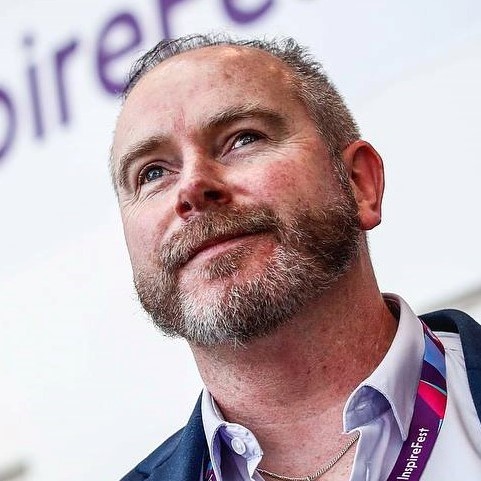
Tony Lanigan, managing director, Creative Technology Ireland shares his life and business lessons.
Tony Lanigan is the managing director of Creative Technology Ireland, one of the country’s leading audio-visual and technical production companies. Established nearly 60 years ago, the business employs over 85 people across Dublin and Cork and works on some of Ireland’s best-known events, including the Marlay Park Concert Series, the Dublin Horse Show, major conferences, awards ceremonies and large-scale public productions.
Creative Technology Ireland is part of the Creative Technology global network, one of the world’s leading providers of audio-visual technology and creative services for the corporate, education, entertainment, sport and permanent installation sectors. Backed by the global NEP Group, Creative Technology operates from more than 40 locations across 17 countries, combining international scale with local expertise and delivery.
“We have the backing and the opportunities to scale beyond what others can, and that is our ambition, but we want to do it without losing what got us here, which ultimately was good people, strong relationships and delivery that clients can trust”
Appointed to the role in 2024, Tony Lanigan has spent more than 20 years with the company, having first joined in 2004 as a technician and then progressing through several senior roles within the business, including Technical Director and Head of Live Events.
During his two decades with Creative Technology Ireland, Tony has led complex, large-scale productions, managed technical teams, built long-standing client relationships and played a key role in expanding the company’s services across Ireland. As a result, he has a thorough understanding of the technical, commercial and operational demands behind successful projects.
A graduate of Dublin City University with a BA in Communications, Tony is extremely well known within the Irish AV industry for his technical expertise, practical approach and strong understanding of client delivery.
Today, Tony leads Creative Technology Ireland as part of Creative Technology’s wider global network, overseeing the company’s continued growth across live, installed and creative environments.
Tell us about your background, what journey did you take to arrive at where you are?
I left school in Thurles in 1996 and moved to Dublin to study Communications in DCU. I loved my time there. I met friends for life, even met my wife, and got involved in DCU FM as technical officer. I majored in radio, so I was already leaning towards that mix of technology and production.
After college, I worked in telecoms for a couple of years as a call centre team leader, and while it was good experience, I realised fairly quickly that a standard 9-to-5 was not for me.
I found my way back to AV gaining ‘on the ground’ experience, before joining Creative Technology Ireland as a technician in 2004. I started where a lot of people in this industry do – setting up and derigging rooms, working long hours, learning on the job and getting to know how the industry really works. It was corporate conferences, healthcare events, brand activations, automotive launches, a bit of everything. People like Ciarán Moen, an industry veteran, had a big influence on me in those early years.
From there, I moved into project management and later became Head of Live Events. It was a natural progression that brought me closer to clients and to the commercial side of the business, but I was always glad I had started on the technical side as it really gives you a different understanding of the work and what you are asking people to do.
When John Roche, our former MD, was preparing to step back, conversations started around succession, and after internal processes, I was appointed managing director. I would not say I had planned for it to happen exactly that way, or that early, and you can never feel 100% ready for a role like that. John left big shoes to fill, but I knew the business, the people and the standards that had been set. I still think the best thing I brought to the role was the fact I had grown up in the business – from the ground up.
Why are you doing what you are doing? What need are you meeting? What’s your USP?
Clients come to Creative Technology Ireland because they need someone they can trust with the full picture, especially when there is no room for error.
It might start with one event, one install, one video or one support contract, but it often becomes much bigger than that. They need people who can understand the brief, challenge it when needed, and bring the right solution together without the client having to manage four or five different suppliers.
That is where we stand out from others, as we have live events, systems integration, managed services and creative all under one roof. So, if a client is building a new workplace, launching a product, running an ad campaign, rolling out digital signage or looking for ongoing support, we can join all of that up, and design our support based on their needs.
Then behind the Irish team, we have the wider global Creative Technology network. That gives us access to global resources, specialist knowledge and equipment that is very hard to match locally. We are not limited to one warehouse or one office; we can pull equipment from our floating inventory and expertise from team members who have delivered some of the biggest and most complex projects in the world.
“I would say I am a people person. It’s one of the biggest reasons I stayed in this industry. You meet every type of person, in every type of place, and you learn very quickly that relationship building is everything”
We also have a brilliant innovation team so if a brief needs something custom, whether that is LED structures or something completely out of the ordinary, we have the people and the investment behind us to explore it properly.
These are our USP’s. It is the people, the services under one roof, the global backing, and the ability to take something from brief to delivery and offer continual support after that.
How did you fund and start the business and what are your growth plans?
The business has a long history in Ireland, going back to 1967, when Drago Radic, known to many as “Mr Video”, was helping to develop the early video and post-production industry here. Then you had people like John Roche and Graham Lowen, who carried that on through the establishment of AVTEK and Eurotek, transitioning into Ion Solutions and now Creative Technology Ireland.
So, we were never a start-up in the traditional sense, as the business had years of knowledge, relationships and reputation behind it before becoming part of the global Creative Technology group. That move gave us the backing of a global group, while keeping the local experience and trust built in Ireland over decades.
A lot of our growth has always been relationship-led as people buy from people, and work came through referrals and repeat clients because they knew the team, trusted the service and knew we would deliver.
The next stage is about engaging in more nationwide work, and Cork is a big part of that. We have supported clients in the South of Ireland for years, but doing that from Dublin is not always the most sustainable or practical option. We opened a permanent base in Cork recently and this means we can be closer to those clients, respond faster, support them better and create opportunities for local talent.
There is huge growth potential in Cork and the wider region, and we want to be part of that community. Alongside that, the new RDS partnership, the upcoming Ryder Cup and the continued growth of our industry is giving us real momentum.
We have the backing and the opportunities to scale beyond what others can, and that is our ambition, but we want to do it without losing what got us here, which ultimately was good people, strong relationships and delivery that clients can trust.
What are your key skills and qualities that set you apart?
I would say I am a people person. It’s one of the biggest reasons I stayed in this industry. You meet every type of person, in every type of place, and you learn very quickly that relationship building is everything.
“In our world, a job is often won or lost long before anyone walks into the room. The warehouse prep, testing, programming, drawings, pre-builds, crew briefings and planning all decide how the job will go”
I can read a room well, and I try to understand what is really going on before jumping to a conclusion. That helps in all aspects with clients, crews, suppliers and internal teams, especially when the pressure is on.
I still approach problems like a technician. I want to get to the root cause and understand what is actually happening. Most of the time, asking a few simple questions gets you there faster than overcomplicating it.
I like fixing things. Whether it is a technical issue, a client challenge or something within the business, I would rather get into it, understand it and find a way forward than dwell on it.
What (or whom) has helped you most along the way? Who was your greatest mentor/inspiration?
My wife and family have helped me the most, without question. This industry is demanding and requires a lot of head space to talk through scenarios, so having that support at home, and someone you can properly talk things through with, makes a huge difference.
In business, Ciarán Moen was a big influence to me, early on in my career. He had a brilliant way with clients and would always go out of his way to help. People trusted him because they knew they could call him at any time, and he would do everything he could to get the job done.
Our former MD, John Roche, probably had the biggest influence on my career overall. He never told me exactly how to do things, but he opened doors, gave me space and let me find my own way, which helped me build confidence and develop my own style.
What was the greatest piece of business advice you ever received?
It might not be from a traditional business book, but there is a line in Scarface where Al Pacino’s character is told, “Never underestimate the other guy’s greed.”
In business, especially when you are bidding or tendering, you need to understand how badly someone else might want the work and what they might be willing to do to win it. That does not mean you follow them or race to the bottom, but you do need to be aware of the market.
It is about knowing your value, knowing what you are up against, and not being naive.
What circumstances/qualities/events can mark the difference between success or failure in life or business?
Preparation always.
In our world, a job is often won or lost long before anyone walks into the room. The warehouse prep, testing, programming, drawings, pre-builds, crew briefings and planning all decide how the job will go.
“The key for us was taking the benefits of being part of a global organisation without losing what made the Irish business so strong in the first place: the relationships, the service, the local knowledge and the willingness to get stuck in”
It is the same with bids, client meetings and business decisions. If you have done the work beforehand, you give yourself a much better chance. Yes you can still get surprises, and in this industry you always will, but preparation gives you something to fall back on.
That applies in life as well. You can’t control everything, but you can control how prepared you are. As the saying goes, fail to prepare, prepare to fail.
What was the most challenging aspect of either starting or growing the business?
The most challenging period without a doubt was going through cost restructuring in my first year as managing director. It forced us to look honestly at the business and ask what we were doing, why we were doing it, and where we needed to focus if we wanted to grow.
Those decisions are never easy, especially in such a people-focused business, but they were necessary. We had to focus on our strongest areas, build on our specialist expertise and create a more sustainable business.
Integrating with a global business was also a challenge. While it brought huge opportunity, it also required a significant change in mindset, with new systems, new processes, more structure and a broader view of how we operate.
The key for us was taking the benefits of being part of a global organisation without losing what made the Irish business so strong in the first place: the relationships, the service, the local knowledge and the willingness to get stuck in.
How did you navigate your business through the pandemic and what lessons did you learn?
Like everyone, we hit a wall in March 2020 when everything stopped almost overnight.
However, companies still needed to communicate. They were all of a sudden attempting to run important meetings and events through bad webcams, poor audio and flat online calls in gallery view. We knew there had to be a better way.
So, we developed corporate studio solutions. We brought in broadcast professionals, opened studios in the RDS and the Aviva Stadium, and created a more professional way to deliver virtual and remote events. It gave clients a better experience, and it also gave people work at a very difficult time.
That work helped us survive, but it also brought parts of the business closer together. Live clients began to see the value of creative, graphics and broadcast thinking in a different way, while systems integration and creative continued to support clients where they could.
The biggest lesson learned was that you cannot just wait for the market to come back. You have to look at what clients need in that moment and move quickly.
How has digital transformation been a factor in your scaling journey and do you believe Irish firms are utilising digital technologies sufficiently?
We facilitate certain aspects of digital transformation for clients, so we directly see the impact it can have when it is done properly.
Digital signage, IPTV systems, LED displays and integrated communications can completely change how a business talks to its people, customers and visitors. More companies are replacing static signage and traditional communication methods with digital systems because they are more flexible, more engaging and easier to update.
I remember one case study where a company had very little signage or communication in its building. If you walked in, you would not really know who they were or what they did, and even their own people couldn’t tell you. After the right digital systems were installed, people were able to understand the company, its messages and its culture much more clearly. Their entire workforce essentially became a sales tool. It really is that powerful.
Irish firms are moving in the right direction, but many still do not fully realise what these technologies can do. Sometimes they think of screens as just TVs, but when planned properly, they can support internal communication, brand experience, sales, training and customer engagement.
If you were to do it all over again, what would you do differently?
Probably not much, to be completely honest.
You make mistakes along the way, but they are all a part of the journey. They teach you things you wouldn’t learn any other way and inform how you handle the next challenge.
I am more interested in looking forward. This is a brilliant industry for people who want to build a career and are willing to work hard. It is not always glamorous behind the scenes, and the hours can be tough, but it’s never boring.
With so much focus now on AI and automation, real-life experiences matter so much more. People still want to be in a room together, with atmosphere, connection and shared moments. Our industry has a very strong future.
Who inspires you in business today?
JP McManus is someone I find very inspiring. What he has done with Adare Manor, and particularly in bringing the Ryder Cup to Limerick, is incredible. Obviously, there is finance behind a project like that, but finance alone does not make it happen.
There has to be vision, determination and a real ability to bring people with you. He had a clear idea of what he wanted to do and found a way to make it happen.
For Limerick and for Ireland, the Ryder Cup will be huge. We are proud to be involved in it, and I think it is a great example of what can happen when such ambition is matched with delivery.
What advice/guidance do you give new hires and how do you nurture talent in your organisation?
My father always said success is 1% inspiration and 99% perspiration, and I still believe that today.
Hard work, attitude and commitment count for a lot in this industry. I tell new hires to push themselves, make mistakes and not stay too comfortable, because that is how you learn quickly.
That being said, people need to know they are supported too. There is no point encouraging someone to step outside their comfort zone if you are not going to back them when it gets difficult.
I also tell people to think like the client. If you were on the other side, what would you want? How would you want to be treated? What would make you feel confident? We are a service business and a people business. The technology matters, but the way you treat people matters just as much.
What business books do you read or would recommend?
I don’t really read traditional business books. I tend to read business articles and listen to podcasts to keep up with current affairs.
With books, I’m more interested in life stories than business theory. One I found powerful was The Choice by Philly McMahon. It’s very honest about the challenges he came through, and about not allowing difficult circumstances to define the rest of your life.
I think that applies to business too. Everyone faces setbacks, pressure and moments where things do not go to plan but what matters is how you respond, how you keep moving, and how you use those experiences to become better.
What technologies/tools do you use personally to keep you on track?
Lists! I use Microsoft To Do and Tasks, nothing too complicated, but it works for me. I need somewhere to write everything down, so they are not all sitting in my head.
When you are dealing with a busy business, different departments and constant demands on your time, having that bit of structure makes a big difference and ensures you don’t get overwhelmed.
What social media platforms do you prefer and why?
LinkedIn is the one I use most for business. I am not a massive social media user, and I try to avoid doom scrolling, although like the rest of us, I am not always successful.
LinkedIn is useful for keeping up with the industry, seeing what companies are doing, understanding who is moving where, and spotting new talent. I am probably more of a passive user, but I do find value in it as a business tool.
What are your thoughts on where technology overall is heading and how it will apply to business generally and your business particularly?
Technology is becoming part of almost every area of business now. Communication, sales, training, events, workplaces and customer experience are all connected.
The important thing is not just having the newest technology, but making it useful. If people cannot use it, or if it does not improve the experience, then it is not doing its job.
AI will have a big impact, no doubt. It will change how people work, how content is made and how information is accessed. But I do not think it can replace people or in-person experiences.
If anything, I think it makes real experiences more valuable, the more digital life becomes, the more people will want moments that feel genuine, shared and human. That is where our industry has a big role to play.
Finally, if you had advice for your 21-year-old self – knowing what you know now – what would it be?
It is never as bad as it first appears.
-
Bank of Ireland is welcoming new customers every day – funding investments, working capital and expansions across multiple sectors. To learn more, click here
-
For support in challenging times, click here
-
Listen to the ThinkBusiness Podcast for business insights and inspiration. All episodes are here. You can also listen to the Podcast on:
-
Spotify
-
SoundCloud
-
Apple