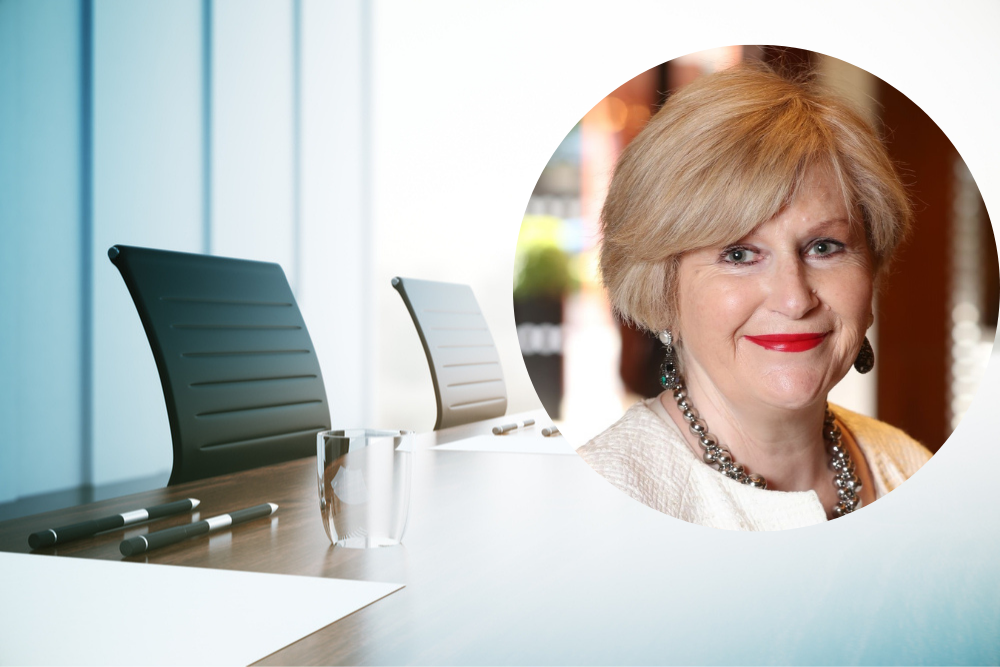
Podcast Ep 359: Delay remains the single biggest mistake founders make when handing over control of their companies, warns Deborah Kelly, a seasoned corporate lawyer and partner at Addleshaw Goddard Ireland.
When most of us think of the subject of succession these days, the eponymous TV show comes to mind with all the dramas, betrayals and emotion. The truth in all of this is often in between.
For Deborah Kelly, partner and head of Corporate at Addleshaw Goddard Ireland, family dynamics do come into it, but not often in the same way. She spoke to the ThinkBusiness Podcast about succession planning, family dynamics, tax structuring and building a business that will outlive its founders.
“Delay is a big mistake. You’ve got to get in front of it, and be as prepared for it as you possibly can”
Ireland is entering a defining moment for family-owned businesses. A large share of the country’s SMEs were founded in the 1980s and 1990s and their founders are now approaching retirement around the same time.
These first or second-generation founders will be taking with them decades of knowledge, contacts and in some cases, the bulk of their family’s wealth.
Values before conflict
-
Listen to the ThinkBusiness Podcast for business insights and inspiration. All episodes are here. You can also listen to the Podcast on:
-
Spotify
-
SoundCloud
-
Apple
Key lessons: How to succeed at succession
| Question | Answer |
|---|---|
| Why is succession planning important for Irish family businesses? | It helps preserve business value, leadership continuity and family wealth as founders approach retirement. |
| What is the biggest succession planning mistake? | Waiting too long to begin planning the transition. |
| When should founders start succession planning? | Ideally five to ten years before retirement. |
| What percentage of family wealth may be tied up in Irish businesses? | Deborah Kelly cites estimates ranging from 70% to 90%. |
| What should families discuss first? | Their values, long-term goals and expectations for the future of the business. |
| Is a family successor always required? | No. Professional management can be appointed if family members are unwilling or unsuitable. |
| What legal document is essential for a succession plan? | A valid and current will. |
| What tax issues should founders consider? | Capital Gains Tax, Retirement Relief and Entrepreneur Relief. |
| How can founders protect business value during a transition? | By identifying and retaining the expertise, relationships and capabilities that underpin success. |
| Who provides the advice in this podcast? | Deborah Kelly, Partner and Head of Corporate at Addleshaw Goddard Ireland. |
Kelly, who advises business owners on succession, business continuity and value preservation says the scale of the concentration is frightening.
“For the most part, succession planning is about more than just ownership. Everybody has to be part of the team rowing, whether that’s looking at the leadership within a family or within a business, or looking at legacy and providing for the wealth going forward.
“At the moment there is a huge concentration in Irish businesses, I’ve heard statistics of between 70% and 90%, for example, of Irish families’ wealth being concentrated in a company. People have dedicated their lives to developing businesses, and they come to a point where they need to plan for retirement, consider how they reduce their involvement, and what the next phase of their lives looks like. So I suppose the urgency is that we need to do it now. Business owners need to focus on how they’re going to retire, consider how that’s going to be funded, again.
“It’s not something people put too much focus on in the past, but certainly in more recent times we are focusing on that. We’re all aware we need to provide for our pensions and ourselves into the future, and then also just identify within the family who is there and available to help drive the business, and for those who may not be suitable or want to be involved, how are they going to be treated?”
Asked what founders get wrong most often, Kelly is direct. “You can’t start early enough.”
Her reasoning is practical rather than sentimental. A founder planning a handover five to 10 years out has time to weigh every option, from bringing in professional management to preparing the next generation of family members or key staff. But leave it too late and the choices narrow sharply.
“Delay is a big mistake. You’ve got to get in front of it, and be as prepared for it as you possibly can, because if you’re thinking you’re going to retire five to ten years from now, that’s ideal, you have the most opportunity at that point in time to consider the full range of options. You have to identify what good looks like. What do you, as a founder, want to achieve? Is it retirement, or just a phased step back? And what income are you going to need, and what security in retirement? Then, how is the business to be sustained? How are you going to retain that value into the future? That’s really, really important.”
Communication is critical
Like the TV show Succession, family conversations about succession can carry an emotional weight that ordinary corporate transitions do not.
Kelly, who works with Irish families navigating these discussions says the difficulty is real. Some conversations may involve siblings who wish to take the helm, but increasingly founders are discovering that the next generation may not wish to take up the reins of the business at all.
“Really speak openly with your family about what you’re trying to achieve as a family, what your desires are and what theirs are. Very often, if it’s a family business, there will have been discussions around the dinner table about what you’re trying to achieve, and separating out the roles between ownership and management is very important too, to ensure that, okay, we’re staying in control, but maybe we’re not going to be managing the business. That’s another conversation that needs to happen.”
Such conversations can, however, be emotionally charged. “You’re talking a little bit about mortality, and nobody ever wants to have that discussion. There’s rivalry between siblings, and sometimes perceived, not always, but sometimes perceived, parental favouritism. It’s just a nightmare situation to find yourself in.
“What I’ve seen work really well is for families to have honest conversations about succession, focusing on a few things in particular. One would be values: what are the values of the business? What is this business meant to be, and what will it stand for in 20 years’ time? I think that’s really helpful, because it makes those discussions less arbitrary.
“People become aligned, they have great pride, and they see a legacy, and so they want to be part of that, or not. But at least it opens up the whole conversation, and it often leads to conversations about what fairness looks like for this family, who’s going to be running the business, are we going to bring somebody in to help facilitate the management from a professional perspective?
“I think it’s for the founders to have these conversations and mould them, and that’s another reason why delay can stymie that, if it’s an unplanned event that triggers the need to consider succession, you don’t get the luxury of having these conversations calmly, separating out family issues from business issues, and coming to fair conclusions. I think the only other thing I’d say on that topic is that, out of fairness, founders have to be honest with families, they have to identify who they consider the future of the business to be, and why. That’s a difficult conversation.”
Once the family conversation is under way, Kelly turns to the technical side of a succession plan. Tax, she explains, is usually the natural starting point.
This includes capital gains tax, retirement relief, and entrepreneur relief, alongside wider structural questions such as separating trading companies from property assets. Share structures are vital, particularly where some family members are active in a business and others are not.
There is one document that underpins everything else. “My number one starting point with any succession plan is to ensure that all founders have a will.”
Bottling the magic
For entrepreneurs hoping to build something that outlasts them, Kelly’s advice is to work out exactly what has driven the business’s success so far, and to make sure that quality does not disappear with the departing founder.
“I love this when I talk to founders: find out what their USP is, what’s unique about that founder that has ensured and developed and built the business up to where it is, because that’s what we need to be able to replicate. We need to ensure that expertise is retained within the business and continues to grow and add value. That may mean looking at professional management teams and surrounding yourself with more than one person, but you’ve got to identify what’s so special about this founder, and whatever that magic sauce is, that we retain it in the business.
“It could be knowledge, it could be know-how, you find it a lot with engineers, who have this incredible desire to improve systems and processes, and that kind of skill set and those capabilities have to be replicated.
“So sometimes what we do is a short piece of due diligence on the business to identify exactly that, what is it about this business that creates the stickiness and the success? And then the other thing is identifying whether there’s a person within the organisation who can replicate that and drive it forward. If there isn’t, you have to find that person. We have to identify and make sure that we can retain the value that’s been put into the business thus far.”
The reality, she says, is not always entirely removed from the famous TV show. “If we dial it down a bit, you can see the impact on Irish families.”
👉 No tech background needed to bring your business into the AI age! Secure your Google AI Professional Certificate to complete the certification at no cost. Apply now and get started!
-
Bank of Ireland is welcoming new customers every day – funding investments, working capital and expansions across multiple sectors. To learn more, click here
-
For support in challenging times, click here
-
Listen to the ThinkBusiness Podcast for business insights and inspiration. All episodes are here. You can also listen to the Podcast on:
-
Spotify
-
SoundCloud
-
Apple