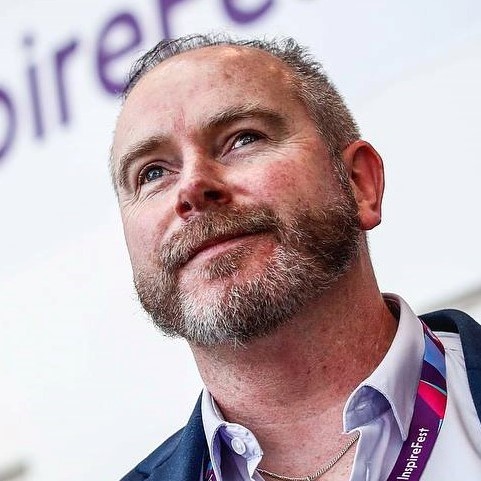
Podcast Ep 346: Velico CEO Richard Meehan on how the Meath-based medtech manufacturer is plotting hundreds of new Irish jobs as it delivers blood plasma technology to a dangerous new world.
Meath and Massachusetts business Velico is planning to scale its workforce to 400 people in the next five years as demand grows globally across for a technology that converts blood plasma into a shelf-stable powder.
The innovation isn’t entirely new – it owes its origins to how dried plasma kept wounded Allied soldiers alive on the battlefield during World War 2 – but using Velico’s technology it will keep people alive in a variety of situations from car accidents to war wounds. For example, soldiers in the field can have blood plasma dried using Velico technology and can carry it as powder in their backpacks. Or ambulances can have supplies of blood plasma to hand when dealing with emergencies.
“The company projects a global market of 1 million units a year within five years”
For Richard Meehan, this technology will matter where the window to save a life on a battlefield or following a car crash can be less than 40 minutes.
“You take a unit of liquid plasma, load it into a dryer and half an hour later you have a dehydrated pouch of powdered plasma.”
Life-saving technology
Velico has already won business with the French military as well as with the NHS in the UK and seven of the largest blood centres in the US.
The business is headquartered in the US but has its technology and manufacturing located in Ireland.
“Velico is a mission-based business. We make devices and an equipment ecosystem that enables the dehydration of blood plasma. We can dry plasma, removing the water element out of it, so you remove the cold chain and make logistics a lot easier. The wonder tech really is that you take a unit of liquid plasma, load it into a dryer, and half an hour later you have a dehydrated pouch of powdered plasma, which stays stable at room temperature and has a shelf life in the fridge of up to two years.
“Going all the way back to World War Two, dry plasma was used to save and keep alive up to 10 million soldiers from the Allied forces. This is almost like a back to the future story. In 2026, we have to go back to the 1940s to look at how medics and doctors kept alive so many people in the last large-scale combat operation, and what they used was dried plasma. That product fizzled out after the war because of the blood screening crises and the HIV crisis, and blood was not looked at as a safe space for many decades afterwards.
“In the last 20 years, that situation has corrected itself, and the technology to screen blood for pathogens from donors is excellent. So the industry has said we need to bring back dried plasma in a big way, but in a better way than it was in the 1940s. Velico is a mission-driven business based around that: bring back dried plasma and eliminate preventable deaths from bleeding.”
Much of the early demand has come from defence. Meehan describes how soldiers will carry two units of dried plasma in lightweight pouches, with elite units able to carry plasma donated from their own blood. Civilian use is expected to follow, and Meehan is candid about the scale of the problem the company is targeting.
“Up to 26,000 civilians die a year in the United States from car crash injuries that have haemorrhages,” he says, describing the toll as equivalent to a town the size of Naas disappearing every year. “Velico is pushing for a change in the standard of care for pre-hospital bleeding, arguing that plasma offers proteins and clotting factors that saline cannot replicate. The company projects a global market of 1 million units a year within five years.
“We have a razor blade business model. We make a set of equipment that dries the plasma, and it requires a single-use consumable: a highly engineered bag that doubles as a manufacturing consumable and the end-user packaging. That’s the razor blade. Velico makes all of that and supplies it to sovereign nations to embed into their blood supply systems.
“If you listen to world leaders across NATO, there’s a common theme around the sovereignty of critical supply chains, as opposed to relying on distant countries, or even neighbours, who might once have been friends but are not friends anymore. Having a sovereign blood product system in your country is a big deal now, and Velico is really the only company in the world that has developed and patented the technology to enable a sovereign nation to become autonomous in its blood component supply.”
Beyond the military, Meehan sees enormous civilian upside to Velico’s potential. “If blood banks mix A and B plasma together, pretty much everybody can take that, so more plasma can be carried by ambulances and first responders if necessary. My mission is to put plasma on every ambulance. Every ambulance that wants to have pre-hospital blood will have our product. In terms of numbers, we see our serviceable, obtainable market on a global scale within five years as being 1 million units per annum.
“What we’re doing in tandem with bringing our technology to market is advocating for a change in the standard of care in pre-hospital haemorrhage. The standard of care right now is clear liquid, whether that’s saline or crystalloid, and that does one job, but not the whole job. What you’re looking for if you’re haemorrhaging at the side of the road after a bad car crash or a gunshot is to keep your blood pressure up, and saline and crystalloid help with that.
“But what you die from, the data says, is bleeding out, and all the nutrients and proteins in blood are lost with it. Plasma has a coagulation factor that stops the bleed, and more importantly it has the right proteins to keep your organs from going into haemorrhagic shock, which is what a lot of people die from when they’re bleeding out. Saline cannot give you that. Plasma should be looked at in the pre-hospital sense as a bridge to getting you to the hospital.”]
Made in Meath
Velico’s journey extends back to the 1990s when a team of bioengineers initially looked at getting rid of blood types as an end product. Following the tragic events of 9-11, the US government was on the lookout for a decentralised way to enable the mass distribution of dried plasma in emergency situations.
Meehan, whose background is in the food business, became aware of Velico when the team was looking for help in scaling and growing the business. “Five years ago I became CEO and president, working primarily on scaling the business. We still have to get regulatory approvals in different jurisdictions. We completed a successful human clinical trial last year, and we’re bringing a chunk of the business across from America to Ireland to service other parts of the world.”
In Co Meath, Velico manufactures what it calls FrontlineODP equipment, a containerised dried plasma production facility. “We recently shipped one across three countries to France, to the French military. Within two days of that Velly Pod landing at their military hospital, they were making their own spray dry plasma. That’s how fast it was. It was a joyous project and a big deal for both the French military and Velico.
“We have systems installed with many militaries in advance of regulatory approval, as well as the NHS in the UK and seven of the largest blood centres across the United States. There’s four times the production capacity installed compared with the old, limited technology that was out there. The industry is excited that we’ve proven our technology is safe and that our devices and our whole system work well, and countries the world over, pretty much all of NATO, are either contracted with us or in advanced stages of taking us on to fill that gap in pre-hospital blood.”
Currently employing 55 people, Meehan says Velico is aiming to employ 100 people within two years.
“At the moment we make our consumables in Massachusetts, but the demand for more provenance of manufacturing production is really strong across European nations, so there’s no doubt we’ll have to. We’ll scale from a base of 55 now to 300 or 400 within the next few years, across the United States and Europe,” Meehan said.
“Ireland is a place we want to do business. It has all the key ingredients for a medical device business: the other larger, more mature medical device businesses are here, and the talent is here.”
👉 No tech background needed to bring your business into the AI age! Secure your Google AI Professional Certificate to complete the certification at no cost. Apply now and get started!
-
Bank of Ireland is welcoming new customers every day – funding investments, working capital and expansions across multiple sectors. To learn more, click here
-
For support in challenging times, click here
-
Listen to the ThinkBusiness Podcast for business insights and inspiration. All episodes are here. You can also listen to the Podcast on:
-
Spotify
-
SoundCloud
-
Apple