Podcast Ep 362: We talk to Kore Insulation’s Caroline Ashe-Brady and Bank of Ireland’s director of Sustainability about how the Cavan business has made sustainability a practical business strategy.
Ireland’s green transition depends on a range of factors that include collaboration amongst businesses, government and finance alongside continued innovation. How quickly businesses can adapt buildings and supply chains and manage risks such as heat, changing technology and influencing their suppliers is at the heart of the challenge.
At the coalface of this challenge is Kore Insulation, a Cavan based business that manufactures innovative building materials such as insulation that goes into new build and retrofit projects. Its second business, Kore Retrofit, designs and constructs retrofit projects, mainly residential and multi-unit developments.
Founded in 1997, Tommy Brady, Helen Brady and Jimmy Macken established Kore Insulation, then known as Airpacks Ltd, after identifying a gap in the Irish market for high-quality, durable EPS insulation products. Drawing on their construction industry experience, they set out to manufacture innovative insulation solutions tailored to the needs of the Irish building sector.
The company’s original base in Kilnaleck, Co Cavan was a 60ft by 190ft factory that required significant refurbishment. As the business expanded, the facility underwent a number of redevelopments and has since evolved into a state-of-the-art manufacturing operation spanning more than 45,000 square feet, supporting Kore’s growth into one of Ireland’s leading building products and retrofit specialists.
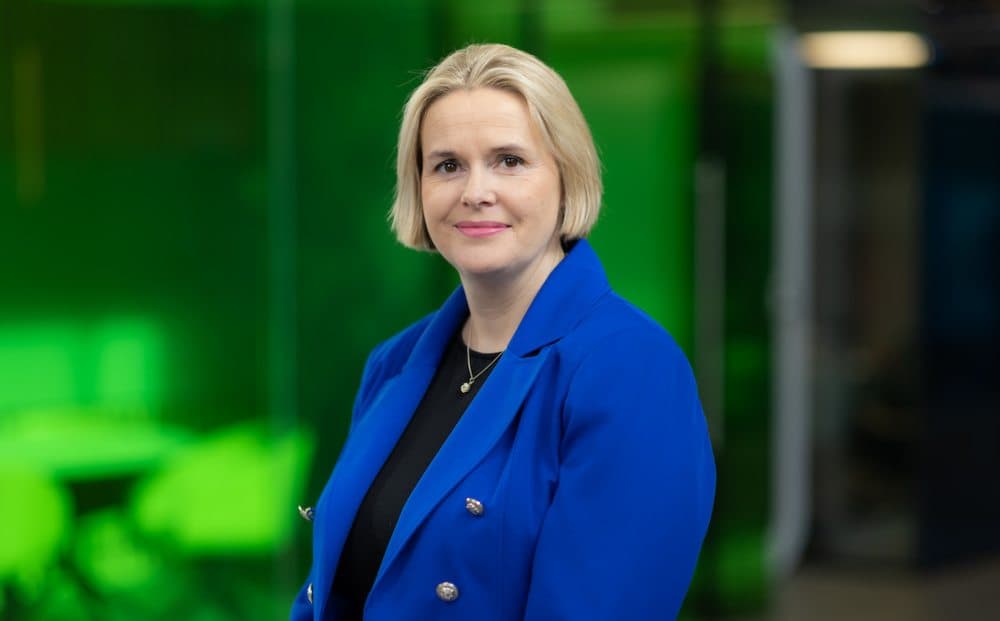
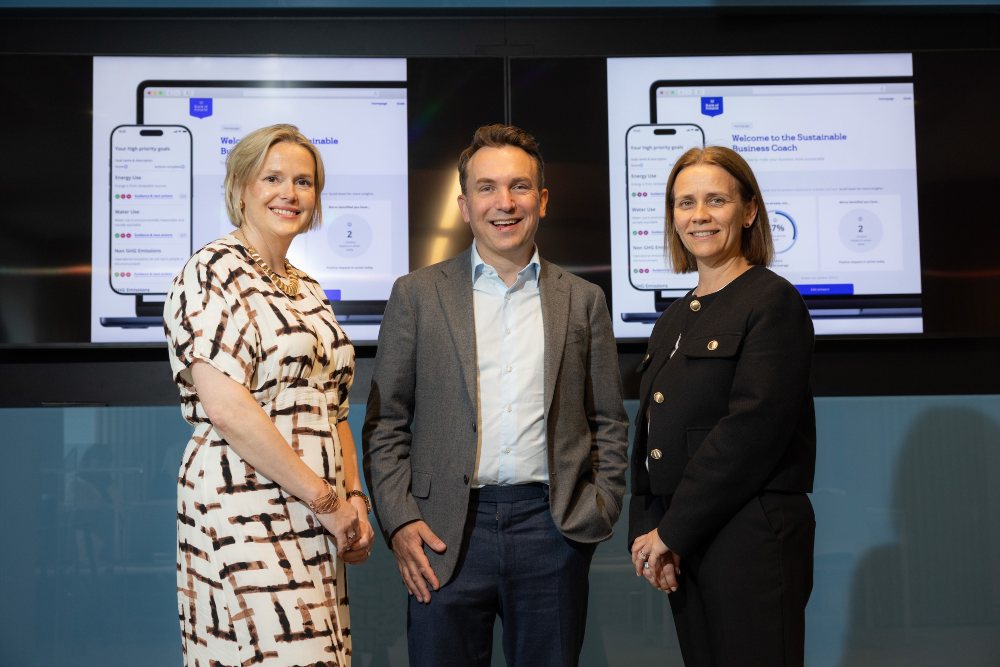
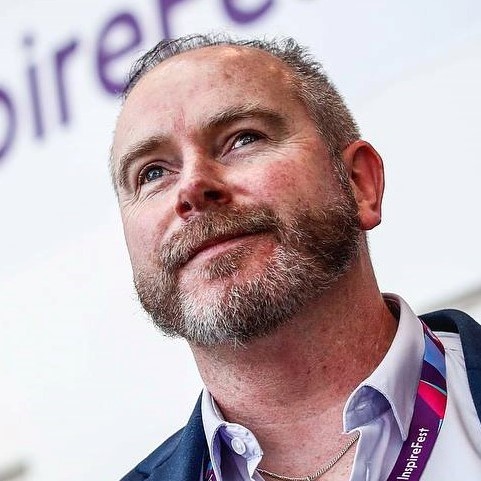
Caroline Ashe-Brady is commercial director of Kore Insulation, founder of Kore Retrofit and chair of the Passive House Association of Ireland. She told the latest ThinkBusiness Podcast, powered by Bank of Ireland, how the company built its approach. She was joined by Colette Shirley, director of Sustainability at Bank of Ireland.
KEY NUMBERS: Kore’s Sustainability Payoff
• €120,000 annual energy cost savings from machinery optimisation
• 52% increase in output across the business
• 8% reduction in energy use per cubic metre produced
• 32% lower embodied carbon in Kore foundation system
• 14 years of sustainability-focused investment and planning
• More than €75m in grants deployed to businesses in 2025
• Over 4,500 businesses received sustainability grant support
• Net-zero roadmap extending to 2050
Editorial takeaway: Sustainability is moving from a compliance exercise to commercial advantage, with measurable carbon reductions delivering tangible cost savings, funding access and competitive differentiation.
Video podcast:
What gets measured, gets managed
-
Listen to the ThinkBusiness Podcast for business insights and inspiration. All episodes are here. You can also listen to the Podcast on:
-
Spotify
-
SoundCloud
-
Apple
As Ashe-Brady recalls, Kore was working on ‘sustainability’ 14 years ago. “We weren’t calling it sustainability at the time,” she says.
The Sustainable Energy Authority of Ireland (SEAI) had launched its grants into the market and Kore was supplying products to it. “We got a very early understanding of the legislation that was coming from Europe, and the mega trends that were going to affect the construction industry over the next 10 years. And also at that point, for ourselves, the business was about 15 years old. We were growing. We were looking at the equipment we had, and we were beginning to think we’re going to have to start upgrading and improving what we’re doing in terms of our facility or manufacturing and so forth. So, because we understood what was happening with legislation from, as we say, early doors, we started to think about energy efficiency in our capital projects quite early on, and we also knew that there was significant funding available.”
Kore examined its equipment and how it transported product, and it brought energy efficiency into its procurement and capital project decisions. SEAI’s guide set out what it expected industries to do. “
“We mirrored our actions to what they required, and we got the supports, we got the projects, and we got energy efficiency right into the heart of the business in what we’re doing every day.”
Bank of Ireland’s Colette Shirley sees the timing as the lesson for other small businesses. “They really acted early. I think that is the key message here.” Kore, she says, “looked at sustainability and embedded it into their strategy and that really placed them well with their customer base.”
“In terms of advice for other SMEs, I would say it’s really important to focus on things that you can measure. Tracking measurable actions is really important, and that’s what builds the credibility. I would say again, the practical actions that you are already taking in your business if you can connect them to data somehow.”
Data becomes an obsession
Ashe-Brady says that the grants came with a requirement to monitor and verify results. “One of the key things around the grants is you have to have monitoring and verification, and so very early on you’re thinking about your data, and you’re thinking about measuring what you’re doing. A lot of SMEs, what we have a tendency to do is spend the money, and put it in and get on with things. And what it does is it almost forces senior management to say, well, have we optimised it? And when you get the results back, you’re thinking to yourself, oh God, that didn’t perform as well as we thought. What can we do to get a better performance out of it?
“And so that part around the data is absolutely critical. Even so much so now that I’d say data is now our obsession. All the data we have from our machines we feed into a data lake, and we’re layering AI over that now, and so it’s that lovely transition within the business, and that data allows you to report, and reporting is key to that credibility.”
Paying for proof
Shirley says that new regulatory requirements such as the Voluntary Sustainability Reporting Standard (VSME) provides a practical framework for covering emissions, energy, labour force and governance.
She concedes that sustainability reporting had become very complicated “ and a little bit overburdensome” in the past few years. “VSME strips it back and is almost creating a common language for SMEs.”
In the construction sector, Ashe-Brady explains the focus is on areas like embodied carbon and operational carbon.
“Embodied carbon is all the carbon that goes into all the products that go into our buildings, and operational carbon is the carbon that, as the word operational suggests, when we’re running that building, how much carbon are we emitting?
“And so our buildings now have targets. And so when it comes to companies like us, our product has carbon and energy data associated to it, and we have what’s called an environmental product declaration. This is a certificate of how good or bad we are, and our competitors have that data, and you can very clearly see and compare each other’s right out to product level.
“And so, when it comes to reporting, we have our environmental product declaration feeding into that, our greenhouse gas inventory, our net zero inventory. But also, what the VSME does, it brings in governance and social aspects. So what do you do for your community? For us certainly, we were very, very strong on environmental sustainability from those aspects. But there’s a stretch metric there for us in terms of social, so it’s key to us sending a message to the market that the data and what we’re saying is backed up.”
Kore published its VSME report and had it independently verified. “We went that extra step to encourage the industry to move in the right way. We have to have it credible. We have to have it transparent.”
How the numbers translate into market advantage
Ashe-Brady wants every reporting figure to translate into a market benefit or a customer benefit.
“For example, we know that our foundation system has almost 32% less embodied carbon than a traditional foundation system. We know that even though our output has increased by 52%, our energy output per cubic metre of material is down 8%. And what does that mean in money terms? That’s €120,000 euro saving per year, and that’s just by us stretching the spec on our machinery.
“And so you still have to buy the machinery, but every year now we’re getting a €120,000 saving that we wouldn’t get unless we had introduced that spec into our machines. The exciting thing for us is now that figure does not include the solar PV we’ve added to the business, and while solar doesn’t reduce the energy you use, it’s providing a renewable form of energy that your business is already using.
“Next year we should see our embodied carbon come down even further. We’re monitoring it, and while every year it’s a small iteration on your performance, it’s the concept of the 1% gain, and you do it. It is very much a journey with sustainability, but once you measure and you see and you can talk about that, and then you can turn it into a market advantage.”
Those gains reach Kore’s customers. “Those advantages move in the construction industry to your customer base because they can say that the energy saved by Kore is now in my building and I can report on that too.”
Free tools and available grants
Bank of Ireland found that its business customers needed educational support around sustainability. Shirley said that the Bank has invested in a Green Digital Hub with guides to the available grants and how to create a sustainability strategy, alongside webinars and other digital tools. As well as this it is in its third year of carbon literacy training with Business in the Community.
The Bank’s Sustainable Business Coach is a free digital tool for Irish SMEs. Shirley describes it as an ESG questionnaire that gives credible and demonstrable actions “bespoke to your business.”
Shirley explained: “It gives you a plan and also a report that you can use. It meets you where you already are, so any businesses of any type can use it, even if you’ve already started on your journey.”
It is an all-island endeavour having just launched in Northern Ireland. “We just see it as a practical support for our customers. It only takes 30 minutes to complete. You can do it on your iPad and on your phone on the way home if you need to, if you’re not driving, of course. “So, there’s plenty of ways to kind of fit it into your day. But it is a useful tool, in terms of terms of ‘what do I, where do I start or what do I need to do next?’”
Ashe-Brady has also used the tool. “I wish it was there 14 years ago when we started out on the journey. It hit the nail on the head in terms of what we already knew.
Grant money is also available in volume for businesses. “ I think in 2025 it was the highest year on record in terms of deployment of grants,” says Shirley. “Over 75 million has been deployed to over 4,500 businesses.”
Ashe Brady says “people get a little bit scared when they hear the words a net zero pathway”. Kore’s own pathway showed “many things to get us to net zero that we didn’t have a huge amount of influence on”, including suppliers and supply chains. The company drew up a plan to 2050, formulated “based on what we know today”.
Her advice is to “make your plan, review your plan, and just one step at a time”. She points businesses to SEAI, Enterprise Ireland and InterTradeIreland, and to the local enterprise office for companies with under 50 employees. “When you’re going to have to do it anyway, you might as well get some cash to help you do it.”
Kore’s last project went through SEAI’s Exceed programme, which she calls “a big, massive investment for the organisation”. Bank of Ireland was the financier. “We were able to get a lower interest rate on that loan because we were able to prove that our project was aligned to SBCI.”
Buildings as living things
Shirley finds her optimism in companies like Kore. “It’s businesses and leaders like Caroline that give us optimism in terms of the really practical actions that they have taken in their business via a commercial lens,” she says. “I am pretty optimistic when I look at our SMEs in Ireland and what they’re doing.”
Ashe Brady sees delivery catching up with policy. “We’re not talking about legislation and policy as much anymore. It’s been matched with delivery.” She recently heard the Central Bank of Ireland discuss climate risk at a conference. “When our financiers are thinking like that, and they understand it, it will just flow down into industry, into business, into our homes.”
Building performance is “one of my obsessions”, says Ashe Brady, who chairs the Passive House Association of Ireland. “I see them as living things, and they perform a certain way when it’s hot, and a certain way when it’s cold.” Cold has been addressed, in her telling, and “nobody saw the heat coming.” Design has to reflect location. “People don’t understand that a house in Cork should look different to a house in Galway.”
She expects attitudes to move. “I’m really excited about that change that will come. That we’ll become obsessed with their performance throughout the year.”
👉 No tech background needed to bring your business into the AI age! Secure your Google AI Professional Certificate to complete the certification at no cost. Apply now and get started!
-
Bank of Ireland is welcoming new customers every day – funding investments, working capital and expansions across multiple sectors. To learn more, click here
-
For support in challenging times, click here
-
Listen to the ThinkBusiness Podcast for business insights and inspiration. All episodes are here. You can also listen to the Podcast on:
-
Spotify
-
SoundCloud
-
Apple