Podcast Ep 351: Squid Loyalty co-founder Matthew Coffey reveals how the Irish business has grown to 4,000 brands and 1m app downloads across Ireland and the UK.
Squid Loyalty founders Katie Farrell and Matthew Coffey met in a scholarship programme and founded their business Squid Loyalty right out of college.
Today the business is one of the largest local loyalty networks across Ireland and the UK with around 4,000 brands and more than a million app downloads.
Consumers have redeemed nearly three million rewards and the business has raised more than €10 million to date.
In recent weeks the Irish company launched Wave Points, Ireland’s first universal local rewards system that allows people to earn loyalty points with one brand and spend them with another across a network of more than 1,000 businesses. This means someone could earn points with their weekly grocery shop and use those points to buy a coffee at a local café.
Loyalty pays
-
Listen to the ThinkBusiness Podcast for business insights and inspiration. All episodes are here. You can also listen to the Podcast on:
-
Spotify
-
SoundCloud
-
Apple
Now that the business is firmly established, Coffey reflects on the journey so far. He says the idea began during a study year in America, where Coffey and co-founder Katie encountered reward programmes everywhere they looked. “For the two of us it was the first time we were immersed in seeing reward programmes everywhere, credit cards, points out the wazoo,” Coffey says. “It did start to trigger this why doesn’t this exist back home.”
On their return, the pair enrolled in a masters in Dublin and decided to bootstrap the idea, starting with independent coffee shops. “We were inspired by the likes of Amazon, which started with books, so we thought coffee would be the natural entry point for us, a very simple form of loyalty, buy 10 get one free,” Coffey says. “We’ve built it up now to the largest local loyalty network across Ireland and the UK.”
Like most founders, their ignorance of the challenges ahead was almost a blessing.
“It was absolute madness, honestly. I didn’t think there was really much to it. The fun part was that we didn’t know how much we didn’t know, and that led us into a kind of ‘how hard could it be’ mentality. We just bounded in, walked into a few places and asked them how they thought about loyalty, and learned so much. That’s part of the thing I enjoy most, the learning, the breadth of everything from the brand side, working with local brands, but also on the consumer side, learning about the cultural differences and how people buy region to region. There’s a lot there, and it became like a hook, you just get roped into wanting to find out.
Coffey admits the early assumptions were not always right. “The biggest one came down to assuming that brands would be happy to abandon their own image and sign up to something where there would be a loyalty programme that works across all brands and they would become a little bit more anonymised,” he says. “That was quite a strong slap in the face.”
The fix was to combine the convenience of a single app with room for each brand to keep its own identity. “The power of aggregation was something we really wanted to get right, but the big learning was we need to do that while also giving the brands that sense of ownership, the space to put out this is our logo, this is what I stand for,” Coffey says.
Internally, the team calls this ambition “one touch loyalty”, a single simple transaction that sits on top of a tangle of competing payment providers. “We’re becoming more like a loyalty version of Visa and Mastercard,” he says. “In the same way that Visa and Mastercard connect banks, which on paper are competitive, we do the same with a lot of other payment companies.”
Making Waves
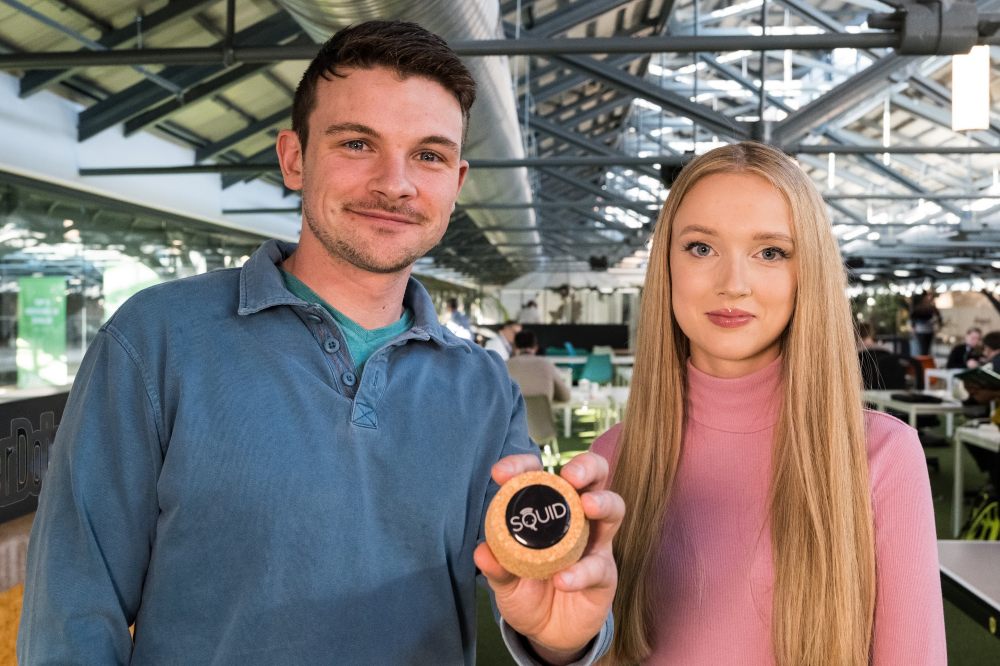
Squid Loyalty founders Matthew Coffey and Katie Farrell
Squid’s newest product, Wave Points, lets customers earn rewards with one brand and spend them with another, already connecting around 1,000 businesses. Coffey describes it as “airline points for local communities”.
The company is now pitching the idea to banks, airlines, grocery chains and fuel retailers, redirecting marketing budgets that would otherwise be spent on billboards into local spending power instead.
“We’re all about the local economy, and our big focus is trying to drive traffic there and keep local communities going and thriving. But one of the learnings we’ve had over time is that there is very much an angle for bigger brands to feed in there.
“So one of the things we’ve been focusing on is helping larger brands open up their loyalty programme, picture a big grocery chain or an airline, and what we’re working on at the moment is helping their points be spent in local businesses, so you don’t have to just spend them back in the same place, you can build up a points balance and walk down the street and spend them in a local butcher, a coffee shop, pay for your dinner.
“Even just in Ireland and the UK, which is where we’re focused at the moment, there’s about €85 billion spent a year influencing where people buy. What we’re trying to do is flip how they look at it, go towards more of that American model, and rather than it being purely about buying attention, jumping up and down with some sort of billboard, flip it into spending power. It’s the same cost for the business, but you’re flipping that advertising budget into spend that can then be directed into local communities.”
For independent retailers, Coffey argues the real value lies less in a single dramatic gesture and more in staying relevant to customers who are constantly distracted. “There’s no one slam dunk thing you can do,” he says.
Asked about artificial intelligence, Coffey is cautious about overstating its role. “The mistake a lot of people make with this is thinking that it’s AI alone that will be able to achieve these things,” he says. “You still need a medium for it to run across.”
He points to Dunnhumby, the data firm behind Tesco’s Clubcard, as the model Squid is chasing for smaller brands, using AI to predict quiet periods and trigger offers automatically, while keeping every reward transparent to the customer.
Open loyalty infrastructure
Looking ahead, Coffey wants to build the kind of open loyalty infrastructure that already exists in the United States, where reward points move freely between brands.
“I think the biggest learnings have been around how we really need to stay with a very simple proposition, that’s something we’re continuously working on in terms of what consumers and brands are signing up to. We need to really focus on ensuring a very seamless engagement, that’s another area of focus.
“In terms of the future, we definitely see the loyalty and rewards market moving more towards an open infrastructure type area, where rewards aren’t siloed to businesses and can move across from brand to brand, which makes the whole proposition more enticing.
“What we’re trying to do is build that sort of infrastructure across Europe in particular. America has it, there are regulatory reasons why Europe doesn’t, but we’re building a GDPR-friendly, EU native version of this that allows rewards to move from brand to brand and helps local communities thrive.”
👉 No tech background needed to bring your business into the AI age! Secure your scholarship to complete the certification at no cost. Apply now and get started!
-
Bank of Ireland is welcoming new customers every day – funding investments, working capital and expansions across multiple sectors. To learn more, click here
-
For support in challenging times, click here
-
Listen to the ThinkBusiness Podcast for business insights and inspiration. All episodes are here. You can also listen to the Podcast on:
-
Spotify
-
SoundCloud
-
Apple