Leading Irish business figure Sean O’Driscoll told Ireland’s engineering leaders that Ireland’s infrastructure barriers are being dismantled as reforms accelerate delivery across energy, water and transport.
Sean O’Driscoll opened the Ibec group Engineering Industries Ireland’s convention last week with a blunt account of what two decades of underinvestment have cost the country.
He said that the nation’s infrastructure deficit is its central competitiveness problem and that two decades of underinvestment have left Ireland struggling with water, transport and electricity capacity problems, stymying both economic growth and housing delivery.
“The good news is, everything here is fixable. There’s no rocket science required here”
“Without basic infrastructure, we won’t be competitive, and we won’t grow,” the former chair and chief executive of Glen Dimplex Group told business leaders at the Heritage Hotel in Killenard, Co Laois, on Thursday (8 October). “And the issues that we have in infrastructure have been 20 years in the making.”
O’Driscoll is a leading voice in Ireland’s infrastructure debate. A UCC Commerce graduate and chartered accountant, he joined KPMG in 1979 and became its youngest ever partner at 31. He moved to Glen Dimplex in 1990, becoming group chief executive in 1998 and later chairman and chief executive before leaving the board in 2018. In 2025, Minister Jack Chambers, TD, appointed him to the Accelerating Infrastructure Taskforce, which is overseeing an action plan containing 30 actions and 138 sub-actions aimed at removing barriers to infrastructure delivery.
KEY NUMBERS: Ireland’s infrastructure challenge
• 44th of 70: Ireland’s ranking for basic infrastructure
• 1.2m jobs created since 2012
• 1m people added to Ireland’s population over a decade
• 30 actions in the infrastructure delivery plan
• 138 sub-actions covering delivery across government
• 95% of actions scheduled for completion by year-end
• 56.2% annual rise in wholesale electricity costs for manufacturers
• €28.9bn net turnover generated by Ireland’s engineering sector
Twenty years in the making
“Every time we have a financial crisis in Ireland, the first thing we do is we cut capital expenditure because it’s politically expedient to do it,” he said. That was “the wrong thing to do because you should always invest constantly, and the time to invest in infrastructure is when economies are weak.”
He said that planning has failed to keep pace with growth. “Our population has increased by a million people in the last decade. We haven’t planned for that, and neither have we planned for the success of our economy.”
O’Driscoll worked with Government on the Action Plan for Jobs in 2012, which targeted 200,000 new jobs by 2020. “Since 2012, we’ve created 1.2 million jobs. Enormous success that we should be very proud of, but it also demonstrates very, very clearly we did not plan for that growth.”
👉 No tech background needed to bring your business into the AI age! Secure your Google AI Professional Certificate to complete the certification at no cost. Apply now and get started!
He tied the shortfall directly to housing. “We will never fix our housing crisis unless we fix our basic infrastructure crisis. They’re inextricably linked,” he said. “Even if you could build the tens of thousands of homes that are required, there isn’t sufficient basic infrastructure of water, transport, or electricity to connect those homes.”
The IMD Competitiveness Index ranked Ireland second in the world in 2023. By 2025 it had slipped to seventh. “When it comes to basic infrastructure of water, transport, and energy, we’re rated 44th out of 70, and that’s what pulls us down,” O’Driscoll said. During the Taskforce’s work, “many foreign direct investment companies made contact with us to say they were losing billions and billions of euro of investment to their sister companies right across Europe.”
Those who raised the alarm were told to keep quiet. “We were discouraged from talking about it publicly because you were seen to be talking down Ireland,” he said. “The dogs in the street internationally knew of our issues. So we went through a period, I would say, of 10 years of denial in Ireland at a political level when it came to infrastructure.”
No tinkering at the edges
When Minister for Public Expenditure Jack Chambers approached him in February 2025, O’Driscoll set three conditions. The work had to be radical: “There is no tinkering at the edges here because this is far too serious, and we need to be radical in our approach.” It had to be “an action plan, not a report with recommendations.” And it needed Cabinet approval, because “when something is approved by Government, all sections of the State put their shoulders to the wheel and get things done.”
A public consultation drew 170 submissions, and the taskforce held about 70 roundtables. The action plan went to Government at the end of November and was launched on 3 December. “Not one thing was changed in our action plan. Not a word was changed. We had no pushback.”
The plan contains 30 main actions and 138 sub-actions, each with a timeline and a lead department, and it names the minister and secretary general of that department as ultimately responsible. “So, total transparency, total accountability, and anybody who hasn’t their homework done can be called out at any point in time,” he said. “It took me six attempts to get it in, but we got it in.”
Of the 62% of actions due by the end of June, O’Driscoll said, “all of them have been done.” The 77% due by the end of September will be complete within two weeks, and 95% are due by year end. “And again, I’d be very confident that they will be done.”
Judicial reviews in the spotlight

Sean O’Driscoll during a fireside chat with Ibec CEO Danny McCoy
The biggest outstanding item is a civil reform bill due in the second quarter of 2027. “For the first time in the history of the State, it will put judicial reviews on a statutory footing,” he said. “Judicial reviews are not mentioned in our constitution. There is no law around them.”
Changes already made have shifted behaviour. Under the old rules, a challenger with a single environmental ground could recover their costs even after losing. “So there was no risk attached to it, and it is being abused, was being abused left, right, and centre,” O’Driscoll said. The average refund to plaintiffs of €200,000 has been capped at €60,000. “Guess what’s happened? There has been a dramatic decline in the number of judicial reviews that have been taken.”
Danny McCoy, chief executive of Ibec, who joined him on stage, said “the judicial review is an industry in itself.”
The plan’s final action, due in late 2027, is an economic impact assessment of everything delivered. McCoy said he was “delighted to hear the economists are going to make the money that the lawyers are going to give up.”
Legislation at speed, agencies transformed
The Critical Infrastructure Act, which names nine projects across transport, water and electricity, passed the Dáil by 132 votes to 15. “That was done in seven weeks,” he said. A new Planning and Development Bill was signed into law three and a half weeks after publication, a turnaround he called “unprecedented”.
State agencies have moved with it. ESB Networks told the taskforce that against a statutory timeline of about 48 weeks with An Coimisiún Pleanála, “they are now seeing it being turned around in 18 to 24 weeks.” Uisce Éireann expects to commission the North Dublin drainage scheme a year ahead of schedule. Of the Maritime Area Regulatory Authority, he said: “I can tell you it’s a transformed organisation.”
For the utilities, the breakthrough was multiannual funding. “At our very first meeting, we said we might as well close our suitcases, our briefcases now and leave unless multiannual funding is put in place,” he said. “You can’t run long projects like that.”
With 92 licensing and permitting authorities in the country, the taskforce’s message to them was direct. “You are part of the problem. Submissions say you are part of the problem. Tell us what you’re going to do to become part of the solution.”
His conclusion was unequivocal. “Everything that’s in that action plan will be done, and will be done on the timescale,” he said. “Whatever the issues when it comes to infrastructure over the next five to 10 years, whatever will prevent it or might prevent it from happening, it won’t be barriers to delivery.”
The harder test is public acceptance
A year ago, O’Driscoll’s worry was whether the Government had the nerve to pass the legislation. “I don’t have any of that concern today. My concern today is around public acceptance.”
“We all expect the lights. We turn on the switch for the lights to come on. Turn on the tap, the water to come on. But when it comes to big projects that impact on our lives, we don’t want it. That’s just human nature.”
He cited the North-South interconnector, stalled for a decade. “Will the politicians be brave enough, when it comes to an issue in their constituency, to stand up?” he asked.
Asked by McCoy whether the message was reaching beyond the policy bubble, he was candid. “The answer to that is no, Danny. But that’s the role that you have to play in this room.”
Asked what drove him, O’Driscoll pointed to free secondary education under Donogh O’Malley. “That’s how I got lucky. I was one of those,” he said. “Ireland has been good to me, and you know, if you can give back, you should give back.”
He recalled what he told the Taoiseach when the taskforce published its findings. “No matter how bad you think it is, it’s significantly worse. That’s the bad news. But the good news is, everything here is fixable. There’s no rocket science required here.”
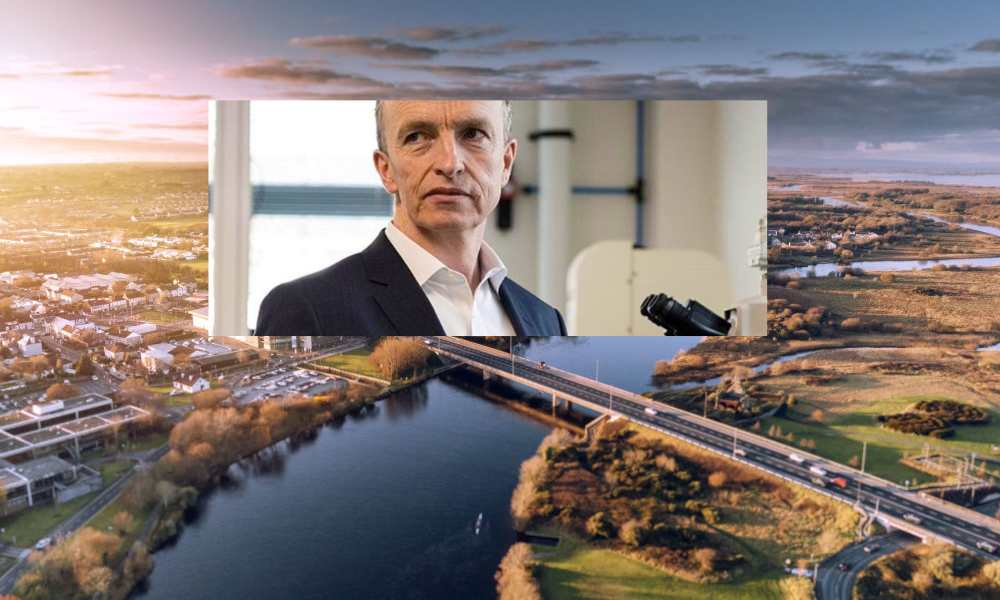
Image at top: Sean O’Driscoll addressing the Engineering Industries Ireland’s convention last week
FAQ
Who is Sean O’Driscoll?
Sean O’Driscoll is a prominent business figure in Ireland’s infrastructure debate. He previously held senior leadership roles at Glen Dimplex and has served in several public and economic roles.
What roles did Sean O’Driscoll hold at Glen Dimplex?
He joined Glen Dimplex as finance director in 1990, became deputy chief executive in 1994 and group chief executive in 1998. He became chairman and chief executive in 2011, stepped down as chief executive in 2016 and left the board in 2018.
What public roles has Sean O’Driscoll held?
His public roles include six years on the National Competitiveness Council, membership of the AIB board and chairmanship of the Economic and Social Research Institute. Since November 2023, he has chaired UCC’s Governing Authority.
What is Sean O’Driscoll’s role in the Accelerating Infrastructure Taskforce?
In 2025, Minister Jack Chambers asked O’Driscoll to join the Accelerating Infrastructure Taskforce. He remains on the taskforce, which is overseeing delivery of its action plan.
What does the Accelerating Infrastructure Taskforce action plan include?
The action plan was launched in December 2025 and contains 30 actions and 138 sub-actions.
👉 No tech background needed to bring your business into the AI age! Secure your Google AI Professional Certificate to complete the certification at no cost. Apply now and get started!
-
Bank of Ireland is welcoming new customers every day – funding investments, working capital and expansions across multiple sectors. To learn more, click here
-
For support in challenging times, click here
-
Listen to the ThinkBusiness Podcast for business insights and inspiration. All episodes are here. You can also listen to the Podcast on:
-
Spotify
-
SoundCloud
-
Apple