
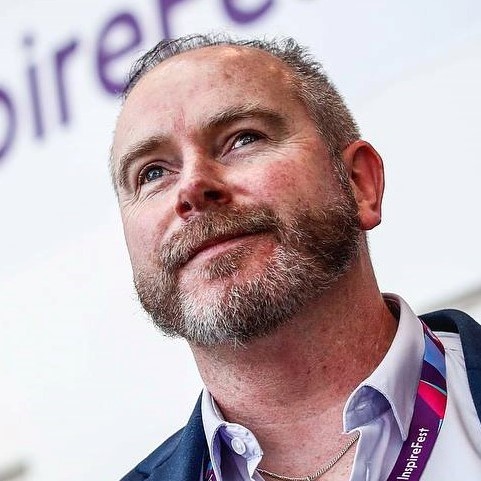
Podcast Ep 370: PwC Ireland’s Laoise Mullane explains why leading AI adopters are growing staff, redesigning workflows and preparing workers for an AI-driven future.
The organisations recording the largest productivity gains from artificial intelligence are using that growth to expand their workforces, according to Laoise Mullane, director of workforce consulting and AI adoption lead at PwC Ireland.
Speaking on the latest ThinkBusiness Podcast, Mullane said PwC’s AI Jobs Barometer measures those gains in revenue per employee, and that the leading companies are reinvesting the growth in their businesses. Mullane said. “It’s positive. It’s not maybe what people were expecting.”
“This is very much transforming our labour market, and we’re seeing Irish businesses embedding AI into their everyday operations”
Her explanation rests on how individual jobs are made up. “Most jobs are made up of many tasks,” she said. “AI is far better at automating or augmenting specific tasks rather than replacing entire roles. The organisations that are seeing the greatest value aren’t asking how many people can AI replace? They’re asking how do we redesign work so AI and people can create more value together.”
PwC’s research found that AI-related hiring in Ireland almost doubled between 2024 and 2025. Mullane said the growth covered both “AI user roles”, existing jobs that now include AI as part of the work, and more technical AI developer roles. “For me, it tells a story that has moved beyond experimentation to real adoption and scaling of AI,” she said.
“And when we look into those numbers of the Irish hiring, what we see is growth in both what we’re calling AI user roles, so they are roles that have previously existed but are now AI enabled and include AI working as part of the role, and also AI developer roles, which are the more technical roles that we might anticipate coming through. And so the growth in AI related hiring, it’s not just about niche technical skills. This is very much transforming our labour market, and we’re seeing Irish businesses embedding AI into their everyday operations.
INSIGHTS: AI and the workforce
- AI-related hiring in Ireland almost doubled between 2024 and 2025
- Top 5% of firms identified as AI-enablement “superstars”
- Three hours per week per user potentially saved by off-the-shelf AI tools
- Leading AI adopters reinvesting productivity gains into workforce growth
- AI better at augmenting individual tasks than replacing entire roles
- Top performers redesign workflows before applying AI
- Executive oversight, governance and security central to leading AI adopters
- Judgment, creativity and leadership becoming increasingly important workplace skills
Editorial takeaway: PwC Ireland’s Laoise Mullane points to AI adoption driving hiring and productivity, while putting greater emphasis on workflow redesign and human judgment.
What the top 5% do differently
-
Listen to the ThinkBusiness Podcast for business insights and inspiration. All episodes are here. You can also listen to the Podcast on:
-
Spotify
-
SoundCloud
-
Apple
PwC identifies a group of companies it calls “superstars”, which Mullane described as “the top 5% when it comes to AI enablement”. She said these firms begin by redesigning workflows instead of automating existing ones. “If you have a bad process, if you add AI, you might have a faster bad process,” she said.
They are more likely to have C-suite or executive oversight of AI governance, she said, and their investment is weighted towards process and workforce spending. They concentrate on high-impact use cases that can scale, put data, governance and security foundations in place from the outset, and measure results as they go.
Mullane put the time saved by widely available off-the-shelf tools at about three hours per week per user, a figure she described as conservative. She said organisations need to decide in advance where that time goes.
👉 No tech background needed to bring your business into the AI age! Secure your Google AI Professional Certificate to complete the certification at no cost. Apply now and get started!
“If you don’t explicitly say where the free time or where the freed up capacity is going to go, it essentially disappears,” she said. “By that, I don’t mean people are clocking off early. I mean that we tend to see people are becoming busier, but they’re not necessarily becoming busier with the higher impact work.”
For smaller businesses, she said AI could make work that was previously uneconomic, such as graphic design or a stronger social media presence, affordable. She also warned of “a massive gap increasing” between what PwC describes as frontier firms and SMEs.
“So I really think it is important for SMEs to start. That is probably the most important thing. Understand what it means, and see it as an opportunity to level the playing field and not let themselves get left behind.”
Shadow AI and trust
Mullane said research continues to show high levels of what PwC calls shadow AI, where employees use their own AI tools for work. “This, to me, indicates a leadership and a culture problem,” she said. “The real enemy here is mistrust and secrecy.”
She said staff should be encouraged to talk openly about how they use AI so that their use can be supported or challenged. Her message to Irish leaders was direct: “If AI is on your technology agenda, but not your workforce and operating model agenda, then you’re really only addressing part of the challenge.”
“The evidence is showing that AI is not simply a technology story; it’s a workforce transformation story. And so, the organisations creating the most value are redesigning work, they’re reshaping skills, and they’re rethinking how their business operates, rather than just deploying new tools. So, it’s really about taking that workforce approach as opposed to pure technology.”
Where judgment comes from
Mullane linked rising demand for skills such as judgment, creativity and leadership to the quality of AI output. “AI can increasingly generate answers that look like expert work, and so the important and therefore in-demand skill is going to be the judgment to know whether the answer is good, whether it’s incomplete or whether it is wrong,” she said.
“And that’s why we’re seeing the demand for capabilities such as judgment, leadership, creativity, influencing, problem solving, even as AI is becoming better and better at producing cognitive output. So, I think it’s interesting to observe, and you’ve touched upon this, that in order to develop judgment, that takes time and experience, and it’s getting it wrong and figuring out how to get it right.”
That judgment has typically been built through the kind of routine work now being automated. “As AI takes on more of the routine and what I would describe as potentially lower risk aspects of work, some of those traditional opportunities for developing judgment through experience may become less common or reduced,” she said.
“So the challenge will be for organisations to figure out new ways for people to develop judgment, and not assuming that AI will replace it.”
She described a risk of skills atrophy among early-career professionals who use AI to bypass foundational tasks. “They might become very efficient, but they might not build the underlying capability that is needed to challenge that output,” she said.
Her model for addressing this is the airline pilot. Technology already plays a large part in flying the plane, she said, and pilots still train in simulations and upskill constantly so they can step in if it fails. “I think we’re going to have to think about workplace skills in a similar vein and make sure that we’re setting up that deliberate practice opportunity.”
Top image: Laoise Mullane, director of Workforce Consulting and AI adoption lead at PwC Ireland
FAQ
What are the companies gaining most from AI doing differently?
According to Laoise Mullane of PwC Ireland, the strongest AI adopters redesign workflows rather than simply automating existing processes. They also focus on scalable, high-impact use cases and put data, governance and security foundations in place from the outset.
Is AI adoption leading companies to reduce their workforces?
Mullane said the organisations recording the largest productivity gains from AI are using that growth to expand their workforces. She explained that AI is better at automating or augmenting specific tasks than replacing entire roles.
How is demand for AI skills changing in Ireland?
AI-related hiring in Ireland almost doubled between 2024 and 2025, according to the article. This includes existing roles where AI is becoming part of the work, described as “AI user roles”, as well as more technical AI developer roles.
How much time can AI tools save workers?
Mullane put the time saved by widely available off-the-shelf AI tools at about three hours per week per user, a figure she described as conservative. She said organisations need to decide explicitly how that freed-up capacity will be used.
What skills could become more important as AI adoption increases?
Mullane identified judgment, creativity and leadership as increasingly important skills. She warned that automating routine work could reduce opportunities for employees to develop judgment through experience, particularly among early-career professionals.
👉 No tech background needed to bring your business into the AI age! Secure your Google AI Professional Certificate to complete the certification at no cost. Apply now and get started!
-
Bank of Ireland is welcoming new customers every day – funding investments, working capital and expansions across multiple sectors. To learn more, click here
-
For support in challenging times, click here
-
Listen to the ThinkBusiness Podcast for business insights and inspiration. All episodes are here. You can also listen to the Podcast on:
-
Spotify
-
SoundCloud
-
Apple