
To drive innovation, energy and homegrown growth, PwC has called on the Irish Government to use Budget 2027 as a platform for long-term strategy. Measures include tax reforms, housing delivery and clean energy investment.
Ireland’s Government should use Budget 2027 to strengthen Ireland’s productive capacity and sustain competitiveness, PwC has said in its Budget submission.
The professional services giant says Ireland is entering the Budget cycle from a position of strength, underpinned by a solid fiscal base, high employment levels and economic performance that continues to outpace many peer economies.
“Budget 2027 represents a critical opportunity to move beyond incremental change and adopt a strategic, delivery-focused approach to policymaking”
However, it said a range of capacity constraints now pose real risks to future growth.
Paraic Burke, head of Tax at PwC Ireland, said that pressures in housing, infrastructure and energy are already shaping economic outcomes.
“Housing shortages, infrastructure bottlenecks, grid congestion, energy supply challenges, persistent skills gaps and cost pressures are immediate risks shaping Ireland’s economic outcomes. In response, we are calling for targeted, practical measures in Budget 2027 across innovation, renewable energy, modern construction and private enterprise to sustain growth, ensuring a competitive economy where prosperity is shared across regions.
“Budget 2027 will be introduced during Ireland’s 2026 Presidency of the Council of the EU. Competitiveness is a core theme of Ireland’s Presidency, with simplification forming a key part of that agenda, and Budget 2027 will be an important opportunity to advance these priorities.”
Innovation and R&D
At the centre of PwC’s recommendations for Budget 2027 is a renewed focus on innovation as the key driver of productivity and living standards.
While Ireland remains a global leader in attracting high-value research and development (R&D), PwC notes a widening gap between multi-national firms and the broader domestic economy.
The current R&D tax credit is increasingly misaligned with modern R&D delivery models, where outsourcing is often required to access niche expertise.
To address this, the firm proposes targeted reforms to address specific limitations, in order to enhance Ireland’s competitiveness, modernise Ireland’s R&D tax framework and strengthen Ireland’s attractiveness as a global innovation hub.
These include allowing connected-party outsourcing to qualify for R&D tax credits, increasing the third-party outsourcing cap from 15% to 30%, and expanding outsourcing eligibility for industry collaboration with universities and higher education institutes.
In addition, PwC identifies a “missing middle” in current policy – innovation activities that fall outside traditional R&D definitions but are critical to productivity.
To bridge this gap, PwC recommends the introduction of a separate innovation incentive for broader innovation activities. This would support investment in areas such as digitalisation and decarbonisation, enabling firms to adopt new technologies, improve processes, drive productivity and scale their operations more effectively.
Energy transition
PwC emphasises that access to clean, secure and affordable energy is now a fundamental determinant of economic competitiveness. PwC notes that it is essential for Ireland to adopt a longer-term perspective.
With Ireland competing internationally for capital to fund the energy transition, Budget 2027 presents an opportunity to introduce targeted fiscal supports to accelerate delivery.
PwC highlights the strategic importance of green ports and energy parks, which can enable offshore wind development, strengthen logistics infrastructure and co-locate large energy users with renewable generation.
Among the key proposals are accelerated capital allowances for green infrastructure, incentives to support regional energy development, and measures to stimulate investment in domestic supply chains.
Similarly, to drive energy efficiency, PwC advocates for further reform of the accelerated capital allowances scheme for energy efficient equipment, including expanding eligible technologies, introducing performance-based criteria, and extending supports to leased or rented equipment to deliver greater carbon emission reduction and incentivise broader uptake.
The firm also calls for urgent action to unlock Ireland’s underdeveloped district heating sector, which currently accounts for less than 1% of national heating demand. Recommended measures include a reduced VAT rate of 9% for renewable district heating, lower electricity taxation for industrial heat generation, and targeted grant support for network infrastructure.
Modernising construction
PwC identifies housing supply as one of Ireland’s most critical economic and social challenges, with direct implications for talent attraction and national competitiveness.
To accelerate delivery, the firm urges targeted tax supports for investment in Modern Methods of Construction (MMC) to significantly reduce build times and costs, helping to address labour constraints and increase housing output. PwC also recommends reintroducing a temporary development levy waiver to lower upfront costs and unlock stalled projects.
In addition, PwC calls for measures to support retrofitting and regeneration, including a tax credit linked to Building Energy Rating (BER) improvements and time-limited tax exemptions for the sale of refurbished derelict properties. These steps would both increase housing supply and advance Ireland’s climate objectives.
The scaling imperative
PwC underscores the importance of building a stronger domestic enterprise base to complement Ireland’s success in attracting foreign direct investment. PwC’s recent report ‘Overcoming Barriers to Scaling Irish Enterprises’ called for a strategic national approach to nurturing and retaining Irish-owned multinationals and put forward a 10-point multi-year roadmap to overcome structural barriers.
A central recommendation for Budget 2027 is a phased reduction in Capital Gains Tax (CGT) to 20%, aimed at encouraging investment activity, supporting reinvestment in Irish businesses and helping to retain business ownership in Ireland.
To encourage long-term scaling, PwC proposes a new “scale-up” relief for entrepreneurs, alongside increasing the lifetime limit for Revised Entrepreneur Relief from €1.5 million to €5 million. These changes would incentivise founders to grow businesses domestically rather than pursuing early exits.
The firm also highlights the need for greater clarity and predictability in tax treatment for ownership transitions and succession planning, recommending enhanced legislative guidance to ensure that genuine commercial transactions are treated as capital gains rather than income events.
Further, PwC advocates for the introduction of Employee Ownership Trusts (EOTs), modelled on the UK system, to enable business owners to transfer ownership to employees. This would support job retention, local economic resilience and long-term business stability.
PwC also recommends introducing a reduced corporation tax rate of 6.25%, for start-up and early-stage companies not within the scope of the global minimum tax rules, linked to new or incremental investment and expenditure, to provide a strong incentive to these companies to expand operations in Ireland.
The consulting giant welcomed Peter Burke, TD, Minister for Enterprise, Tourism and Employment’s recent cross-government initiative to eliminate red tape and streamline administrative processes for businesses.
A recurring theme across PwC’s proposals is the urgent need for simplification, particularly for small and medium-sized enterprises (SMEs). Complex administrative processes and reporting requirements are acting as a barrier to growth and reducing take-up of existing supports.
PwC recommends the introduction of short-form, pre-populated corporation tax returns, alongside a broader “root and branch” review of the tax system to ensure it is more accessible and proportionate for smaller businesses.
The firm advocates for a shift from real-time to annual reporting requirements for certain employer obligations, reducing administrative burdens while maintaining transparency. In addition, PwC recommends updating the employee small benefit exemption by retaining the annual limit of €1,500 but reducing the numerical cap of five, in order to afford employers greater flexibility in how they recognise employees.
“Budget 2027 represents a critical opportunity to move beyond incremental change and adopt a strategic, delivery-focused approach to policymaking.
“By prioritising innovation, clean energy, housing delivery and indigenous enterprise, Ireland can expand its economic capacity, strengthen resilience and position itself for the next phase of growth.
“As global competition intensifies and economic conditions evolve, we emphasise that certainty, simplicity and targeted investment will be key to sustaining Ireland’s competitive edge.
“As Ireland’s EU Presidency aims to deliver tangible benefits for people, companies and communities across the EU, a strong focus on competitiveness supported by simplification will help shape this work. Budget 2027 offers an opportunity to help turn those ambitions into concrete measures.”
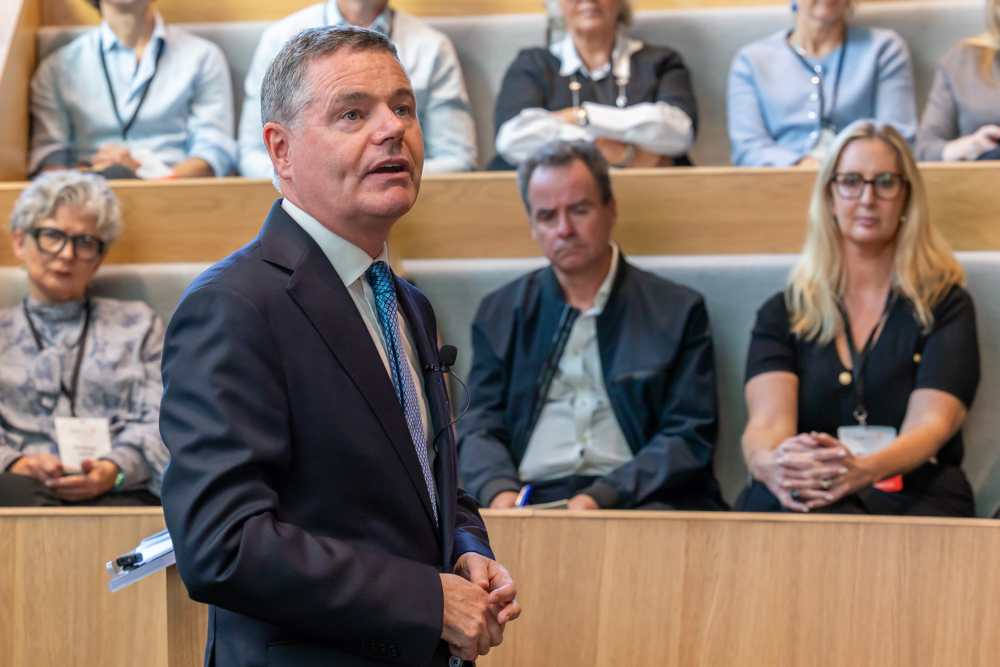
Top image: Paraic Burke, head of Tax at PwC Ireland
-
Bank of Ireland is welcoming new customers every day – funding investments, working capital and expansions across multiple sectors. To learn more, click here
-
For support in challenging times, click here
-
Listen to the ThinkBusiness Podcast for business insights and inspiration. All episodes are here. You can also listen to the Podcast on:
-
Spotify
-
SoundCloud
-
Apple