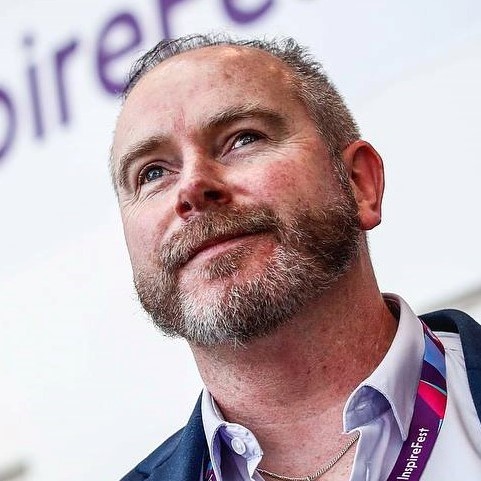
Owen Power, CEO of Greenvolt Next Ireland, shares his life and business lessons.
Greenvolt Next is one of Ireland’s leading renewable energy solutions provider for enterprise, completing some of Ireland’s largest solar farm projects, including Dublin Airport, Lidl, Aldi, Tesco and Sanofi on their renewable energy requirements.
The company was founded originally as Enerpower in 2005 by Owen and his brother Cormac Power before joining the Greenvolt Next Group in 2024.
“This year we are 20 years in business, and I’m proud that we have continued to grow the business steadily each year, to be where we are today”
Owen, as CEO of Greenvolt Next Ireland brings over 25 years’ experience within the renewable energy industry and is passionate about supporting businesses transition to clean energy, ensuring a sustainable future for generations to come.
Tell us about your background, what journey did you take to arrive at where you are today?
When I finished school, I decided I wanted to study engineering. I completed my degree at the National University of Ireland, Galway (NUIG), before working across a number of industries, including air conditioning, pharmaceuticals, aviation and electronics.
While I started out my career as an engineer, I gradually moved into managerial roles, including Quality Manager, Operations Manager and General Manager. These positions gave me an in-depth insight into business and the acumen required to succeed.
In 2007, I decided to leave my role as general manager of a pharmaceutical company and set up my own business, formerly known as Enerpower, alongside my brother. Today, that business is known as Greenvolt Next Ireland, part of the Greenvolt Group, a leading specialist in renewable energy solutions for the commercial and industrial sector. This year we are 20 years in business, and I’m proud that we have continued to grow the business steadily each year, to be where we are today.
Why are you doing what you are doing and what need are you meeting? What is your USP?
What really interests me is working in a sector that has a positive environmental impact. Generating energy in an efficient, carbon-free way is something that genuinely excites me and it’s important that we leverage advancing technology to support a sustainable way of living and doing business.
At Greenvolt Next, we are essentially converting natural resources such as wind and solar into electricity. The energy itself is free – the challenge is converting it efficiently.
“If you can navigate and grow a fledging business during a difficult economic period, it builds resilience, commitment and a passion for success”
Our USP is that we provide an end-to-end solution, where we manage the entire process for our clients. Our service offering includes support and delivery of all requirements, from planning permission and installation to grid connection and commissioning, we support the project and our clients throughout every stage of its lifecycle. This ensures our clients are not burdened with the administrative requirements, while remaining confident Greenvolt Next will deliver the project seamlessly from start to finish.
How did you fund and start the business and what are your growth plans?
When we launched the business in 2006, we initially funded the business through personal savings. I left my full-time job to start the company and, in hindsight, it was not the easiest time to launch a business – starting shortly before the financial crash in 2008.
The reality was that we had only been operating for a year when the recession hit, which had a significant impact on our pipeline, our customers and the country as a whole. However, I take the positives from that time, as the challenges it presented were valuable learning experiences. If you can navigate and grow a fledging business during a difficult economic period, it builds resilience, commitment and a passion for success.
In addition to personal savings, we also received some support from the Local Enterprise Office at the beginning of our business journey. Later, our local bank, helped finance our early energy-as-a-service model.
One of our earliest business successes was when we signed our first power purchase agreement with Tesco. We installed biomass boilers and supplied energy to their stores, with Tesco paying for the energy produced. It was quite a forward-thinking model at the time and one that would continue to establish the business as an innovator within the renewable energy sector.
What key skills or qualities have helped set you apart?
My engineering background gives me a strong understanding of the technical side of what we do. At the same time, I recognise that a business must be financially sustainable. Profit is a critical part of any business, without it you cannot survive.
Another important aspect is growth. Businesses rarely stand still. You are either growing or shrinking. My approach combines technical knowledge with a practical understanding of how a business needs to operate, which enables me to lead this business on its continuing growth trajectory.
Who has helped you most along the way? Who has been a mentor or inspiration?
On a personal level, my greatest inspiration has been my mother. Her work ethic, resilience, and positive approach to life have always been a huge influence on me. She has shown me the importance of perseverance, staying grounded, and always giving your best, even in challenging circumstances. The values she has instilled in me have shaped who I am both personally and professionally.
In business, Micheal O’Leary is someone who inspires me. His approach to business has revolutionised not just the Irish aviation industry, but the global industry – he made flying accessible for everyone. O’Leary is a truly sharp businessman who continues to deliver for his customers every day.
What is the best piece of business advice you have received?
One piece of advice I remember came from a quote I saw in the offices of Flahavan’s, the porridge company based here in Waterford. It said: “Always leave something for the other fella.”
“In terms of qualities that lead to success, consistency is important. You have to show up every day and keep making progress”
The meaning behind that quote is simple but important, and its one that has always stayed with me throughout my business journey. In any business transaction both sides need to benefit. If only one side wins, the relationship will not last. I believe it’s important to work with people to achieve greater successes for both sides, both in terms of business, relationships and satisfaction in the work itself.
What factors make the difference between success and failure in business?
Some circumstances are beyond your control. Covid-19 demonstrated that – many good businesses failed simply because the economy shut down and consumers stopped visiting restaurants, bars and local stores.
In terms of qualities that lead to success, consistency is important. You have to show up every day and keep making progress. Every day something can be achieved, developed or enhanced.
Another key factor to success is understanding people, both your own team, your clients and what’s important to them. For us, building a team where individuals fit the culture and strengths of the business is incredibly important.
What was the most challenging aspect of starting or growing the business?
Starting during the recession was certainly difficult. However, the challenges it presented, forced us to focus on the fundamentals. During difficult periods you quickly learn that the core business matters most – the extras or “frills” become irrelevant.
“AI is beginning to influence certain areas of the business and will likely become more significant in the years ahead”
The other challenge is the long-term commitment required. Running and growing a business never really stops, and again, that consistency, showing up every single day is required when you’re a business leader.
How did you navigate the pandemic and what lessons did you learn?
We were fortunate that our business was considered mission-critical, so we were able to continue operating on our sites during the pandemic.
It was still an uncertain time. Investment slowed and people were nervous about the future. However, the projects we had already secured continued and we actually experienced growth during that period.
One major lesson from that time, was just how effective remote working tools can be. Platforms such as Microsoft Teams and Zoom allowed us to operate efficiently and significantly reduced travel.
How has digital transformation influenced your business?
Digital tools are now embedded in almost every aspect of the business.
We use software for design, project management, health and safety compliance and financial management. While we are fundamentally an engineering business dealing with physical infrastructure, digital systems play an essential role in how we operate.
AI is also beginning to influence certain areas of the business and will likely become more significant in the years ahead.
If you were starting again, what would you do differently?
I would probably spend more time developing a clearer customer plan from the outset.
However, there is a well-known quote from Mike Tyson: everyone has a plan until they get punched in the face. The recession was that punch for many businesses.
“Solar has become far more efficient and accessible in recent years, while advances in battery storage are making it easier to capture and use renewable energy when it is needed most”
In reality, circumstances can change quickly, so building contingency into your planning is important.
Who inspires you in business today?
Michael O’Leary, as I mentioned, is one example because of the scale of the impact he had on air travel.
Another is Eddie O’Connor, who played a significant role in developing the renewable energy sector. He was a true visionary and advanced Ireland’s wind-power technology and capabilities immeasurably.
Closer to home, the people I work with every day are also a source of inspiration. I’m fortunate to work with a strong team who bring passion and commitment to their work every day.
How do you nurture talent within your organisation?
The key to nurturing talent is giving people responsibility and encouraging them to take ownership of their work.
At the same time, accountability is important. People need to understand their role and the expectations that come with it.
Employees also need to feel a sense of pride in the organisation and the work they are doing, which through our work at Greenvolt Next, we’re advancing the renewable energy space. Our teams advocate for a cleaner environment and greener energy usage. Every day we’re delivering on that for our customers.
What business books would you recommend?
Some of the books that come to mind include:
- Good to Great by Jim Collins
- Jack, Straight from the Gut by Jack Welch
- The Leader Who Had No Title by Robin Sharma
- Who Moved my Cheese by Dr. Spencer Johnson
I have read many business books over the years. They can provide useful tools and ideas, but ultimately success depends on commitment and execution.
What technologies or tools help you stay organised?
Communication platforms such as Microsoft Teams are essential. They allow us to collaborate effectively and significantly reduce travel.
Meetings that previously required several hours of travel can now be done quickly and efficiently online. The savings that remote meetings provide in terms of time, enables me to focus my energy on other key areas of the business and projects at hand.
Which social media platforms do you use most?
LinkedIn is the main platform for business purposes, it’s a fantastic way to connect with peers, industry specialists and keep abreast of the latest insights.
Where do you think technology is heading?
Solar has become far more efficient and accessible in recent years, while advances in battery storage are making it easier to capture and use renewable energy when it is needed most. Over time, this has the potential to reduce reliance on traditional energy sources, improve energy security, and make sustainable power a more practical option for both businesses.
Automation and AI will continue to grow in importance. However, I don’t think the rate of AI adoption will be a quick as initially considered. We can see that technological progress can sometimes move both faster and slower than expected. For example, autonomous vehicles were predicted to be widespread by now but are still limited to certain areas.
Despite technological advances, personal relationships and trust will remain fundamental to doing business.
What advice would you give your 21-year-old self?
Perhaps I would have focused earlier on progressing through university and starting my career. I didn’t begin my professional career until I was around 28, which was quite late at that time, although I did enjoy my time in college. That said, I learnt a lot during those years and I’m very happy with how things turned out – I wouldn’t change too much about the journey.
-
Bank of Ireland is welcoming new customers every day – funding investments, working capital and expansions across multiple sectors. To learn more, click here
-
For support in challenging times, click here
-
Listen to the ThinkBusiness Podcast for business insights and inspiration. All episodes are here. You can also listen to the Podcast on:
-
Spotify
-
SoundCloud
-
Apple