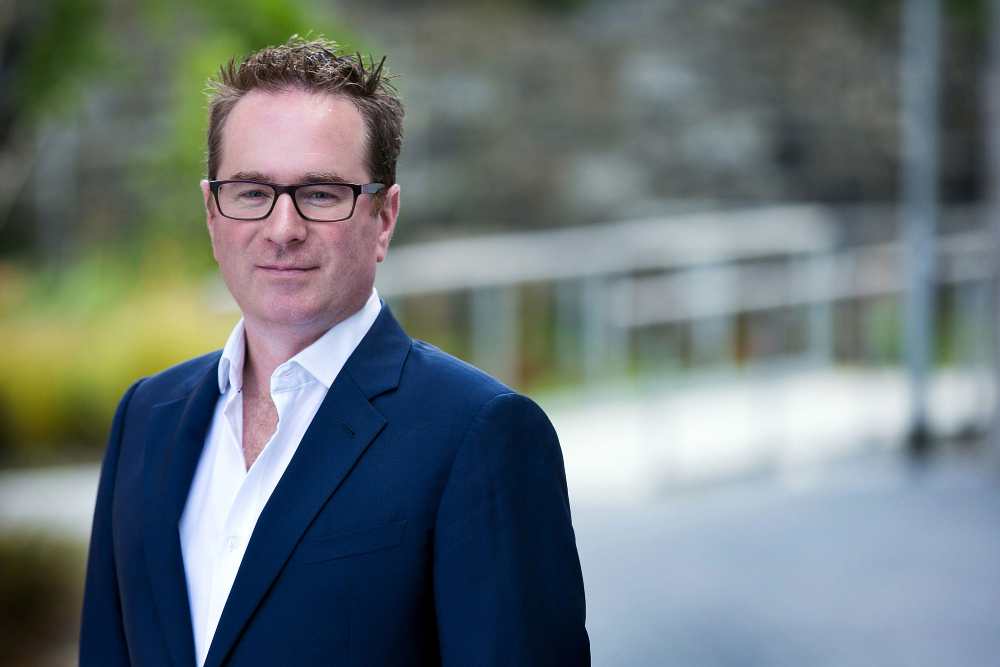
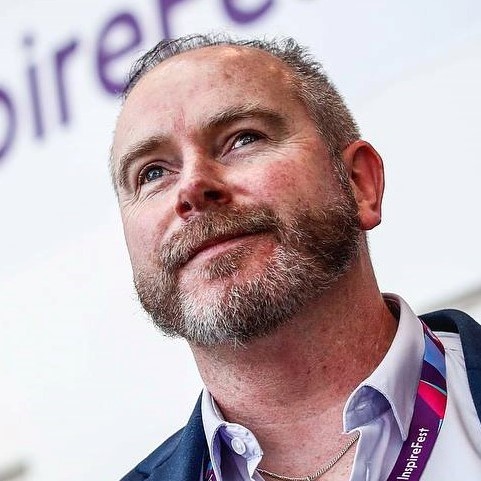
Podcast Ep 330: Powered by advances in AI and collaboration between traditional financial firms and next generation fintech players Ireland’s insurtech moment has come, says InsTech CEO Gary Leyden.
When Ireland puts its mind to doing something – really doing something – man-made miracles can be achieved. All that is required is imagination, political will and action. One of those was the creation of the International Financial Services Centre (IFSC) in the 1990s, paving the way for a multi-billion financial services industry and a growing fintech cluster.
This realisation was often foremost in Gary Leyden’s mind as he walked to work in a previous role at the NDRC when it was in the Digital Hub in Dublin 8, where he worked with promising start-ups to make them scalable and investable.
“If you don’t hang out with the tech kids, how do you go find them? That’s our role”
As the gleaming towers of the IFSC district disappeared and the brickwork of Dublin 8 moved into view he often wondered why those two worlds were never joined at the hip from a policy perspective.
“I would walk past the IFSC on my way up to the Digital Hub and just wonder why those two worlds were never connected,” says Leyden, chief executive of InsTech, Ireland’s insurtech hub. “You have a very successful large financial services industry, and you also have a very successful emerging tech ecosystem, and the opportunity is to bring those two worlds together.”
That observation, nursed over years of working with early-stage companies at the NDRC, Ireland’s national digital research centre, eventually led Leyden to the job he now holds: building what he describes as “probably the first true innovation cluster” in the global insurance industry.
Building Ireland’s insurtech hub
-
Listen to the ThinkBusiness Podcast for business insights and inspiration. All episodes are here. You can also listen to the Podcast on:
-
Spotify
-
SoundCloud
-
Apple
InsTech describes itself as Ireland’s insurtech hub, but Leyden is careful about how he positions it. The organisation is not simply an accelerator, not a lobbying body, and emphatically not a trade association for incumbents. It sits, deliberately, in the middle.
“We’re a neutral convener,” he says. “We sit in the middle and create bridges from the tech world into the insurance world.”
The structure reflects a calculated view of what the Irish insurance industry actually needs. Ireland is, by any measure, a serious insurance market.
The sector is the largest provider of cross-border insurance services in the EU and held €465bn worth of assets in early 2025. Yet for most of its history it operated in silos, with insurers that were reluctant to share intelligence with competitors, and largely disconnected from the technology talent building companies in their own backyard.
InsTech tracks more than 120 Irish insurtechs and maintains a living directory of those companies. It also runs a dedicated accelerator, the Foundry, which recently graduated its first ten companies. Every participant in the Foundry was paired with a mentor from an established insurer, a deliberate choice to help founders understand how to build a value proposition for organisations that think very differently from early-stage startups.
“If you don’t hang out with the tech kids, how do you go find them?” Leyden says. “That’s our role.”
The model is funded through membership fees paid by insurance companies, which now number 23 firms. Insurtechs, by contrast, pay nothing to participate. Enterprise Ireland and IDA Ireland came on board roughly 18 months ago through Smart Regions funding, effectively matching industry contributions, which allowed InsTech to invest in its accelerator and in a digital sandbox that lets insurers experiment with emerging technologies outside their core systems.
“We could invest in setting up the accelerator at the Foundry, we could invest in building the sandbox out,” Leyden says. “It’s now innovation infrastructure for the industry.”
The cultural problem
Leyden is candid about where the real obstacles lie. Regulation, which might seem the obvious friction point, has been more accommodating than expected.
The Central Bank reached out proactively when InsTech launched, and Leyden now sits on an innovation group within the Financial Services Forum, the regulator’s industry engagement body. A regulatory sandbox within the bank gives companies space to test new approaches without immediately running into the full weight of compliance requirements.
The harder problem is culture. Ireland’s insurance companies, like their counterparts across Europe, built their businesses on stability, process discipline, and a studied caution toward anything untested. Innovation, when it happened, tended to flow from the inside out: a new product developed internally, a process tweak approved through layers of governance.
“It’s a very traditional business,” Leyden says. “It’s been doing it the same way for almost 100 years. It’s very process-driven, and a lot of the innovation tends to come from inside out rather than outside in.”
The attitude toward insurtechs has shifted considerably from a decade ago, when new technology companies were often seen as competitive threats rather than potential partners. Most incumbents now accept, intellectually, that they need to engage with outside partners. The gap, Leyden argues, is between acceptance and execution.
“The culture has definitely changed, and there’s an openness to reach out beyond their own individual insurance companies and start to build those networks. The challenge is they don’t know how to go about that.”
The digital sandbox addresses part of this. By giving insurers a safe space to run experiments at an early stage, InsTech hopes to shorten the notoriously long sales cycles that have historically discouraged insurtechs from targeting the sector at all. Selling into a regulated financial institution is a significant undertaking, requiring security reviews, compliance assessments, and the kind of patience that early-stage companies with limited runway can rarely afford.
“The bar is really high,” Leyden acknowledges. “It’s a big enterprise sale. It takes a long time. Anything that can take that friction out.”
The talent question
Assembling the right talent sits alongside culture as a defining challenge. The insurance industry requires actuarial expertise and a deep understanding of risk management that most technology companies neither possess nor particularly want. The technology sector brings skills in artificial intelligence, machine learning, and data science that most insurers have struggled to recruit directly.
Leyden sees these as complementary shortages rather than competing ones. The actuarial profession is itself moving toward data science, he notes, and the skills the tech ecosystem has built up are precisely what insurance companies need as they modernise their operations.
“Within the insurance world, the actuarial talent that’s required is significant, and that’s starting to move very much into the data science world as well,” he says. “Then the specific technical skills, particularly around AI, machine learning, data science, are skills that need to be brought into the insurance world. That’s true synergy. That’s where we get real advantage.”
Ireland’s size, which is often cited as a constraint on ambition, functions here as an advantage. Leyden believes the density of relationships in a small market makes the kind of ecosystem-building InsTech is attempting far more achievable than it would be in London or Frankfurt.
“We’re small enough to connect all these stakeholders, but we punch way above our weight internationally when it comes to impact,” Leyden says. “That’s our secret sauce and our competitive advantage.”
Agentic AI and the next disruption
The most immediate challenge is keeping pace with artificial intelligence. Leyden is blunt about what is at stake. Agentic AI, where software systems act autonomously on a user’s behalf, has the potential to fundamentally reshape how consumers buy insurance, make claims, and manage their cover.
The implications are not abstract. At InsTech’s transformation summit in June, one of the speakers is a company called Malcolm, which has already embedded insurance into ChatGPT. Users can buy car insurance, holiday cover, or property insurance directly through a conversation with the AI. Policies are being written and bound today.
“That’s something that would have been looked at very cynically maybe six months ago,” Leyden says. “But it’s already in production and out there.”
For insurers trained on decade-long product cycles and deliberate, committee-driven decision-making, the pace is disorientating. Leyden is sympathetic to the difficulty, but clear about what it demands.
“The pace of change is unlike anything I’ve ever seen in a relatively short period of time. We’ve gone from ‘wow, this is really interesting’ to ‘we’re implementing this and executing it.’ You can’t sit back and wait for this to happen. You need to start learning on the go and experiment. That’s a skill that is alien to a lot of insurance companies.”
Ireland’s international pitch
Against this backdrop, Leyden sees a significant opportunity to attract overseas insurtechs to Ireland, particularly from North America, using a pitch that draws on many of the same arguments that made Ireland attractive to technology multinationals a generation ago: English language, EU membership, regulatory credibility, and a dense network of existing relationships.
“There’s a massive opportunity to build a regulated insurance business in an environment where the regulator is respected,” he says. “I think there’s an opportunity to attract scaling insurtechs from North America looking to expand into Europe. We’ve already pitched a very successful story if you’re a tech company looking to establish your EMEA HQ. Now we need to do that for the equivalent insurance and insurtech companies.”
In September, InsTech will take 10 Irish companies to ITC in Las Vegas, one of the largest trade shows in the global insurtech industry, under the banner of “Insurtech Island.” It is a deliberate attempt to shift how Ireland is perceived internationally: not as a collection of individual companies, but as a coherent ecosystem with a unified story to tell.
“It’s not come talk to one stakeholder or another,” Leyden says. “It’s come talk to an ecosystem.”
Leyden is aware that building the foundations takes time, and that the temptation to declare victory too early is ever-present. He started InsTech with what he calls “a coalition of the willing” of 10 insurance firms. There are now 23 members. The Foundry has graduated its first cohort. The sandbox is up and running. The international roadshow is about to begin.
“Sometimes you just have to build the right foundations,” he says. “And then it’ll really take off. But you’ve got to build them in the right order.”
-
Bank of Ireland is welcoming new customers every day – funding investments, working capital and expansions across multiple sectors. To learn more, click here
-
For support in challenging times, click here
-
Listen to the ThinkBusiness Podcast for business insights and inspiration. All episodes are here. You can also listen to the Podcast on:
-
Spotify
-
SoundCloud
-
Apple