
Irish start-up ESG Data Core takes climate risk from COP31 to the boardroom. Having returned from a challenging COP31, co-founder Flávia Melo Vieira Macruz refuses to be discouraged and if anything is more determined.
Dublin-based ESG Data Core is building technology to help businesses identify supply-chain, regulatory and climate risks before they become financial problems.
For co-founder Flávia Melo Vieira Macruz, a first visit to COP31 brought valuable commercial validation and frustration at the failure to secure a clear global agreement on fossil fuels.
“I do not believe that responsibility sits only with governments. Corporations have an important role to play as well”
A flooded factory, a disrupted supply chain or a new regulation can quickly become a financial problem for a business.
Dublin start-up ESG Data Core believes companies need a clearer view of those risks before they undermine contracts, increase costs or interrupt operations.
KEY NUMBERS: ESG Data Core
• €17bn estimated annual cross-industry market opportunity
• €5.1bn potential annual subscription market in initial target sectors
• 213,000 potential technology and pharmaceutical customers
• 100+ discovery conversations with businesses and industry professionals
• 3 co-founders spanning sustainability, regulation, AI and cybersecurity
• 15+ years technology experience for CTO Henrique Sloty Gonçalves
• 8 years sustainability and regulation experience for CEO Flávia Macruz
• 1st COP for ESG Data Core, providing international customer validation
Editorial takeaway: ESG Data Core is targeting a multibillion-euro international opportunity after extensive customer discovery and its first COP experience.
Risk intelligence
The young Irish company is developing a connected risk and sustainability intelligence platform aimed initially at mid-sized technology and pharmaceutical businesses. Its ambition is to bring capabilities often associated with larger enterprises within reach of companies with smaller teams and fewer resources.
“The problem is not simply collecting sustainability data or producing reports. It is understanding where the business is exposed, what the financial consequences could be and what action to take before a risk becomes a loss,” the company said.
Its founders believe that represents a substantial commercial opportunity. ESG Data Core’s preliminary assessment identifies around 213,000 potential technology and pharmaceutical customers across its target international markets, representing an estimated €5.1 billion annual subscription opportunity. Its wider cross-industry market estimate is approximately €17 billion annually.
Building intelligence from sustainability data
“As an entrepreneur building an early-stage company, COP31 was incredibly valuable”
The company is led by CEO and co-founder Flávia Melo Vieira Macruz, a qualified lawyer with around a decade of professional experience, including eight years working in sustainability and regulation with State Street, Deloitte and Fidelity International.
She founded the business with CTO Henrique Sloty Gonçalves, who has more than 15 years’ experience across cloud infrastructure, cybersecurity and software engineering, and CPO Alexandre Spezani de Moraes, who has approximately 12 years’ experience in software engineering, AI and product development.
For Macruz, the idea emerged partly from watching businesses devote significant resources to collecting information, complying with regulation and preparing reports without necessarily getting the intelligence required to make better decisions.
“I began questioning how mid-sized businesses, without the same financial resources or specialist teams, could realistically manage these challenges,” she said.
ESG Data Core’s answer is a platform built around a granular data engine in which information can be collected once and reused for carbon accounting, compliance, reporting, supplier analysis and risk assessment. Changes to individual datapoints can then be reflected automatically across related calculations.
Its Risk, Impact and Opportunity engine is being developed to connect company, supplier and product information with signals including climate hazards, geopolitical developments, human-rights risks, cybersecurity exposure and regulatory changes. A separate regulatory intelligence engine is designed to monitor changing rules and identify which parts of a business may be affected.
“Our objective is not to create another carbon accounting or reporting tool. We are building an intelligence layer where the same underlying data supports risk management, regulatory compliance, decarbonisation and supplier oversight – helping companies stay ahead of both external risks and regulatory change rather than reacting after the fact,” Macruz said.
COP31 brings global validation
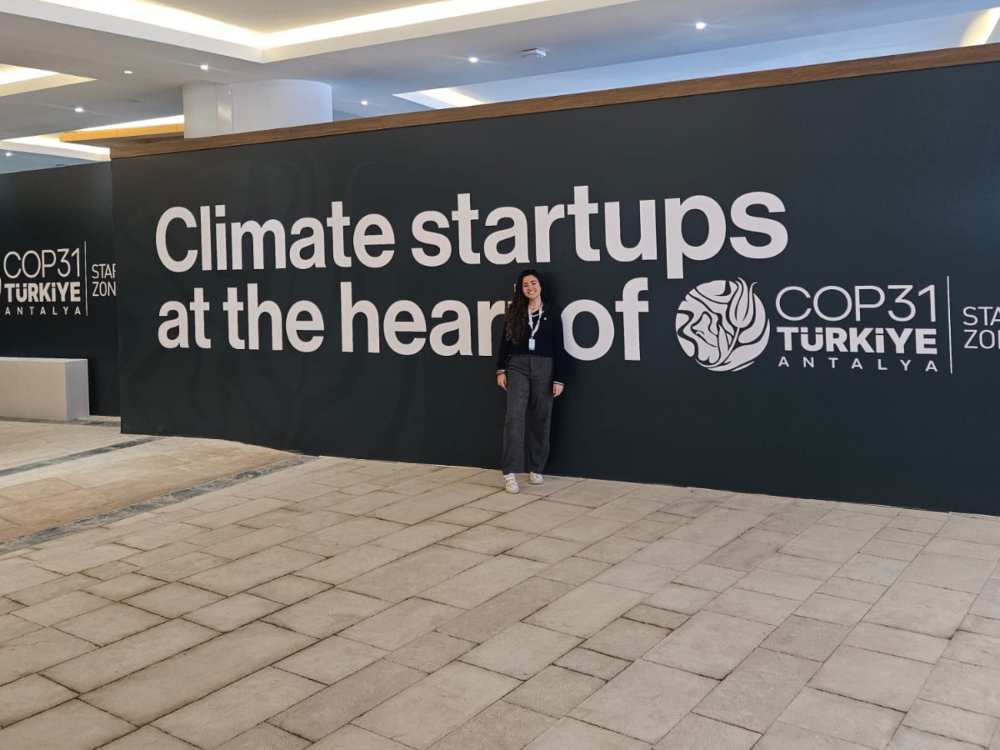
That international ambition recently brought ESG Data Core to COP31 in Antalya, Türkiye, where it was selected as the only Irish start-up to exhibit in the Green Zone start-up area.
For Macruz, attending COP for the first time provided an unusual opportunity for an early-stage business to put its proposition directly in front of organisations from different countries and economic environments.
“As an entrepreneur building an early-stage company, COP31 was incredibly valuable.
“The biggest benefit was the quality of the connections we were able to make with companies, public-sector representatives, investors, partners and people from very different markets.
“It was also an important validation exercise for us. We had the opportunity to speak directly with organisations facing the problems we are trying to solve and test whether our assumptions reflected what they were experiencing in practice.
“Those conversations reinforced both the problem and the direction of our solution. For an early-stage startup, having that level of direct access to potential customers and stakeholders from around the world is extremely valuable.”
Frustration over fossil-fuel agreement
The experience also left the entrepreneur troubled by the inability of world leaders to reach a clear agreement governing the impact of fossil fuels.
“It was frustrating,” Macruz said.
“For people and companies that are not working with climate issues every day, the lack of a clear global agreement can create the impression that this is no longer an urgent or relevant issue.
“At times, the negotiations seemed to reflect individual national interests more than the collective objective that COP is meant to represent.
“At the same time, I think it is important to recognise that many countries have continued to set their own targets and commitments, even when a stronger global consensus has not been possible. That progress still matters.”
She also believes businesses have responsibility for maintaining momentum.
“I also do not believe that responsibility sits only with governments. Corporations have an important role to play as well. Companies influence enormous supply chains, investment decisions and emissions, and they can continue moving forward even when political agreement is difficult.”
Smaller markets sharpen the mission
Some of the most significant conversations for ESG Data Core during COP31 came from smaller and developing countries.
“What particularly stood out to me was how engaged many smaller and developing countries were. In many cases, they are among those most exposed to the impacts of climate change, so the urgency is very real for them,” Macruz said.
“It was also very encouraging for us as a company.
“From the beginning, our mission has been to make sustainability, decarbonisation and risk-management capabilities more accessible to smaller and mid-sized organisations, companies that often have fewer resources but still need to participate in global supply chains and respond to growing climate and regulatory expectations.
“Speaking with representatives from countries and markets with more limited budgets, but very strong interest in these issues, reinforced that mission.”
For the founders, those conversations strengthened the case for building the company with an international rather than purely Irish market in mind.
“It showed us that the need is not limited to large corporations or wealthy markets. If anything, organisations with fewer resources may benefit most from technology that makes these capabilities more accessible.
“That experience strengthened our conviction that we are moving in the right direction and reinforced our ambition to build ESG Data Core for a much broader international market.”
Ireland as a launchpad
Ireland has already played an important role in that journey. ESG Data Core participated in Enterprise Ireland’s New Frontiers Phase 2 programme through IADT from April to September 2026.
It was also selected by Digital Irish for Irish Tech Week in New York, where the start-up presented at Nasdaq.
“What has impressed me most is how internationally connected the Irish ecosystem is,” Macruz said.
The company has carried out more than 100 discovery conversations with businesses, potential customers and industry professionals internationally. Those discussions prompted the founders to move beyond an initial emphasis on sustainability data management and reporting towards regulatory compliance, supply-chain exposure, risk and business continuity.
Funding the next stage
ESG Data Core is now pursuing pre-seed funding, including Enterprise Ireland’s Pre-Seed Start Fund, while preparing for a broader investment round.
Its immediate priorities include accelerating product development, advancing its supplier-risk assessment capabilities and bringing its next generation of compliance and risk-management tools to market.
The company also wants to develop its commercial presence, attract early customers and secure strategic partnerships to support international expansion.
For Macruz, the combination of customer discovery and the company’s experience at COP31 has clarified what ESG Data Core needs to build and who could ultimately benefit from it.
The opportunity she sees is increasingly global: giving businesses with limited resources the tools to understand their exposure, respond to changing regulation and make decisions before emerging risks become expensive problems.
Image at top: ESG Data Core co-founder Flávia Melo Vieira Macruz at COP31
FAQ: ESG Data Core and COP31
What is ESG Data Core?
ESG Data Core is a Dublin start-up developing a risk and sustainability intelligence platform for businesses, initially targeting mid-sized technology and pharmaceutical companies.
What does ESG Data Core’s technology do?
The platform connects business, supplier and product data with climate, geopolitical, human-rights, cybersecurity and regulatory risks to support compliance, decarbonisation and risk management.
What did ESG Data Core gain from COP31?
COP31 gave the company access to potential customers, investors, partners and public-sector representatives, while helping validate the problems its technology aims to solve.
Why was COP31 frustrating for ESG Data Core co-founder Flávia Macruz?
Macruz said the lack of a clear global agreement on fossil fuels was frustrating and could create the impression that climate issues are no longer urgent.
What are ESG Data Core’s plans for growth?
The company is pursuing pre-seed funding, developing its product and supplier-risk capabilities, attracting early customers and building partnerships to support international expansion.
-
Bank of Ireland is welcoming new customers every day – funding investments, working capital and expansions across multiple sectors. To learn more, click here
-
For support in challenging times, click here
-
Listen to the ThinkBusiness Podcast for business insights and inspiration. All episodes are here. You can also listen to the Podcast on:
-
Spotify
-
SoundCloud
-
Apple