
EcoKinly founder Kate Doyle has found a way to help reduce household waste through sustainable childcare products.
When Kate Doyle stood in the supermarket nappy aisle with her first baby, she felt “cornered” by the single-use options dominating the shelves.
That moment of frustration has since evolved into EcoKinly, a Wexford-based start-up challenging the €71bn global disposable nappy market with a simple proposition: reusable nappies that work like disposables.
“The current generation of parents have no lived memory that nappies were historically washed – they have only known the single-use linear model that exists in the supermarket. This leaves them cornered”
The scale of the problem EcoKinly is addressing is staggering. According to the UN Environment Programme, more than 300,000 disposable nappies are incinerated, sent to landfill, or released into the environment every minute globally.
In Ireland alone, more than one million disposable nappies reach landfill daily, accounting for 10% of household residual waste – approximately 75,618 tonnes in 2022, according to EPA data.
Reducing household waste
“The current generation of parents have no lived memory that nappies were historically washed – they have only known the single-use linear model that exists in the supermarket,” Doyle explains. “This leaves them cornered.”
The financial burden is equally significant. Disposable nappies and wipes cost families up to €1,500 per child from birth to potty training. EcoKinly’s reusable alternatives can save up to €1,000 per child while dramatically reducing household waste.
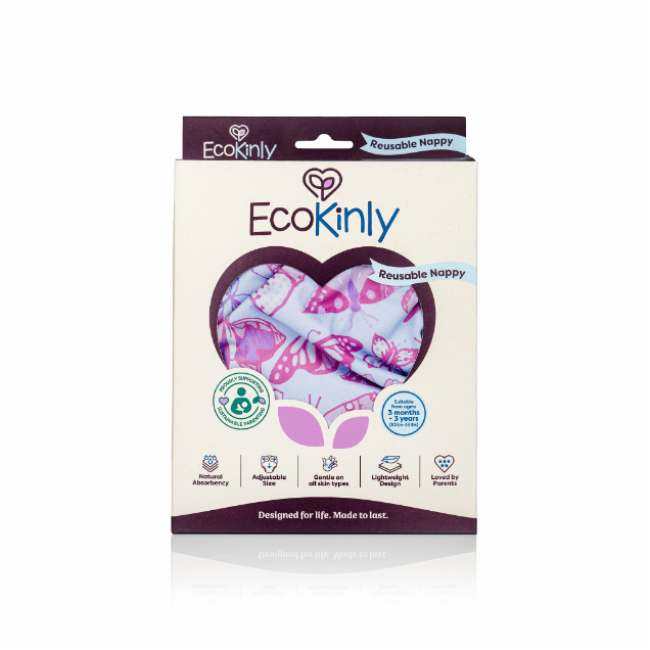
EcoKinly’s core product, the Grab & Go Nappy, is designed to eliminate the complexity traditionally associated with cloth nappies.
“If you can use a disposable nappy, you can use an EcoKinly Grab & Go,” says Doyle. “There’s no folding or complicated systems – it’s one piece, one step, closes with velcro.”
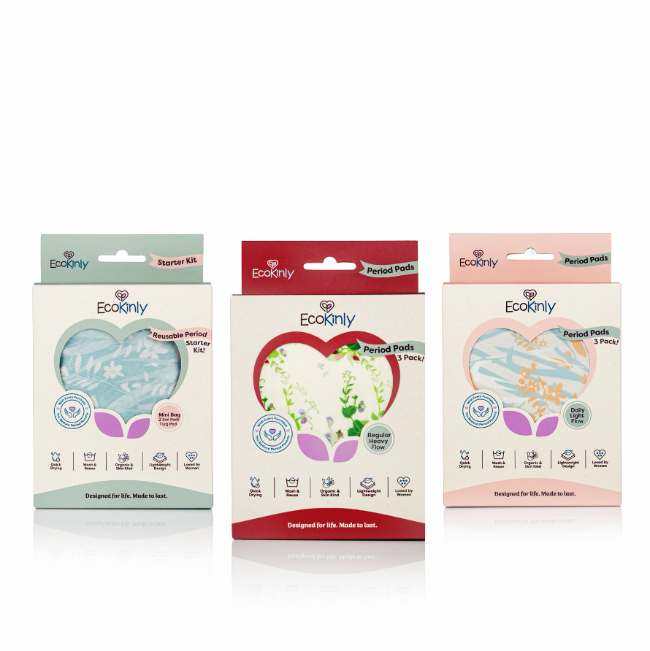
The company has filed a patent for its design configuration and expanded beyond nappies to include starter kits, potty trainer pull-ups, wipes, swim nappies, and period products. All items are made from bamboo, cotton, hemp and recycled PUL, designed for hundreds of wash cycles in standard machines.
Retail strategy
Doyle’s background running a successful online health and fitness business with her husband gave her insights into behaviour change that she’s applying to nappy use. “Having the product isn’t enough – placement of the product and peer verification is key to moving reusable out of the margins and into the mainstream,” she says.
EcoKinly has developed a retail-ready solution with shelf-ready packaging and wooden point-of-sale displays designed to create new reusable sections in mainstream retail.
The strategy also targets retailers like baby stores and pharmacies that don’t currently sell disposable nappies but serve the same demographic, potentially capturing some of the €100m being spent in supermarkets.
“I remember finally getting a call with a major retailer after months of trying to get an email reply,” Doyle recalls. “I expected to talk market and category – she was ten steps ahead asking for case sizes and pallet configurations. It was a realisation: this was the right product at the right time.”
EcoKinly’s feminine care range tackles another social issue. With an estimated half of Irish girls aged 12-19 having experienced period poverty, and UNESCO research suggesting lack of menstrual products leads to 10-20% of school year being lost, the company has built a “period poverty promise” into its model.
“When building the EcoKinly feminine care range, we applied the same idea as ‘pay it forward’ coffee initiatives,” Doyle explains. “With each pack the consumer buys, one is donated to tackle period poverty.”
Market timing and growth potential
The reusable nappy market is expected to grow at 12.15% CAGR from $2.91bn to $6.4bn by 2032.
EcoKinly’s early traction supports this optimism. The Nappy Market, Doyle’s initial online retailer for reusables, has received orders from over 40 countries.
“If I don’t launch EcoKinly, how many more generations will go by until there is a viable alternative for parents to the disposable?” Doyle asks. The company recently won the National Sustainability Champion Award, validation of its approach to mainstreaming reusable childcare products.
Start-up ecosystem and funding
Doyle credits Ireland’s start-up ecosystem, particularly the Local Enterprise Office, for crucial early support. “Ireland is an excellent place to build because it’s a perfect sandbox: small, well-connected, and relationship-driven,” she says.
The company has been self-funded with LEO grant support and is open to strategic conversations, particularly with retail partners across Europe. Doyle’s advice to fellow founders reflects her practical approach: “Start where you are and do what you can. You don’t need perfect conditions, you just need the right momentum.”
With two children under three when she started in April 2023, Doyle represents a growing cohort of parent-entrepreneurs reshaping consumer goods markets.
“People do business with people,” she notes. “In a world of AI and automation, it’s still human connection that moves things forward.”
-
Bank of Ireland is welcoming new customers every day – funding investments, working capital and expansions across multiple sectors. To learn more, click here
-
For support in challenging times, click here
-
Listen to the ThinkBusiness Podcast for business insights and inspiration. All episodes are here. You can also listen to the Podcast on:
-
Spotify
-
SoundCloud
-
Apple