Ireland’s €235bn a year tech sector is the second largest tech exporter in the world after the US. But as energy availability and data centres become a hot topic, can the country triumph in the next AI-driven chapter of tech?
The debate over data centres and Ireland’s electricity grid is far from over, despite the onset of the Government’s Large Energy User Action Plan (LEAP). It is really only getting started.
The LEAP is designed to provide certainty to investors in infrastructure who will unleash the next wave of job creation in the AI age but also to the State to ensure a balanced infrastructure rollout.
“This idea that we’re adding energy demand when we build data centres is the wrong way to look at it”
After a moratorium on data centre construction, such certainty and clarity is key. Proponents of this infrastructure claim next generation data centres will actually generate electricity and heat and feed it back into society.
The investments are coming. In recent days we reported how data centre giant Equinix revealed plans to invest as much as $700 million in a major new Hanley Energy manufacturing facility in Dundalk.
At the heart of FDI matters
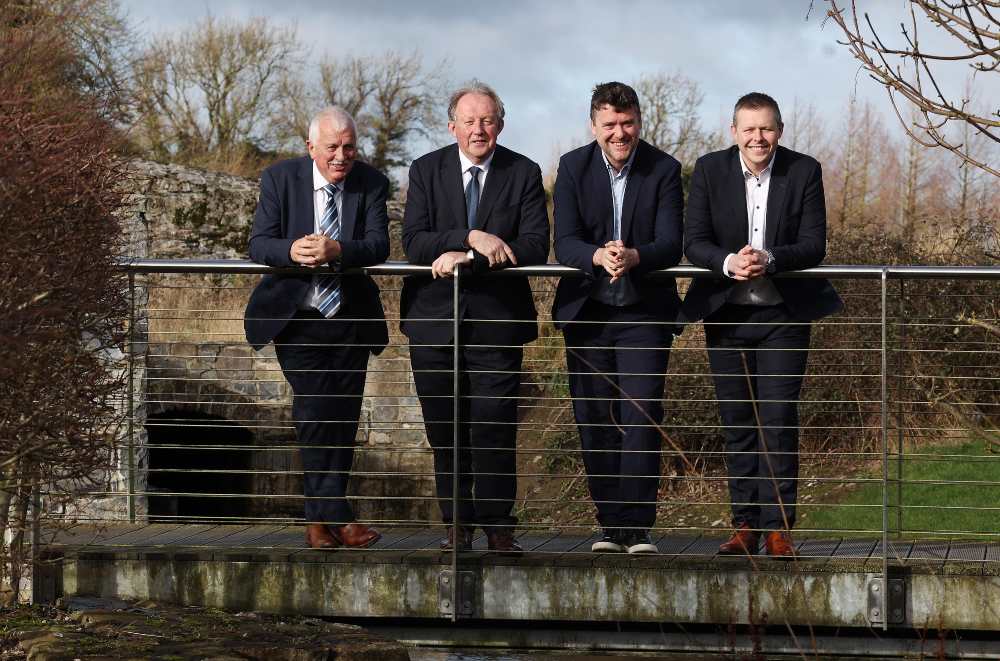
At the launch of the Irish Data Centre Supplier Alliance in Grange Castle Business Park were: Joe Conway, Director of Business Development at Dornan Engineering; Tom Parlon, chair of the IDCSA; Colm Phelan, Director of DECI Ltd; and David Quinn, Group Business Development Manager at STS Group. Credit: Robbie Reynolds Photography
At a recent Property Finance briefing in Dublin organised by Bank of Ireland, the CEO of Echelon Data Centres Niall Molloy pointed out that data centres contributed €1 billion annually to the Irish economy over the past decade, while driving renewable energy development.
He emphasised that AI investment is crucial to Ireland’s corporation tax base, with major tech companies like Microsoft, Google, and others driving significant foreign direct investment into Ireland. The country, he said, faces huge international competition for these investments.
“Investment in the AI revolution is the bedrock of our corporation tax base,” he said. “If you look at tech companies like Microsoft and Google, they are huge from an FDI perspective, their cloud services, the AI work that they’re doing is now at the heart of their business.”
Kate Tuohy, head of Sustainability, Energy and Infrastructure at Bank of Ireland, agreed and highlighted the dramatic shift in ESG credentials from “nice to have” marketing tools to essential requirements. Large corporates now prioritise energy-efficient buildings as part of their decarbonisation strategies.
The data centre businesses are getting organised. A new trade association called the Irish Data Centre Supplier Alliance (IDCSA) has been formed to represent homegrown Irish companies that operate in the data centre supply chain.
Ex-minister Tom Parlon, the former director general of the Construction Industry Federation (CIF), will become the IDCSA’s first chair. He said that if anything, the sector needs more State support.
“The growth of the data centre industry over the past 15 years has been one of the foundations of Ireland’s economic recovery since the financial crash,” Parlon said. “The sector has contributed over €20 billion through direct and indirect investment during that time, directly employing 1,800 people whilst supporting thousands more jobs across the Irish supply chain.
“Data centre investment has also been a vital avenue of growth for Irish business, allowing many companies to evolve into a new generation of multinationals and establishing Ireland as a global leader in the provision of digital infrastructure services. Unfortunately, the debate around data centre investment in Ireland has become deeply polarised over recent years and the benefits to domestic businesses are largely ignored.”
A walk in the cloud
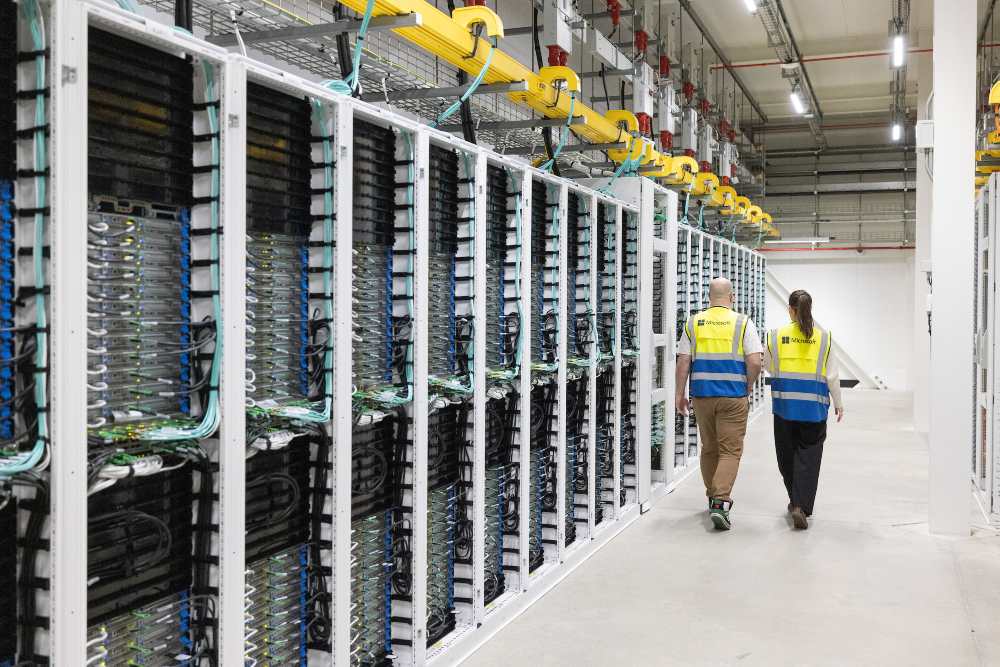
Not many people know it but deep within the industrial hinterland of west Dublin one of the world’s most advanced data centres lies at the heart of the global cloud boom … and soon to be an AI boom.
“Every kilowatt of electricity we have used has been matched with renewable energy”
Global software giant Microsoft is this year marking 40 years in Ireland after initially coming to the country to produce software on little blue disks, then CD-ROMs, and in 2009 this all moved to the cloud with the construction of its first data centre globally in Dublin.
While it is just one of close to 200 Microsoft data centres worldwide, it is one of the most important as it drives most of Microsoft’s hyperscale cloud activities in Europe. Battery tech innovation pioneered in Dubin has been exported to three Nordic countries while AI applications help optimise energy grid operations.
Indeed energy is at the heart of the matter. In recent weeks Ireland was the location that Microsoft’s chief sustainability officer Melanie Nakagawa chose to reveal that the software giant is now matching 100% of its annual global electricity consumption with renewable energy.
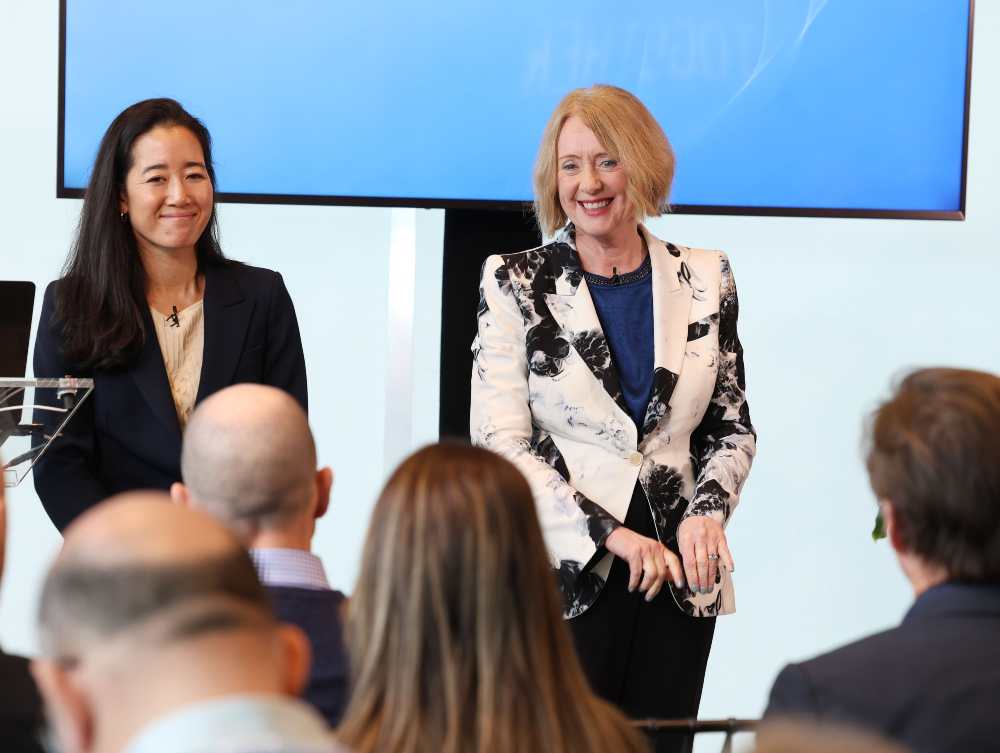
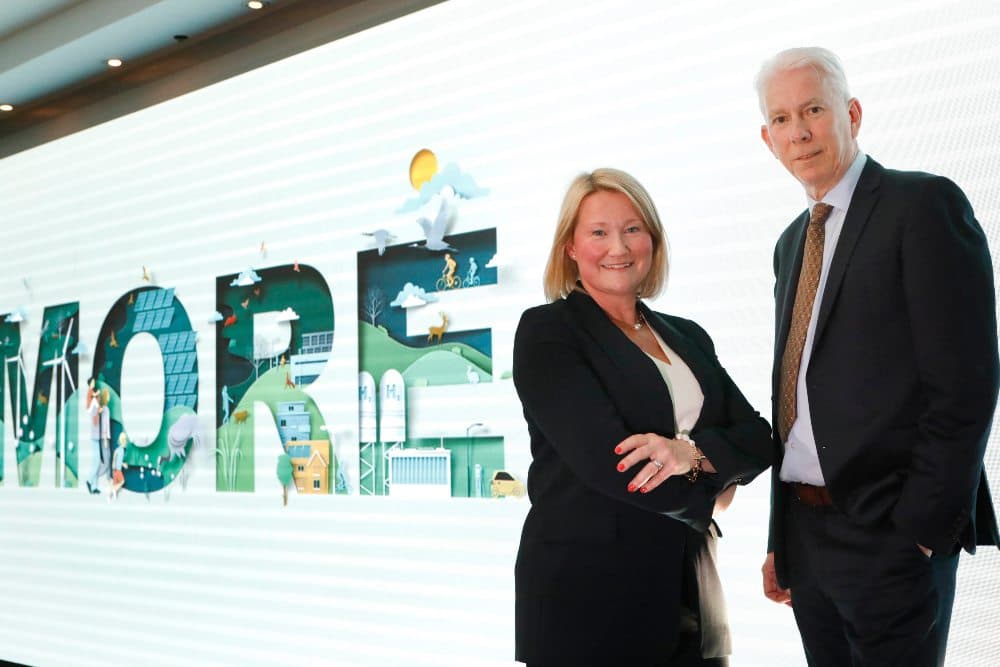
Melanie Nakagawa, Chief Sustainability Officer, Microsoft and Noelle Walsh, President, Microsoft Cloud Operations + Innovation. Photo: Leon Farrell/Photocall Ireland
Since announcing its carbon negative commitment in 2020, Microsoft has contracted 40 gigawatts of new renewable energy supply across 26 countries. “Every kilowatt of electricity we have used has been matched with renewable energy,” Nakagawa said.
Flanked by Irish native Noelle Walsh, global head of data centres at Microsoft and Lavinia Morris, general manager, EMEA Data Centre Operations at Microsoft, it was made clear by Nakagawa that as the compute continuum moves inexorably into AI, these data centres need to be giving as much energy back to the grid as they could take. For example, the new data centres will use zero water insofar as they will replace every drop they consume.
A tour of the Dublin data centre was a bit like gaining entry to Fort Knox and it was slower and more rigorous than going through airport security. There’s a reason for this. “90% of Fortune 500 companies are on Microsoft Cloud,” Walsh noted.
In Ireland, where Microsoft operates one of its largest European data centre campuses, questions continually arise about whether new renewable energy projects primarily serve data centres rather than residential consumers.
The Microsoft facility is just one of close to 100 data centres in Ireland today, with 14 under construction and an additional 40 with planning approval. 95 of these data centres are concentrated in just six counties, with the majority concentrated around Dublin.
Until late last year Ireland had a de facto moratorium on data centre grid connections driven by capacity constraints and fears of electricity shortages. This moratorium was lifted in December as long as stringent rules such as on-site energy generation or battery systems to meet demand and supply power back to the grid when needed.
Since January the Irish Government confirmed that new data centre development can resume under strict renewable supply and onsite generation rules. Ireland’s Large Energy User Action Plan (LEAP) was published last month which represents a major policy reset for data centres requiring them to align with Ireland’s climate energy targets, including the creation of Green Energy Parks where data centres can co-locate with renewable energy sources like offshore wind and solar.
Powering up
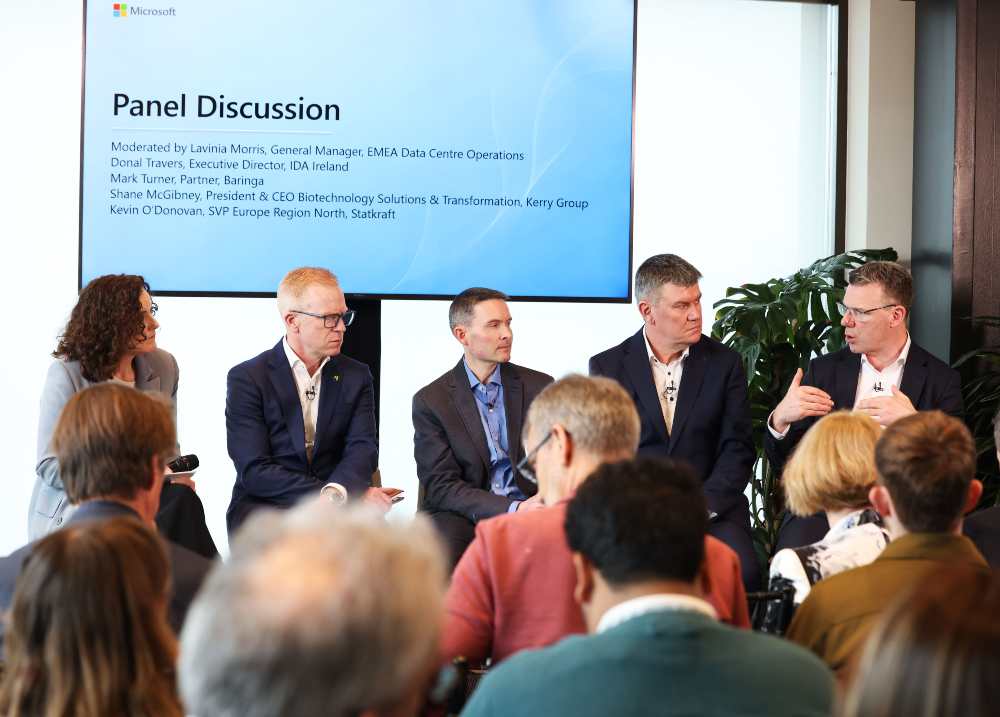
Pictured at Microsoft’s Grange Castle data centre campus in west Dublin during a panel discussion on Digital Infrastructure as a Growth Engine for Ireland and Europe were Lavinia Morris, General Manager, EMEA Data Centre Operations; Donal Travers, Executive Director, IDA Ireland; Mark Turner, Partner, Baringa; Shane McGibney, President & CEO, Biotechnology Solutions & Transformation, Kerry Group; and Kevin O’Donovan, senior vice president for Europe Region North at StatKraft. Photo Leon Farrell/Photocall Ireland
At the same briefing where Nakagawa revealed the 100% renewable milestone for Microsoft’s data centres, the power of AI and the importance of the cloud to Ireland’s export future was underlined by executives from Kerry Group, IDA Ireland and renewable energy provider Statkraft.
Shane McGibney, president and CEO of Biotechnology Solutions at Kerry Group revealed how data is informing product development. “We can concept with a customer who wants to launch a functional beverage in a particular market. We can tell them what products have launched, how successful they’ve been, and design that product in 90 seconds by leveraging the power of data.”
This transformation exemplifies Ireland’s emergence as a crucible for the convergence of AI, renewable energy and industrial innovation. The country now exports €235 billion ($278 billion) worth of technology, software and services annually, cementing its position as the world’s largest exporter after the United States.
The scale of Ireland’s digital economy is striking. Data centre services alone represent nearly 60% of all service-related exports, worth approximately €300 billion. The broader tech sector employs more than 312,000 people across nearly 1,900 companies.
“The tech sector for us started 70 years ago when IBM became our first technology client,” said Donal Travers, executive director at IDA Ireland. “What we have today evolved from early screwdriver-type operations to software, higher value activities, and now we’re in the fourth wave – the AI wave.”
Research by consultancy Baringa reveals that moving computing from on-premise servers to hyperscale data centres delivers an 80% reduction in energy consumption for the same output. “This idea that we’re adding energy demand when we build data centres is the wrong way to look at it,” argues Mark Turner, a partner at Baringa. “If you accept that we need these digital services powering every part of our economy, this is by far the most efficient way of doing it.”
Far from being mere power consumers, he said data centres are actually driving renewable energy development across Europe. Corporate power purchase agreements (PPAs) with hyperscale data centres have enabled three-quarters of completed wind and solar investments in Ireland over the past six years.
“What the PPA allows us to do is have long-term certainty on the price that Microsoft will buy that power for,” explains Kevin O’Donovan, senior vice president for Europe Region North at renewable energy company Statkraft. “We can estimate quite accurately what a wind or solar project will produce, then make a very good investment decision.”
The model is expanding rapidly. Baringa projects that data centre operators will underpin another 50-55 gigawatts of renewable power across Europe through new corporate PPAs in the coming years.
Pillars of Ireland’s digital transformation
The Irish Government is doubling down on this digital-green convergence with unprecedented investment, Minister for Enterprise Peter Burke TD told the Microsoft audience.
“We have a very exciting capital plan,” Burke told the Microsoft event. “We’re going to spend about €19.1 billion in our economy in 2026. If you look around private companies, there aren’t many investing at that scale of increase in capital expenditure, especially over two years.”
The boost in infrastructure spending represents a 56% increase from €8 billion in spending just two years earlier, he said.
Burke said the Government’s Large Energy User Action Plan provides regulatory certainty for major infrastructure investments. He said that this policy framework addresses energy capacity constraints while maintaining Ireland’s competitive advantage in attracting global technology investment.
The Minister emphasised three pillars for Ireland’s digital transformation: energy, skills and leadership. The Government aims to train 40,000 people in AI-related skills over five years, having already reached 30,000 in the first year. Additionally, a new 50% R&D tax credit supports companies investing in artificial intelligence research and development.
“When you look at AI, you think of ADAPT in Trinity College Dublin, the largest research centre in AI in Europe,” Burke noted. “Those are critical, tangible tertiary partnerships that we will be building on in years ahead.”
Kerry Group’s McGibney illustrates how this ecosystem approach works in practice. “When we met with Microsoft a couple of years ago, we shared our strategy and business problems, and we’re partnering together to solve them. Enterprise Ireland has been fantastic on the journey with us. We’re learning from peer organisations and sharing our stories.”
The practical applications are already delivering measurable results. Kerry Group has automated 80,000 supply chain decisions and achieved a 20% yield improvement through digital twin technology in fermentation facilities. The company released results showing 80 basis points of margin enhancement driven by its transformation programme.
“We use less raw material to make more product with less waste,” McGibney explains. “Kerry’s sustainability is at the heart of what we’re doing. That’s just the baseline – now we can go further with science.”
As Ireland prepares to assume the EU presidency in July, the country positions itself as a leader in balancing technological advancement with regulatory prudence. An AI summit planned for October in Dublin will showcase applications and opportunities while addressing public trust and proportionate regulation.
The convergence of data centres, renewable energy and artificial intelligence represents more than technological progress. For Ireland, it embodies a strategic vision where digital infrastructure serves as the foundation for both economic growth and environmental sustainability.
As Turner from Baringa observes: “We should be seeing data centres as facilities that are helping to refine renewable energy and transform that into incredibly high-value digital services and exports.”
A rising tide
Lavinia Morris said that Microsoft’s 40-year partnership with Ireland reflects a long-term vision that aligns with the country’s ambitions for digital and green transformation.
Morris said the company’s presence has not only attracted complementary investments across the technology value chain but has also fostered a thriving ecosystem of Irish companies that export over €2 billion worth of data centre-related services annually.
On data centres as energy catalysts, she concluded: “There’s often a perception that data centres simply consume power.
“They’re actually symbiotic. They can work together in order to drive both of those agendas for both the decarbonisation agenda and the digitalisation agenda, and, of course, technology such been such a foundation here in Ireland. It’s great to think that those two things can move forward together and in symphony with each other.”
-
Bank of Ireland is welcoming new customers every day – funding investments, working capital and expansions across multiple sectors. To learn more, click here
-
For support in challenging times, click here
-
Listen to the ThinkBusiness Podcast for business insights and inspiration. All episodes are here. You can also listen to the Podcast on:
-
Spotify
-
SoundCloud
-
Apple