Podcast EP 336: The recent All-Island Bioeconomy Summit signalled Ireland is serious about turning agricultural waste into energy and commercial opportunity. The hardest part? Making it pay.
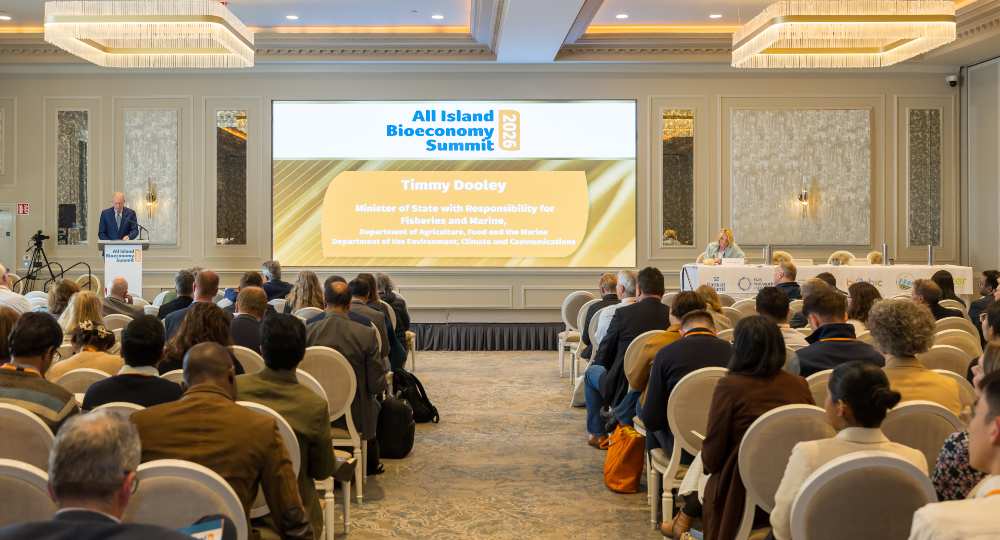
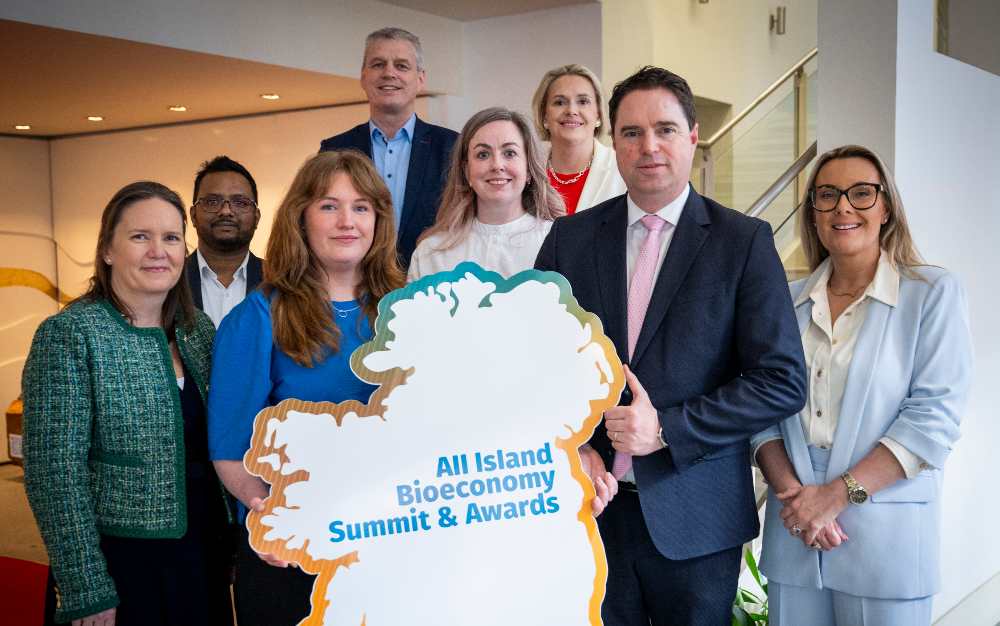
The crowded ballroom of entrepreneurs, academics and policy-makers at the All-Island Bioeconomy Summit at Johnstown House in Co Meath was proof in itself that something is happening. Consider it a prelude to Ireland hosting the Global Bioeconomy Summit later this year and a genuine sign that Ireland wants to reap any commercial gains the bioeconomy presents.
At the Co Meath event, industry participants highlighted Ireland’s strong starting position, built on its agri-food sector, marine assets and research base. The main constraint lies in translating innovation into scalable businesses supported by stable demand and investment.
“There’s an opportunity for businesses to consider their own business model and the potential to commercialise some of their own waste and byproduct”
For Colette Shirley, director of Sustainability in Bank of Ireland’s Corporate and Commercial Banking division, the change starts with businesses themselves and how they could look at their own waste differently.
“There’s an opportunity for businesses to consider their own business model and the potential to commercialise some of their own waste and byproduct,” she explained. “Maybe look around and think about working with partners, whether to solve gaps in the supply chain or around product innovation.”
The opportunity and challenge for the bioeconomy lies in how broad it is. The sector spans biomethane production, bio-based fertilisers, circular waste management and marine-derived materials.
The common logic linking these activities? It is that biological processes and agriculture residues – long treated as disposable problems – represent an under-exploited commercial opportunity for Ireland.
Crystalising this is perhaps not as sexy as AI is today. But the opportunity is enormous. We wrote this morning about how Gas Networks Ireland is working with the Malting Company of Ireland and Ahascragh Distillery are working on a new pilot designed to reduce emissions in the whiskey supply chain using biomethane in barley malting; an energy-intensive stage in whiskey-making.
Waiting for the signal
The creator of the All-Island Bioeconomy Summit Percy Foster of Foster Environmental, offered a wider assessment of where the industry stands. With a background in composting and biogas, he has watched the sector develop over a long enough period to appreciate that a lot of the groundwork has been laid, but much progress depends on decisions that lie outside the industry’s control.
The most significant of those decisions concerns a Government mechanism that would provide a revenue floor for operators supplying renewable gas. “Part of the delay is that we’ve all been waiting for the Renewable Heat Obligation Scheme from Government that is coming down the tracks in a few months’ time. When that gets into place we will see a lot more biogas plants being built.”
Foster is frank about Ireland’s international position. “We’re probably a little late, but that gives us the opportunity to learn from others who’ve made mistakes, and then we can catch up quickly.”
He pointed to a cross-border research initiative called Regenerate which was jointly funded by the Department of Agriculture in Dublin and its counterparts in Northern Ireland. The initiative is focused on commercial-scale extraction of nitrogen and phosphorus from digestate, the material that remains after biogas has been produced. It addresses one of the sector’s significant side benefits: if Ireland can produce bio-based fertiliser locally, it reduces dependence on imports – a third of which have historically come from the Iran region.
Foster predicts a future in which biogas plants function like biorefineries, extracting a sider range of chemicals and materials from the same organic inputs. Carbon dioxide produced as a byproduct of the fermentation process, for example, has applications in the food and beverage space.
“In the future, there’ll be a lot more bio-based products coming from the processes.”
The financial rationale
Bank of Ireland’s head of Agriculture Eoin Lowry has been tracking the biomethane opportunity for several years and two years ago produced a report with Davy that suggests the creation of a biomethane sector in Ireland represents a €1.6bn investment opportunity that will also provide an economic boost to rural communities.
Lowry predicts that Ireland’s agricultural sector could participate in renewable energy production through anaerobic digestion, a process that converts organic material into biogas.
This could be a welcome boost to a sector where only 43% of farms are currently considered commercially viable. Lowry notes that one-in-seven jobs in Ireland depends on agriculture. Diversifying income streams on farms is not just a commercial question – it carries social weight too.
“We need to decarbonise and, especially since the ongoing crisis in the Middle East coupled with what’s happening in Russia, we need to become more energy secure while creating a greater opportunity to make farms more viable.”
Lowry says it is time for action. “It’s time to move beyond the strategy documents, the pilot projects , and to move into real-time scaling up of these into commercial businesses.
A model worth studying is the co-op movement. “The co-op movement was critical. Farmers had direct ownership in the process, they invested in the processing and he technology but there was a shared value creation, and I think that’s critical as we look to develop out the bioeconomy in general.”
Another area to double-down on is policy certainty if meaningful investment is to flow. “Until that drives a long-term vision and commercial plan for the sector, finance and investors are going to be critical. What they need, and what we need as a Bank, is that policy certainty over the longer term. And we’re getting there, but what we now need to see is the financial models that provide income certainty and the cash flows required to allow investment.”
The sector already has pioneers. On the day of the Summit, Gas Networks Ireland revealed an agreement to connect a new €80 million biomethane facility in Co Cork to the national gas grid, marking a further expansion of Ireland’s renewable gas infrastructure and circular economy ambitions. The project, being developed by Stream BioEnergy at Little Island, is currently under construction and is expected to begin operations in 2027.
Proving the bioeconomy is not hot air
One entrepreneur who has also hit the ground running is Patrick Harte, co-founder of Carbon AMS, a development platform for biomethane, who has spent the past five years trying to build what the policy environment has been slow to provide: actual plants, actual gas and actual revenue.
The company brings 15 years’ worth of experience operating anaerobic digestion facilities in Northern Ireland and the UK to a market, that is still in its infancy. “We’re starting from scratch, so we have a good opportunity to build an industry that’s sustainable, efficient and traceable.”
The traceable aspect is key. Harte believes a significant portion of the commercial opportunity in Irish biomethane lies with large corporations seeking to decarbonise their operations in a verifiable and accountable way.
“There are a lot of blue chip companies that are willing to put sustainability front and foremost in terms of Scope 1 and Scope 2 emissions, and that additionality aspect, to inject capital into the Irish economy to decarbonise their manufacturing.”
Harte is measured about the question of farmers’ participation, pointing out that the capital required for commercial-scale anaerobic digestion plants is substantial. He was cautious about encouraging individual farmers or small co-ops to go it alone, instead emphasising partnership with operators like Carbon AMS.
Through its Duleek plant, Carbon CMS has developed a feedstock partnership an agricultural business that can expand its operation on the supply side while Carbon AMS concentrates on the technical and operational challenges of running the digestion facility. It is perhaps a model of the kind of supply chain integration the broader sector needs.
“There’s no point in farmers not gaining the benefits of a developing biomethane industry, because that just means it’s not going to get off the ground. Farmers are an integral part of the industry and should be duly rewarded.”
From waste to working capital
Bank of Ireland’s Colette Shirley says the Bank sees the bioeconomy as a meaningful commercial opportunity across its existing business book, from large dairy co-ops converting agri-residue into bio-fertiliser, to smaller agri customers finding new revenues in overlooked by-products.
She cited a Bank of Ireland customer who had built a business around surplus straw, a low-value agricultural residue, by converting it into animal bedding and reselling it. While the economics were modest at an individual level, the logic is the same as what underpins the entire bioeconomy argument: material that was previously a cost or a problem can be turned into an income.
“We’re really impressed by all of the innovation that is happening out there with our big and small businesses. We just want to be along for the ride and supporting them.”
She said the Bank is also positioning itself around broader energy transition activity, including biomethane and agri-PV solar, which allows farmers to generate electricity from solar panels installed on agricultural land while continuing to use that land productively.
“The bioeconomy is a strategic area that aligns with our own ambitions to support the transition to a lower carbon economy. Beyond the energy transition, other innovative solutions are required for alternative carbon sources.”
She said events like the All-Island Bioeconomy Summit help to accelerate the knowledge sharing the nascent sector needs. “They bring together the full ecosystem and create a powerful platform for collaboration.”
-
Bank of Ireland is welcoming new customers every day – funding investments, working capital and expansions across multiple sectors. To learn more, click here
-
For support in challenging times, click here
-
Listen to the ThinkBusiness Podcast for business insights and inspiration. All episodes are here. You can also listen to the Podcast on:
-
Spotify
-
SoundCloud
-
Apple