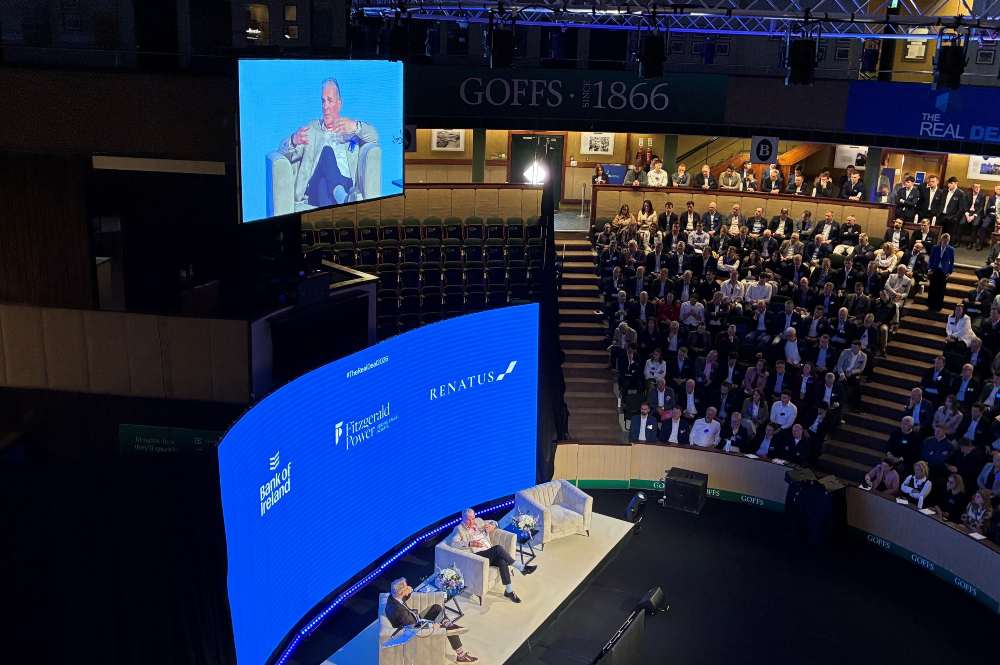
At the recent Real Deal Conference, entrepreneur Áine Denn recalled how she scaled Altify into a serious sales machine across three continents before selling it to Upland Software. She revealed her grá for entrepreneurship has brought her back into business with her new venture Blazer.
“We knew that the digital revolution had not yet reached sales,” Denn told attendees at The Real Deal Conference 2026 as she recalled how over 15 years she and her Altify co-founder Donal Daly built a business that they exited for $84m in 2019.
The size of the deal elicited a round of applause from the 1,000 attendees who were spellbound by her story.
“My passion is around founders and how disproportionately the success factor impacts their families or their communities”
“We never saw ourselves as an Irish company,” she said in an interview with host Matt Cooper. “We saw ourselves as a US company that happened to have Irish engineers.”
Denn and Daly co-founded Altify in Dublin in 2005, a global B2B software as a service (SaaS) business that built innovative sales technology for revenue teams.
The business scaled internationally across the US, the UK and Europe before it was sold to Upland Software in 2019.
Since exiting Altify, Denn has focused on board and advisory work and recently co-founded Blazer, a new AI start-up focused on SME founders.
Serious about SaaS
The 15-year odyssey into global SaaS wasn’t originally her intention. She and Daly intended to prove the model quickly, attract some interest and move on.
Denn studied computer science before moving into consulting and then into the world of multinationals, arriving in the start-up space just as the SaaS model was taking hold.
“Every SME has to work out who the right customer is. They have to follow the budgets and then go and find those customers”
She describes the shift from on-premise software to cloud subscription as obvious in retrospect but genuinely radical at the time. “Salesforce were the first real pioneers,” she said. “They said: we’ll host it, we’ll maintain it, you just pay us a monthly or annual fee. For anyone who had spent years managing rooms full of servers, it looked like a no-brainer.”
Altify was built around sales enablement, specifically the idea that large enterprise sales teams were spending enormous sums without getting reliable returns. The company acquired the IP behind a well-known sales methodology called Target Account Selling just six months after incorporation, a move Denn describes as always part of the plan, even if the timing was faster than expected.
As she said, the digital revolution had yet to impact selling. “Sales was the last part of the business process where digital was not being embraced, and we knew we had unique domain expertise.”
Rather than starting with smaller Irish clients, the company targeted large US enterprises from the outset. The ideal customer profile, Denn explains, was any organisation with more than a hundred enterprise salespeople carrying significant annual targets. Expedia became the first marquee name on the books, a decision driven as much by personal networks as by strategy. The founders had spent time in Seattle previously and still had contacts in Bellevue, not far from Microsoft’s sprawling campus at Redmond.
“Every SME has to work out who the right customer is,” she said. “They have to follow the budgets and then go and find those customers.”
The engineering team remained in Ireland throughout, but Denn and her co-founder spent the majority of their working lives in the United States, alternating stints of several months each.
Denn noted that being Irish actually helped in certain American rooms. “You are easier to remember than the person presenting in the next slot. And if you are a woman, it helps as well, without a doubt. I used to always wear a green blouse to every sales event.”
The contrast between selling in the US and in Europe, she said, was real and often understated. American companies tended to move at pace once they saw value: if a product could work for a thousand salespeople, they would often pilot it with all of them at once. European organisations, she said, took a different approach entirely.
“You would find a group within a company like HPE or Orange who were genuinely on the leading edge of what they wanted to do. They would champion it internally. But it would start with 15 people in Geneva, and you would work it from there.” Once they were committed, however, European customers proved to be exceptionally loyal advocates, both within their own organisations and across their wider networks.
The eventual sale to Upland Software came about in an unexpected way. The company had been in extended due diligence with another American buyer, a process that had stretched on for months and grown increasingly granular in its demands. “They kept moving from gross retention rate to net retention rate to something else,” Denn said. “We knew it was not going to go ahead.”
The call from Upland came the following day. The two companies had offices in the same building in Texas, and Upland’s team had overheard a conversation in a lift that prompted their interest. They moved quickly and offered to match the previous bid.
Denn was in Japan when the deal closed and remained with Altify for the final quarter before the financial year closed in January 2020 which she spent travelling the world telling customers about the transition.
She did not go into the office on her last day. “I was not going to send that last email, the one that goes: ‘Thank you very much everybody, I am about to close my laptop and it has been a pleasure.’ It was very hard. But it was also very interesting.”
Blazing a new trail
What followed was a period she describes as one of the more disorienting of her career. The pandemic arrived just as she was working out what came next. She almost accepted a senior role at a large multinational before her husband talked her out of it. “He said: why would you even consider this? It is not you. You are not going to go back into the corporate world. Give yourself some time.”
She heeded the advice, spent time studying for her Institute of Directors exams and began building a portfolio of board and advisory roles with genuine intentionality. “I knew, as a woman of a certain age who had done computer science and been in tech, that I would be offered a large number of board positions. I wanted to know exactly what I was getting into before I accepted them.”
Denn’s passion for entrepreneurship and awareness of the challenges of being a founder sparked her new business “My passion is around founders and how disproportionately the success factor impacts their families or their communities, or when they’re not successful how it also impacts their families and communities.”
That awareness crystallised into Blazer, co-founded with another seasoned Irish entrepreneur Leonora O’Brien, whom Denn had met through the peer mentoring programme Going for Growth.
The platform is designed to help founder-led SMEs move from being dependent on the founder for every decision to operating as structured, scalable businesses. The mechanism is an AI-native tool for documenting strategy, communicating it across teams and tracking progress against clear metrics.
“The founder is involved in every single decision, every single sale, and the team may not be on the same page.
“The founder-CEO knows where they want to go. They are absolutely passionate. They have a vision,” Denn said. But unless they can document that and share it with their teams, align the teams, make people accountable for their progress along the way, they are not going to become the investable, valuable, exit-ready business they want to be.
Blazer currently has 50 companies live on the platform. Unlike Altify, which focused on large American enterprise clients, the target here is Irish SMEs across all sectors. “It is not just tech,” Denn said. “It is farmers. It is people who fit kitchens. It is people who make beauty products. The SMEs in Ireland are doing amazingly well, and with just a little push they can double.”
Asked whether AI poses an existential threat to SaaS as a business model, Denn was unequivocal. “They are not mutually exclusive. SaaS is a delivery model, a business model. It is not the technology itself. What we need now are AI-native SaaS companies, and we need existing SaaS companies to make sure they are genuinely embracing AI rather than bolting it on.”
On the question of whether AI agents might eventually replace human sales teams, she was similarly direct. “Every day in sales, someone used to say: do you want me selling, or do you want me filling in the CRM system? AI is brilliant at things that humans get bored of. But a really good salesperson gets to know their customer so well, builds genuine long-term relationships, and marshals the resources of their organisation to make sure that customer is looked after. None of that is AI.”
Her parting advice to those still in the earlier stages of building was characteristically unvarnished. Stay true to the vision when it is tested, which it will be, repeatedly. Measure the things that matter from day one, because a measurement framework is what tells you where progress is being made and where course correction is needed.
She paused, then smiled. “That would not be me if I did not end with: go and sell something. Revenue cures all.”
-
Bank of Ireland is welcoming new customers every day – funding investments, working capital and expansions across multiple sectors. To learn more, click here
-
For support in challenging times, click here
-
Listen to the ThinkBusiness Podcast for business insights and inspiration. All episodes are here. You can also listen to the Podcast on:
-
Spotify
-
SoundCloud
-
Apple