A new Trinity College Dublin and Microsoft Ireland study reveals AI use is surging across Irish businesses, but threat of a two-speed economy emerges with a skills productivity between SMEs and larger organisations.
Whether business leaders realise it or not, artificial intelligence (AI) is already a part of everyday working life across the Irish business world, with workers using it to save time and easing workload pressure for leaders.
New research from Trinity College Dublin in collaboration with Microsoft Ireland shows that Ireland is now amongst the leading economies globally for AI adoption.
“The data clearly shows that Ireland is at an inflection point: AI is firmly embedded in day-to-day operations, and Ireland is among the leading AI-adopting economies globally”
However, there is a widening maturity gap between SMEs and larger organisations that may shape productivity outcomes in the years ahead.
The report’s authors say that if this situation is left unchecked, this would risk constraining national productivity and growth.
The AI Economy Ireland 2026 report – the third in an annual series tracking how AI adoption and organisational readiness are shaping economic capacity nationwide – finds that AI adoption is now near-universal with 92% of organisations using or planning to use AI.
Despite this, just 10% of leaders describe their deployment of AI as advanced or frontier-level, and SMEs remain disproportionately concentrated at the early stages.
AI drives productivity gains
SMEs that invest in AI are more likely to report significant productivity gains than large organisations (18% vs 8%) – a sign that, where SMEs do commit, the returns are real.
But too few SMEs are making that investment. Given that SMEs account for more than two-thirds of all employment in Ireland and contribute over 40% of gross value added, the economic stakes are significant.
The report shows a persistent AI readiness gap that is already translating into uneven business outcomes between large firms and SMEs.
Large firms are more than twice as likely to deliver weekly time savings of two hours or more per employee (54% vs 25%), and SMEs are more than twice as likely to have no formal AI training in place (15% vs 6%). Left unchecked, this divide risks becoming a structural drag on the country’s productivity and growth.
This gap matters because even modest levels of AI adoption are already delivering measurable gains in day‑to‑day work. A typical mid-sized organisation in Ireland is freeing up to 1,000 hours a month through everyday AI use, driven by reduced time spent on meetings, email and routine administrative tasks. For large multinational organisations operating here, this rises to up to 5,000 hours per month.
Less pressure for leaders
Importantly, the impact extends beyond organisational efficiency, with clear, direct benefits for leaders themselves. 70% of leaders report a reduction in overall workload pressure, while one in three say AI is making it easier to switch off from work. A further 26% report reduced evening or weekend work.
While efficiency gains are important, they represent only the first phase of AI’s economic potential. International evidence already suggests the biggest returns come not from doing today’s work faster, but from using AI to create new value – through innovation, new products and growth.
However, the findings show that many organisations have yet to redesign workflows, governance or operating models to capture these gains at scale.
Ultimately, the next phase of economic impact in Ireland will depend on whether organisations use the time freed up by AI to drive innovation and growth, not just efficiency.
Closing the confidence gap
“AI is already delivering real value for Irish organisations, freeing up thousands of hours a month,” said Catherine Doyle, General Manager, Microsoft Ireland. “The opportunity now is to make sure the benefits are felt equally. That means closing confidence gaps wherever they exist and supporting SMEs to scale from early adoption to full integration. That’s where the next wave of value will come from.
“But the data reveals a growing divide. While large organisations race ahead, too many SMEs are still at the starting line, and the confidence gap among women in leadership tells us the skills challenge goes beyond technical training. Widespread adoption is what unlocks the biggest gains – and it’s where the real opportunity begins. The next step is using AI not just to do today’s work faster, but to build new products, enter new markets and create value we couldn’t create before.”
Regarding AI adoption, Ireland compares relatively well when set against international benchmarks. Current levels of AI use across Ireland’s workforce place the country among the leading group globally, while enterprise-level adoption in Ireland sits modestly above the EU average. Challenges around governance, skills and translating adoption into organisational impact mirror patterns identified in OECD and international research.
“The data clearly shows that Ireland is at an inflection point: AI is firmly embedded in day-to-day operations, and Ireland is among the leading AI-adopting economies globally,” said Professor Ashish Kumar Jha, ADAPT Centre, Trinity College Dublin.
“The competitive advantage will come from how quickly organisations move from early deployment to scaled, governed and value-driven AI adoption. The levers are clear: organisations with a formal AI policy are ten times more likely to report major productivity gains, and SMEs that do invest in AI capability report higher rates of significant productivity gains than large firms.
“Closing the maturity gap between large organisations and SMEs will be essential if Ireland is to translate widespread AI adoption into durable, economy-wide productivity gains.”
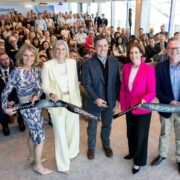
Top image: Kieran McCorry, national technology officer, Microsoft Ireland; Catherine Doyle, general manager, Microsoft Ireland; and Prof Ashish Kumar Jha, ADAP Centre, Trinity College Dublin
-
Bank of Ireland is welcoming new customers every day – funding investments, working capital and expansions across multiple sectors. To learn more, click here
-
For support in challenging times, click here
-
Listen to the ThinkBusiness Podcast for business insights and inspiration. All episodes are here. You can also listen to the Podcast on:
-
Spotify
-
SoundCloud
-
Apple