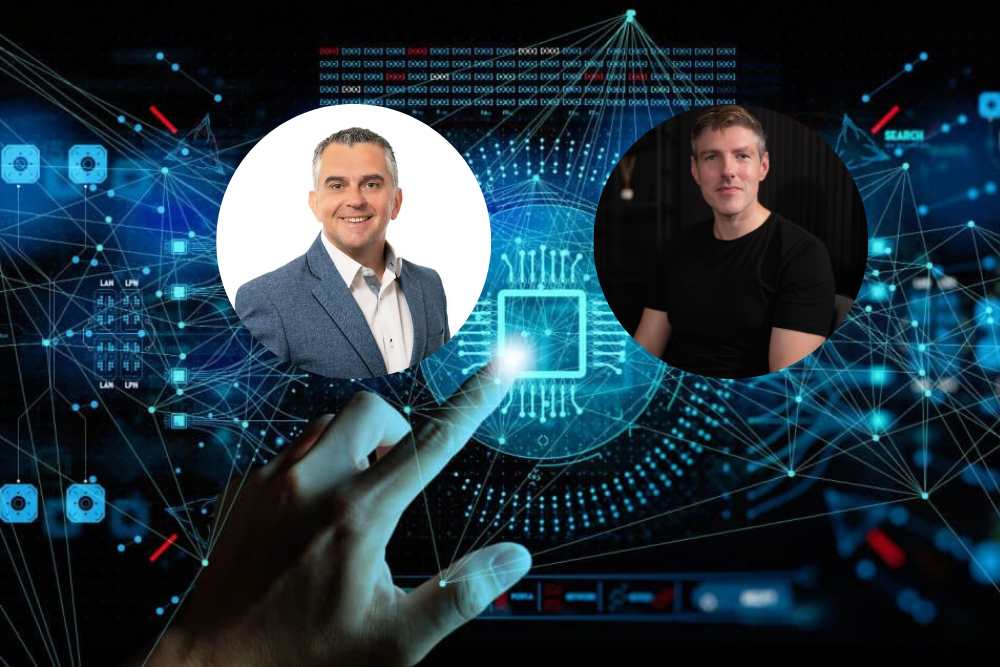

In his latest Developments & Insights report, Bank of Ireland’s head of Tech, Media and Telecoms Paul Swift warns that companies risk falling behind unless they embrace training and prepare for a new era of frictionless e-commerce
When Bank of Ireland hosted an interactive AI workshop recently the goal was simple: Cut through the hype and show businesses how to make the technology work for them.
“We wanted to demystify AI and give people confidence,” says Paul Swift, head of the bank’s Tech, Media and Telecoms sector.
“First build confidence, then competence”
The sessions traced the evolution of artificial intelligence from its foundations to the launch of ChatGPT in late 2022, a moment Swift describes as “the revolution we are now navigating.”
Attendees were shown practical use cases, from real-time language translation for tour operators to conversational AI generating invoices. For many, their experience with AI had been limited to drafting emails or basic ideation.
Feedback revealed a common theme: confidence matters. “By providing context and adopting a persona with specific instructions, you can unlock a whole new level of creativity,” Swift explains. He argues that organisations of every size need AI literacy training to level up skills across teams.
IBM defines AI literacy as understanding capabilities, limitations and ethical considerations. Yet studies by Accenture and PwC show that few companies have deployed AI at scale. Low literacy levels remain a barrier, compounded by concerns over data privacy and bias.
Swift believes businesses must take a human-centric approach: “First build confidence, then competence.”
He advocates for company playbooks that simplify jargon, outline everyday use cases and set guardrails on privacy and bias. Cheat sheets for functions such as sales, marketing and operations can help, backed by formal training and departmental AI champions. Regular “show and tell” sessions, where teams share new learnings, are key to embedding adoption.
Agentic commerce: A new standard
In recent weeks, Stripe and OpenAI unveiled Instant Checkout, an AI-powered shopping experience that allows users to buy goods directly within a chat. Powered by the Agentic Commerce Protocol, the system acts like a personal shopper, recommending products and completing purchases in a few clicks.
“It’s the definition of frictionless e-commerce,” says Swift. While the service is in its infancy –limited to Etsy in the US with Shopify to follow – the implications are profound. Businesses that once relied on search engines must now ensure their products are visible to AI agents. “It won’t be long before other platforms integrate with ACP,” Swift predicts.
The technology promises to transform marketing strategies by revealing shopping patterns through conversational transactions. For Swift, the message is clear: adapt now or risk being left behind.
Employment trends signal uncertainty
CSO figures show employment in Ireland’s tech sector fell by 8,000 in Q3 2025 compared with a year earlier. Youth unemployment rose to 14.1 per cent, up from 11.5 per cent.
While some commentators blame AI, Swift is cautious. “It’s too early to tell,” he says. “If adoption has been slow, it’s hard to argue automation is driving job losses.”
Instead, he points to macroeconomic uncertainty and a more measured approach by businesses.
“We await Q4 data to see if the trend continues,” he adds.
As Irish businesses navigate a trading environment impacted by global geopolitical uncertainty, the opportunities associated with artificial intelligence (AI) and fluctuating consumer sentiment, the Bank of Ireland Sectors team examine the developments, challenges and opportunities across seven key elements of the Irish economy; Agriculture, Healthcare, Hospitality, Manufacturing, Food & Drink, Retail and Technology-media-telecoms (TMT).
Read the full report:
-
Bank of Ireland is welcoming new customers every day – funding investments, working capital and expansions across multiple sectors. To learn more, click here
-
For support in challenging times, click here
-
Listen to the ThinkBusiness Podcast for business insights and inspiration. All episodes are here. You can also listen to the Podcast on:
-
Spotify
-
SoundCloud
-
Apple