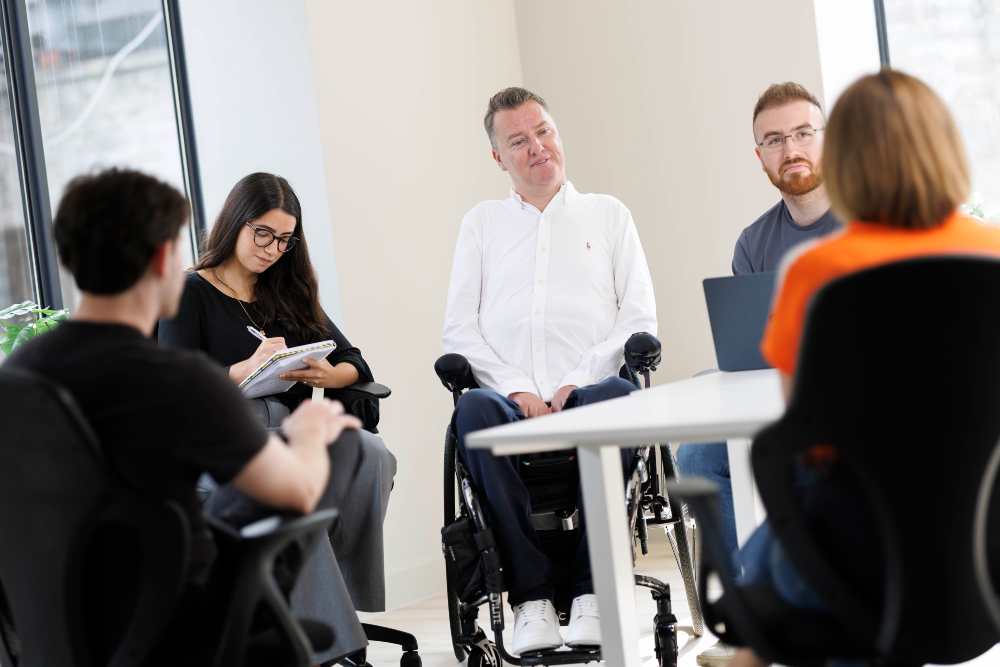
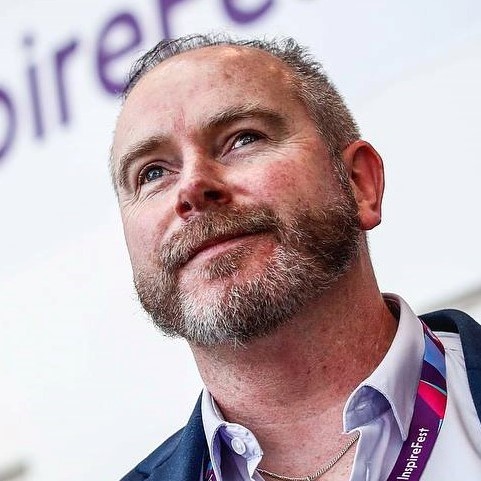
Podcast Ep 298: A spinal cord injury at 18 could have finished Stephen Cluskey’s ambitions. Instead it became the foundation for building Mobility Mojo, a business that is making accessible workplaces a reality for more than 1m people.
There are some days you will remember forever. Mine was a wakeup call delivered with equanimity and dignity by Stephen Cluskey, a wonderful entrepreneur who can say with certainty he is making a difference in the world.
Monday morning’s back to school mope and other trivialities fled my mind as I joined the call with Stephen and he began telling his story.
“Looking back, I feel incredibly fortunate. I should be dead, really, and if not dead, on a ventilator because of the level of my injury. I see being able to breathe for myself as a huge blessing”
“I was 18 years old, going into sixth year in Belvedere College with a good life ahead of me. On the fourth of August, 2002, I was out camping with friends when I fell from a hay bale. It wasn’t the fall that caused the damage – as I was lying on the ground, I lifted my head to move out of the way of a rolling bale, and it caught the back of my head and pushed it forward. I heard this crack in my neck, and in an instant, everything in my body went dead. It was like a bolt of lightning had hit me.
“I spent 14 months in the National Rehabilitation Hospital trying to come to terms with being paralysed from the neck down.”
The power of technology
You can also listen to the Podcast on:
“I get up every morning knowing we have the potential to impact more than 1.3 billion people across the world with disabilities – that’s our North Star. Almost 70% are unemployed. We want to dramatically reduce those unemployment rates”
Not long after the accident and while he was still coming to terms with things, a teacher showed Cluskey a head mouse that allowed him to move a cursor via a sensor in a sticker on his forehead. This changed everything.
“If I hold my head in position for a second or two, it clicks. I could use a computer faster than most people using assistive technology. That opened my eyes to the power of technology.”
As Cluskey’s world reopened, before him lay possibilities. He hasn’t wasted a day since.
Today he is the CEO of Mobility Mojo, a Dublin-based business that he founded along with Noelle Daly and Patrick Hickey.
Mobility Mojo provides a digital platform that helps organisations assess and improve accessibility across offices, retail spaces and manufacturing sites. The company’s technology replaces traditional paper-based audits with a standardised, data-driven approach, reducing costs and improving consistency.
The business recently reported a 63% rise in annual revenue as its platform now reaches more than 1,500 buildings and supports over one million employees worldwide. The growth comes as businesses face mounting pressure to meet new accessibility standards under the European Accessibility Act.
Mobility Mojo, which completed a €4.25m Series A funding round in January led by Gresham House Ventures, now operates in more than 30 countries and counts Accenture, UBS, Eli Lilly and Bayer among its clients. Other major employers including Diageo, Coca-Cola and HubSpot have also adopted the platform.
It plans to double the number of buildings assessed to more than 4,000 by the end of 2026 and expand its reach to 2.5mn employees.
The power of perspective
While technology brought Cluskey back into the world, it has been a long road. The challenges posed by his disability opened his eyes to the plight of others and sowed the seeds of a business idea.
“I spent the first eight years after the accident dedicated to recovery – intensive physio six days a week, four hours a day. By 2011, after all that work, I could literally move my elbow maybe an inch more than I could 10 years before. I thought, I have to get on with life.
“The catalyst came from a night out when I got stranded for six hours trying to get an accessible taxi. People with disabilities face huge challenges with transport in Ireland. I woke up the next day thinking this just isn’t good enough. I advocated with the Irish Wheelchair Association, spoke with the Minister for Transport, and got appointed to the Taxi Advisory Committee to influence creating more accessible taxis.
“I set up Wheelchair-taxi.ie to list every accessible taxi in Ireland. I met our original co-founder, Noelle Daley, at a Social Entrepreneurs Ireland event where we were pitching against each other. Neither of us was successful with those pitches, but we joined forces to create Mobility Mojo.”
Cluskey demonstrates that circumstances can become your greatest strength when viewed through the right lens.
“Perspective really helps. You have the power to choose how you look at things. Looking back, I feel incredibly fortunate. I should be dead, really, and if not dead, on a ventilator because of the level of my injury. I see being able to breathe for myself as a huge blessing.
“I get up every morning knowing we have the potential to impact more than 1.3 billion people across the world with disabilities – that’s our North Star. There are 1.3 billion people globally with disabilities, and almost 70% are unemployed. We want to dramatically reduce those unemployment rates. If not us, then who? Never underestimate the power of a stubborn, determined person or group of people to change things.”
Cluskey has to be the most authentic entrepreneur I have ever had the privilege of speaking with. Successful entrepreneurs reframe problems as opportunities and they choose optimism over pessimism, especially when the data says otherwise.
“When people hear accessibility and see my wheelchair, they probably think of ramps and big bathrooms. But accessibility is so much broader – it touches every one of our lives at some stage. We’re talking about mobility, visual, hearing, and neurodivergent challenges. By 2040, 60% of the workforce will be neurodivergent.
“The business case is compelling. Accenture did a global study and found that organisations inclusive to people with disabilities see 28% greater annual revenue because of the different perspectives these employees bring. When we design for the highest needs, ultimately everyone benefits. The remote control was originally designed for someone with a disability who couldn’t get up to change TV channels.”
So how does Mobility Mojo work and why are organisations like Accenture, HubSpot and Diageo embracing the platform?
“We’ve digitised accessibility assessment. Traditionally, you’d bring an accessibility consultant to spend three or four days in a building and get a 100-plus page report. We’ve developed technology where you walk through a building with our software on your phone, answering questions and taking photos for about three hours. You capture accessibility information based on 450 to 500 criteria, and we present it in a digital dashboard with all your actions to improve your building.
“For Accenture’s 650 buildings worldwide, they now have metrics on how inclusive and accessible each building is, with C-suite reporting capabilities. The output sits in Accenture’s workplace app, so employees with disabilities can see accessibility information before visiting any office. When they advertise job roles, they’re publishing accessibility information against job postings – the first in the world to do this. It’s saying subconsciously and consciously: ‘We want you working with us. We welcome you.’”
Cluskey views technology, especially AI, as “a great leveller and game-changer” and if anything it should democratise access, not create barriers.
“Our customers ask about costs for improvements – say, colour-contrasting handrails in Mumbai. AI has the potential where a building manager can ask our chatbot to get five quotes from local suppliers, and it will act as an agent to bring that information back. Think of the knock-on effect – we’re lifting all boats and making it as easy as possible to make buildings more inclusive.”
Cluskey’s calm manner dissipates slightly when he vents frustration at how competent people are disqualified from roles just because of a disability.
“I spoke to a friend in the US with visual impairment recently. She’s really smart but got 30 job applications and no interviews. She mentioned her visual impairment and guide dog in her cover letters. It’s just not good enough. There’s an opportunity for organisations to increase workforce diversity, get different perspectives, and increase their bottom line.”
The power of mind over matter
Cluskey’s personal story and how he put mind over matter to engineer a better future for millions of people is inspirational. The lesson for all of us is that no setback, however trivial or however great, should derail you from your vision.
“Going through bad things isn’t necessarily bad – it can bring perspective and open your eyes to things you were focused on wrongly. Having the accident gave me perspective to see all the good things in the world”
He believes that perspective should be considered a business superpower.
“Business can be a big driver for change in the world. You have the option to view things in a bad way or a good way. I’d much prefer to be positive about something and wrong rather than negative and right.
“There was a great phrase in the movie Vanilla Sky: ‘The sweet never tastes so sweet without the sour.’ Going through bad things isn’t necessarily bad – it can bring perspective and open your eyes to things you were focused on wrongly. Having the accident gave me perspective to see all the good things in the world.”
Cluskey’s story about meeting with former Taoiseach Leo Varadkar illustrates how making people uncomfortable can be strategically powerful.
“The power of making people uncomfortable can create change. I had a meeting with Leo Varadkar when he was Taoiseach. When we met, he went to shake my hand, and I couldn’t shake back. He got really embarrassed. I was able to use that to my advantage – in the next hour, he basically wanted to give everything I was looking for because he was so uncomfortable about that moment.”
In conclusion I asked Cluskey what emerging technologies will redefine accessibility in the next decade?
“We can’t have this conversation without mentioning AI. We see a big place for AI within our platform. But the bigger picture is about thoughtfulness – people just need to think beyond their own situation and consider others.
“The power of business to make real change is incredible. From our start in Ireland with Noelle and myself sharing a desk to raising about €6m euros and working with the biggest organisations in the world – there’s opportunity in tragedy and challenges.”
-
Bank of Ireland is welcoming new customers every day – funding investments, working capital and expansions across multiple sectors. To learn more, click here
-
For support in challenging times, click here
-
Listen to the ThinkBusiness Podcast for business insights and inspiration. All episodes are here. You can also listen to the Podcast on:
-
Spotify
-
SoundCloud
-
Apple