Podcast Ep 300: Business in the Community Ireland climate action programme doubles participation as supply chain demands drive sustainability action among SMEs.
Small and medium-sized enterprises across Ireland are accelerating their climate action efforts, driven by increasing demand from large corporate customers and new regulatory requirements that are reshaping business relationships.
Business in the Community Ireland (BITCI) recently concluded the second phase of its All-Ireland Climate Action Programme, with participation doubling to 40 companies from the previous year.
“It’s about laying a foundation so people are on the same playing field and giving them practical tools”
The initiative, delivered in partnership with Business in the Community Northern Ireland, brought together SMEs with support from major corporates including Bank of Ireland Group, ESB and SSE Airtricity.
Making sustainability easy
You can also listen to the Podcast on:
“We have a certain role in society in terms of making sure that we are bringing all of our SMEs on the journey with us as a large company,” said Colette Shirley, director of Sustainability at Bank of Ireland.
“This programme breaks down sustainability into easy to understand topics and gives people practical knowledge to take action in their business immediately.”
The programme provided accredited carbon literacy training and helped SMEs develop tailored climate action plans. It also encouraged collaboration between large companies and their suppliers to cut emissions across value chains.
For many participating businesses, the driving force was customer demand rather than regulatory compliance.
Maura Lavelle, head of marketing at Willows Ingredients, said her company was prompted to act by questions from European and UK customers operating under Corporate Sustainability Reporting Directive (CSRD) requirements.
“A lot of our bigger customers, particularly across Europe and the UK, are starting their financial reporting and CSRD requirements,” Lavelle explained. “We have a huge, complicated value supply chain dealing with suppliers from Asia to parts of Europe to America. Being able to measure their environmental impact and deliver that information to our customers is crucial.”
The supply chain goes green
The shift reflects a broader trend where large companies are engaging their supply chains as part of their own decarbonisation strategies.
Dorothy Maxwell, partner and head of Sustainability at BDO, noted that over 70% of a large company’s carbon footprint typically sits in its supply chain.
“If the large company wants to do something about it, they have to engage,” Maxwell said. “Most businesses now recognise there’s a risk if they don’t manage the impacts of climate change on their business, and also a massive opportunity when they do.”
For ESB, which has set a target of achieving net zero emissions by 2040, engaging with SMEs represents both an opportunity and a necessity.
Conor O’Regan, ESB’s chief procurement officer, said SMEs make up a large part of the company’s supplier base and can bring crucial innovation to the energy transition.
“SMEs are very close to the work. They understand what needs to be done, and they can bring in that innovation,” O’Regan said. “If they’re builders, they’ve got their hands on the operating equipment. They can see a cheaper and better way of doing things.”
The energy sector itself is undergoing rapid transformation, with companies like SSE Airtricity working to meet diverse customer requirements ranging from domestic renewable energy supply to corporate power purchase agreements.
Russell Keating, sales director at SSE Airtricity, said the company serves over 35,000 SMEs, all at different stages of their decarbonisation journey.
“Many of them are finding that when they’re tendering for business from larger companies, they need to be able to chart their own emissions,” Keating explained. “There’s an onus on us as a leader in this space to provide guidance to these companies.”
Thinking bigger
The programme’s success has encouraged organisers to expand further. Eadaoin Boyle Tobin, sustainability advisor at BITCI, said there are plans to increase participation again next year.
“We find there’s a vast range of maturity among SMEs. Some are not even aware of what’s going on, others are taking real action,” she said. “It’s about laying a foundation so people are on the same playing field and giving them practical tools.”
Bank of Ireland has complemented its programme participation with additional support tools, including a free digital platform called Sustainable Business Coach available to all Irish SMEs.
Shirley emphasised the importance of practical action over complex sustainability jargon.
“If you think of sustainability as practical actions, if you think of sustainability as efficiency in your businesses, both of those things will add up to decarbonisation,” she said. “Focus on renewable energy, using less energy, thinking about waste and water usage. All of those actions will lead to more efficiencies and hopefully cost savings.”
The programme’s emphasis on peer-to-peer learning has proven particularly valuable. Traci Adams from Business in the Community Northern Ireland highlighted the benefits of bringing together companies from similar sectors.
“They get that peer-to-peer learning, which is incredible,” Adams said. “You start to get scale, engagement, and then they can move on to the next sustainability innovation.”
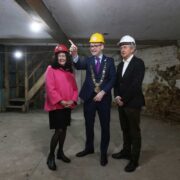
Top image: Kevin Baxter, interim head of Corporate & SME Banking at Bank of Ireland, with Maura Lavelle, head of marketing at Willows Ingredients, at the BITCI graduation event
-
Bank of Ireland is welcoming new customers every day – funding investments, working capital and expansions across multiple sectors. To learn more, click here
-
For support in challenging times, click here
-
Listen to the ThinkBusiness Podcast for business insights and inspiration. All episodes are here. You can also listen to the Podcast on:
-
Spotify
-
SoundCloud
-
Apple