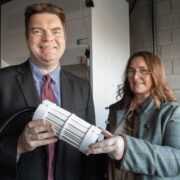

Ireland’s manufacturing sector is riding the tariffs storm with skill, says Bank of Ireland’s head of Manufacturing Sector Conor Magee.
Irish manufacturing is showing renewed strength in 2025, buoyed by a sharp rise in exports to the United States as firms seek to mitigate the impact of tariffs, according to Magee’s latest update in Bank of Ireland’s Developments & Insights report for December 2025.
The sector’s Purchasing Managers Index averaged 52.1 this year, signalling expansion, while the EU remains close to neutral at 49.
“Manufacturers are laser-focused on costs and margins”
Export activity has been a key driver. Shipments to the US jumped 90% year-on-year from January to September, with pharmaceutical exports soaring 153%. A second spike in September suggests companies are hedging against ongoing uncertainty over tariff rules.
The new manufacturing reality
“As the tariff story plays out, businesses will not deflect from a laser focus on costs and margins with a new emphasis on how best to serve their US customers in line with the new landscape of tariff costs,” Magee explained.
The EU-US trade agreement, effective from August, introduced a 15% tariff on most goods, with exemptions under review for pharmaceuticals, semiconductors and aerospace. Steel and aluminium face a 50% levy. Ireland currently holds the lowest trade-weighted average tariff in the bloc at 5.6%, a burden estimated at €5.7 billion.
Magee said that legal challenges and policy reviews in Washington could reshape the tariff regime. A Supreme Court case questioning the legality of tariffs under the 1977 IEEPA Act could cut the average US rate from 17.9% to 9.1%.
Meanwhile, Section 232 investigations may yet impose duties on pharmaceuticals and semiconductors, and lobbying by US SMEs could add hundreds of products to the tariff list.
The US government expects tariff revenues to reach $2.6 trillion over the next decade and has floated the idea of a $2,000 dividend for low-income households funded by these proceeds.
Magee said that for Irish businesses, the shifting trade environment underscores the need for scenario planning and cost control. Enterprise Ireland grants remain available to help SMEs adapt.
Beyond trade, climate targets pose another challenge. The UN Emissions Gap Report warns the world is off track to meet temperature goals. Ireland faces similar pressure: the Environmental Protection Agency projects a 23% cut in greenhouse gases by 2030, far short of the 51% target. Failure could trigger penalties of up to €23 billion.
Despite this, corporate commitment to decarbonisation appears resilient. PwC’s latest survey of 4,000 firms found that 47% maintained their goals and 37% became more ambitious.
Magee noted: “Companies which were once accused of ‘greenwashing’ – making deceptive promises, are now “greenhushing” – getting on with the job of decarbonisation behind the scenes, without fuss, because they know it is the right thing to do to create long term value.”
As Irish businesses navigate a trading environment impacted by global geopolitical uncertainty, the opportunities associated with artificial intelligence (AI) and fluctuating consumer sentiment, the Bank of Ireland Sectors team examine the developments, challenges and opportunities across seven key elements of the Irish economy; Agriculture, Healthcare, Hospitality, Manufacturing, Food & Drink, Retail and Technology-media-telecoms (TMT).
Read the full report:
-
Bank of Ireland is welcoming new customers every day – funding investments, working capital and expansions across multiple sectors. To learn more, click here
-
For support in challenging times, click here
-
Listen to the ThinkBusiness Podcast for business insights and inspiration. All episodes are here. You can also listen to the Podcast on:
-
Spotify
-
SoundCloud
-
Apple