
Irish research teams have secured over €6.9 million in National Challenge Fund prize funding, announced by Minister James Lawless as part of an EU‑backed programme supporting the green and digital transition.
More than €6.9 million in prize-phase funding has been awarded to Irish research teams developing practical solutions in sustainable textiles and aquaculture, as the National Challenge Fund moved into its final phase.
The funding was announced today (Tuesday, April 21, 2026) by the Minister for Further and Higher Education, Research, Innovation and Science, James Lawless, TD, and supports four teams across the Sustainable Communities and Future Food Systems challenges.
The National Challenge Fund is financed through the EU Recovery and Resilience Facility and is designed to support projects aligned with Ireland’s green transition and digital transformation priorities.
Social and economic value
Speaking at the announcement, Minister Lawless said the successful teams were showing how research can translate into outcomes with direct social and economic value.
“The teams receiving funding today join a network of researchers supported through challenge-based funding programmes that are delivering real and tangible benefits for the people of Ireland.
“From pioneering new circular approaches to textile recycling, transforming mobility at community level, advancing sustainable aquaculture and resilient agrifood production, the teams have demonstrated exceptional ambition, scientific excellence, and a clear pathway to real-world impact.”
The Sustainable Communities Challenge prize was awarded to PUreTex, led by Dr Susan Kelleher and co-led by Dr Jennifer Gaughran at Dublin City University, with Claire Downey of the Rediscovery Centre acting as societal impact champion.
The project addresses the growing issue of textile waste. Around 60 garbage truckloads of textiles are landfilled or incinerated every minute across the EU, while globally less than 1 per cent of clothing is recycled back into garments. PUreTex focuses on post-consumer textiles, using chemical recycling techniques to convert end-of-life materials into high-value products such as polyurethane foam insulation.
Alongside technical development, the team is working with the Rediscovery Centre to support behavioural change in textile design and consumption, and to strengthen understanding of circular practices across industry and communities.
“This funding means a great deal to us. The chance to work on a problem this important, alongside partners this strong, is a real privilege. Addressing textile waste at scale requires both rigorous fundamental research and a clear pathway to real-world impact, you cannot do one without the other.
“Understanding how end-of-life textiles can be broken down into high-purity, high-value building blocks is essential to developing high-performing insulation materials. Our partnership with the Rediscovery Centre, who bring expertise across circular design, policy, and industry engagement, will be central to ensuring this research creates genuine, lasting impact.”
A runner-up award under the same challenge was made to the CONUNDRUM team, led by Professor Niamh Moore-Cherry of University College Dublin, with Professor Brian Caulfield of Trinity College Dublin as co-lead and TASC’s Kieran Harrahill as societal impact champion.
Under the Future Food Systems Challenge, the top prize went to NanoSA, led by Dr Niall Maloney at Atlantic Technological University, with Professor Enda McGlynn of Dublin City University as co-lead and Catherine McManus of Mowi Ireland as societal impact champion.
The NanoSA project is developing rapid, on-site diagnostic tests for bacterial and viral infections in salmon aquaculture. Pathogenic disease is estimated to cost the global salmon sector between €1.2 billion and €1.7 billion each year. Current diagnostic processes often involve sending samples to off-site laboratories, delaying treatment decisions.
NanoSA’s lateral flow assay technology aims to provide fish health specialists with fast, reliable results at farm level, supporting timely interventions, improved animal welfare and reduced losses.
“We’re thrilled to receive prize-phase funding,” Dr Maloney said. “The National Challenge Fund has helped shape our technology so that it addresses real operational challenges for aquaculture producers. Working closely with DCU and our industry partners at Mowi has been central to our progress.”
“We’re thrilled to receive Prize phase funding under the Future Food Systems Challenge,” Dr Maloney said. “This support allows us to continue developing our platform for rapid, farm‑site detection of pathogenic infections in salmon aquaculture.
“The training provided through the National Challenge Fund has been central in shaping our technological developments so that we’re addressing key challenges for the aquaculture industry. I’m grateful to our collaborators in DCU and to our industrial partners at Mowi – their involvement has been key to our success to date. We’re excited to continue this work and help build a more sustainable and resilient aquaculture food system.”
A runner-up award in the Future Food Systems Challenge was also made to the SINFERT team, led by Dr Kirill Nikitin and Dr Simon Hodge of University College Dublin, with societal impact champions from Dawn Meats Group and ICL Group.
The value of challenge-based research
Dr Diarmuid O’Brien, chief executive of Research Ireland, said the programme demonstrates the value of challenge-based research that embeds collaboration from the outset.
“As we embrace increasingly complex environmental and societal challenges, we are proud to support research teams who are delivering innovative, evidence-based solutions,” Dr O’Brien said.
“At Research Ireland, we are committed to building partnerships where stakeholders are not passive beneficiaries but active co-creators, helping to drive decisions, shaping outcomes, and ensuring that innovation delivers real and meaningful benefit.
The teams receiving further funding today represent not only scientific excellence but the power of partnership between researchers, communities, industry, and policymakers. I congratulate all of the teams advancing to the next stage and look forward to seeing their projects translate into meaningful impactful outcomes.”
EU Commissioner Michael McGrath said the projects illustrate how EU funding can generate local impact while supporting wider European goals around climate neutrality, resource efficiency and the circular economy.
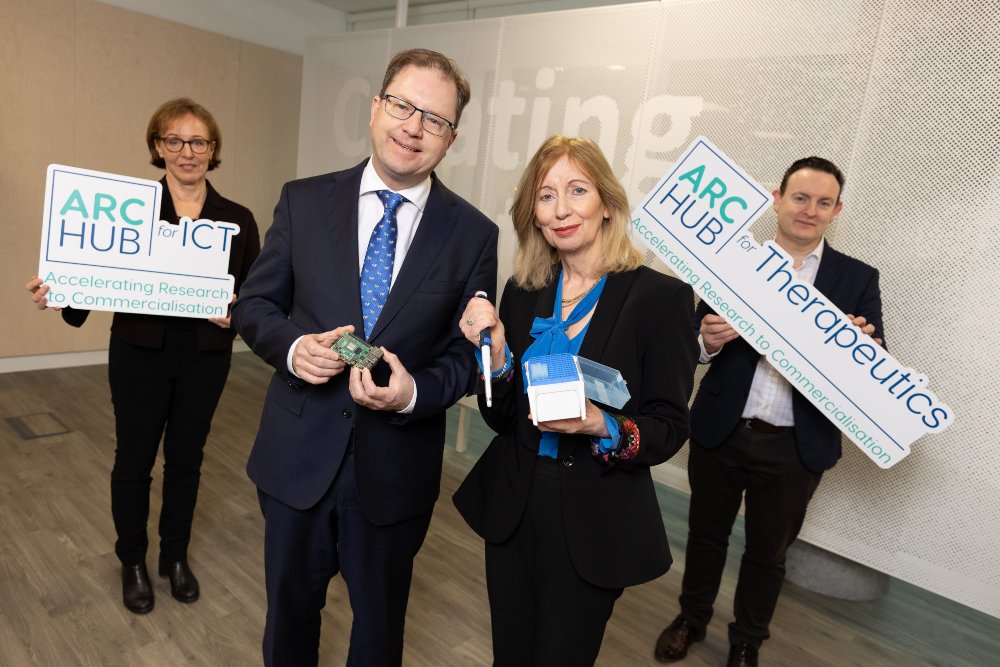
Top image: Colm O’Reardon, Secretary General, Department of Further and Higher Education, Research, Innovation and Science; Dr Jennifer Gaughran, DCU, Co-lead PUreTex Team; Dr Niall Maloney, ATU, Lead of the NanoSA Team; Dr Susan Kelleher, DCU, Lead of the PUreTex team; and Dr Ruth Freeman, Director of Research for Society, Research Ireland. Photo: Johnny Mallin
-
Bank of Ireland is welcoming new customers every day – funding investments, working capital and expansions across multiple sectors. To learn more, click here
-
For support in challenging times, click here
-
Listen to the ThinkBusiness Podcast for business insights and inspiration. Latest episodes are here. You can also listen to the Podcast on:
-
Spotify
-
SoundCloud
-
Apple