
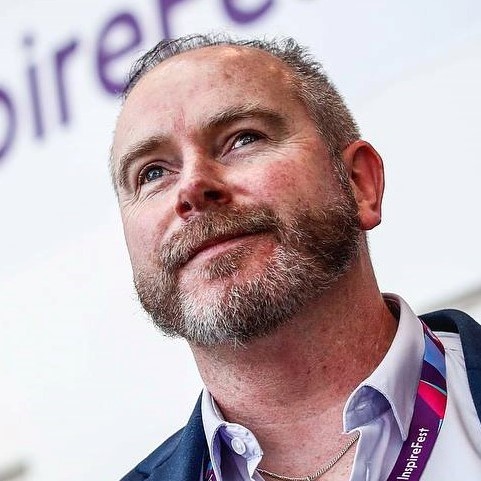
Podcast Ep 293: From art college to skating to where the puck is going in VR, Mersus Technologies CEO Geoff Allen talks about the importance of timing and resilience for entrepreneurs.
Geoff Allen’s art college experience of weekly critiques taught him that “if you can’t take criticism without going into a tailspin, your resilience drops.” This prepared him for entrepreneurship where you must put your ideas on the counter and accept feedback.
Resilience he told the ThinkBusiness Podcast isn’t just about surviving – it’s about maintaining a “mindset of plentiful bounty” and finding positives even in challenging situations. This mental toughness he says is crucial for start-up founders facing constant rejection and setbacks.
“Behind AI, there’s a growing undercurrent of suppressed creativity. What we’re about is realising that into something of value”
Mersus Technologies, based in Athlone, Ireland, is a virtual reality and animation studio specialising in immersive training solutions for advanced manufacturing and life sciences. Its flagship product Avatar Academy uses VR to simulate cleanroom and industrial environments, reducing training costs and improving compliance.
Founded by Allen, the company has roots in digital training since 1997. Mersus has won major European tech awards and attracted Enterprise Ireland support, positioning itself as a leader in industrial VR innovation.
The business recently won the Excellence in Talent Development Award for its groundbreaking strategy to solve the critical XR (extended reality) talent shortage at the 33rd annual Technology Ireland Industry Awards (2025).
The imagineer who sees things differently
-
You can also listen to the Podcast on:
-
Spotify
-
SoundCloud
-
Apple
Allen is a refreshingly different kind of businessperson to interview. You could say he’s happy in his own skin, doesn’t really fit a typical executive mold nor tries to. What you see is what you get.
I first met him during the summer in a restaurant in Dublin where he immediately stood out among the crowded tables, wearing a VR headset and doing gestures in the air to manage his virtual surroundings. People looked agog. He didn’t care. Within minutes I too was learning how to manage a virtual factory and he impressed on me how the future of business and industrial training is indeed virtual.
He doesn’t see himself as an engineer, an entrepreneur or an artist. He’s all three combined. An imagineer!
“Disney actually borrowed the word, and like true Disney, they trademarked it,” he quips. “But ‘you imagine it, and we’ll make it’ – that’s pretty much it. That’s the world I see unfolding. The only limit is your imagination when it comes to the virtual.
“I think business owners these days need to think in three dimensions: the physical, the digital, but also now the virtual, which is the dawn of the virtualisation of the web. Behind AI, there’s a growing undercurrent of suppressed creativity. What we’re about is realising that into something of value.”
As mentioned, Allen credits his early days at art college where criticism was a constant as forging a steely resilience within him.
“One of my investor colleagues always sees the positive in any situation, even in sinking ship stuff. That’s what entrepreneurship is about – when the world’s closing in, you need to turn and pivot.”
Allen’s father was a car and truck dealer and he learnt his business chops watching his father at work. Growing up he was obsessed with graffiti, types, fonts and design and when he went to college he was amazed by the rows of shiny new computers with no one to teach their use. He was hooked.
“Myself and Johannes Gutenberg are in the same business. When he was at it, nobody could read and paper was really expensive. For me, the immersive media we create is simply the next generation of the internet.
“I’ve been following that thread since the 1980s when Apple gave computers to all the colleges. I left and did my Leaving Cert in ‘88, went to the local regional technical college, and they had computers with nobody to teach it. So I just sat down and started poking keys. I always thought a computer was just a paintbrush – a tool. Still is.”
After graduating from NCAD, Allen went to New York just as the internet arrived.
“We were compiling magazines on a single computer, which was amazing – it was Star Trek, Arthur C. Clarke magic. We made a lot of money, spent a lot of money. I returned to Ireland after 9-11, came home to the family business importing machinery from Japan. When the [financial] crash came, I went back to college and did my Master’s in Digital Media where I met my co-founder Dermot Condron.
“We founded a partnership called Making Media Mobile for mobile devices. I rang 650 people and sold none – everyone said ‘who uses the phone to search the internet?’ From there we got into websites, animation, and video. Dermot said, ‘why not use gaming engines to make animations?’ That started our journey in VR in 2015.”
Finally, a perfect storm is coming for VR?
For the last two decades the tech world has been hotly anticipating the rise of VR or XR as it is increasingly being known, with Microsoft pushing its HoloLens technology, Meta chomping at the bit to create virtual worlds and Apple releasing its prohibitively expensive Vision Pro headset.
So far, the devices have proven beyond the minds and wallets of most consumers but Allen is confident things may soon change.
“There have been a lot of false dawns for virtual reality, augmented reality, and all the realities – we call them immersive. Those false dawns were because we weren’t in a perfect storm. Now the headsets are becoming more affordable at €300 euros, as opposed to Apple’s at €3,500.
“We target industry because industry can afford it. It’s eye-wateringly expensive to make this media correctly, and that’s the challenge – not many studios can make it correctly. It boils down to physics: we watch video at 25 frames per second, but for immersive media to fool the brain that you’re in that space, it needs to be 72 frames per second. If it drops below 72 into the 50s and 30s, the brain starts thinking there’s something wrong and people feel nauseous.
“The biggest inhibitor of virtual reality for Meta, Google, and Apple is the quality and technical prowess of the media. If it’s not good, people shrink away from putting on a headset because they’ve had bad experiences.”
He believes the Athlone business is in the right place at the right time. “Mersus does high-fidelity graphics as well as anybody in the world, and industry is the best use case.
“If you asked me a year ago, I’d be wondering if this would be the future. For certain, it is now. Last year, Apple got into the game and Google got back in. AI will drive these virtual worlds, and the high-fidelity graphics will do that. I’ve lived this journey into the internet for the last 30 years – that content will need to be rebuilt now for the virtual internet.”
He says his company’s Avatar Academy will eventually become a “no code” platform that will allow anyone to author their own VR content.
“We’re creating the PowerPoint of VR. We’ve avoided investments so far and bootstrapped with small mom-and-pop investment and Enterprise Ireland support. We’ve been able to stay true to the cause without commercial pressures to sell inferior media. The people who use it really love it – some of the biggest names in med tech and biopharma in the world. Now we’re expanding into semiconductor and data centres.
“Our intellectual property is around standardised interactions – we can apply interactions like picking up a mug of coffee, swirling it, tilting it, and drinking. We sequence these interactions so people using our software can sequence those. All the voiceover is now AI – text to speech. Mark Zuckerberg launched AR glasses that work on the same operating system as VR headsets, and Avatar Academy outputs content for both AR and VR.”
One of Ireland’s best kept tech secrets is Athlone which, with a regional university focused on AI and VR, as well as local tech businesses and long-time employers like Ericsson, has a cachet for software development that few other locations outside of Dublin or Cork can match.
Allen credits the midlands city as a brilliant place to start a business. “Why Athlone? I have emotional support from family and friends, and a very low cost base, which makes it possible. I couldn’t do this in Dublin with the costs. Technology is accelerating everything, but the model around entrepreneurship is not accelerating in line with that.”
-
Bank of Ireland is welcoming new customers every day – funding investments, working capital and expansions across multiple sectors. To learn more, click here
-
For support in challenging times, click here
-
Listen to the ThinkBusiness Podcast for business insights and inspiration. All episodes are here. You can also listen to the Podcast on:
-
Spotify
-
SoundCloud
-
Apple