ManageEngine CEO Rajesh Ganesan outlines Ireland growth plans, leadership lessons, AI risks, long-term strategy and preparing businesses for uncertainty.
Enterprise technology business ManageEngine has revealed plans to expand its business in Ireland after recording 25% growth in the market.
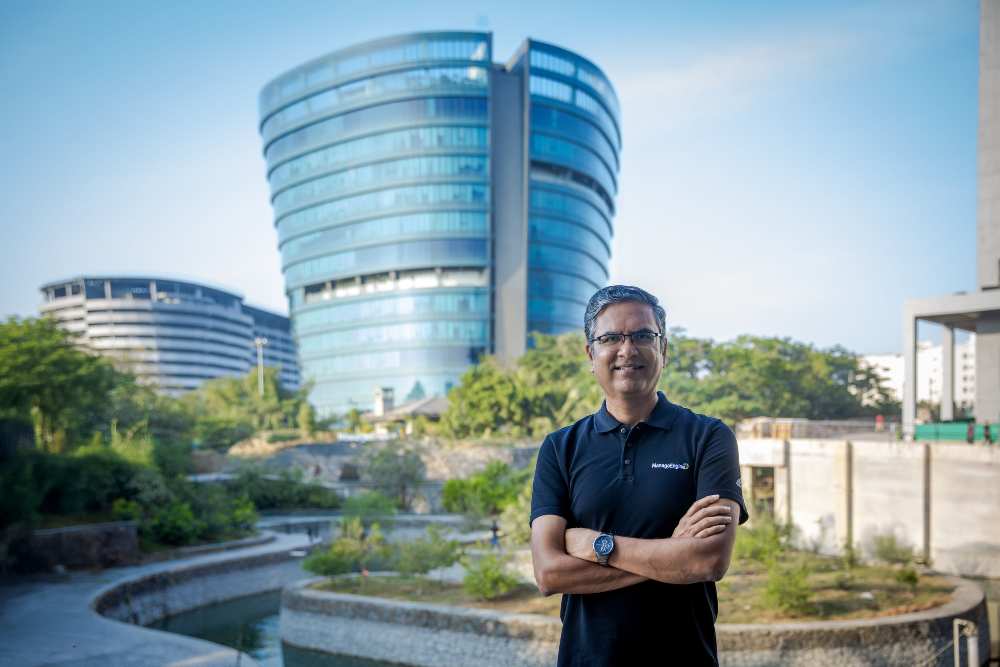
The business, which counts 80% of Irish local authorities among its customers, has been active in the Irish market for two decades and is led by CEO Rajesh Ganesan, an engineer at heart who believes in reinventing himself every few years to stay relevant and good at his job.
“We believe there is significant headroom for us to grow in Ireland, and we are committed to investing in the market for the long term”
ManageEngine is a division of the giant India-based Zoho Corporation and counts Ireland and the UK as its second largest market globally, contributing 10% to its overall global revenue.
It opened a data centre in Dublin in 2017 alongside a sister data centre in Amsterdam to support its European customer base and reinvests 40% of its global revenues into R&D to accelerate product development.
Much of ManageEngine’s growth in Ireland is attributed to its strong partnership with Irish firm Servaplex, whose relationships with local businesses have been pivotal to its growth. It counts organisations such as McHale Engineering and Foróige as customers and attributes its strong reach into 80% of local authorities to its partnership with Servaplex.
Ganesan told ThinkBusiness how he plans to widen the business’s partner network in Ireland to deepen customer relationships.
“Ireland is a digitally mature market with a strong technology orientation, a significant multinational presence and a large base of SMEs,” Ganesh said. “For us, that combination makes it a very important opportunity. Servaplex has played an important role in building our presence in Ireland, and we see considerable opportunity to build on that foundation. Our ambition is to grow not just our customer base and revenues, but also our partner ecosystem, bringing more capable partners into the market and working closely with them to reach and educate more businesses. We believe there is significant headroom for us to grow in Ireland, and we are committed to investing in the market for the long term.”
KEY NUMBERS: ManageEngine’s Ireland Growth Ambitions
• 25% growth recorded in Ireland
• 80% of Irish local authorities among customers
• Ireland and UK generate 10% of global revenue
• 40% of revenue reinvested in R&D
• More than 60 products sold globally
• Operations across 190 countries
• 6,000 employees worldwide
• Two-year runway modelled for zero-revenue scenarios
Editorial takeaway: ManageEngine is combining strong Irish growth, deep R&D investment and a conservative, bootstrapped strategy to expand while preparing for potential AI and economic turbulence.
Be patient and bootstrap
Perhaps because he isn’t caught up in the Silicon Valley bubble by virtue of being headquartered in Chennai in India, Ganesan has a different take on the current AI frenzy. A market correction caused by the sheer amount of funding going into a tiny handful of AI frontier firms is likely, but he has seen it all before.
“We don’t go all bullish and pump everything into cloud and everything into AI. We are not in the business of building the next shiny new toy”
Ganesan has run ManageEngine for long enough to have watched three global downturns arrive, do their damage and pass. The same will be true of the AI bubble. If it does go pop, there will be damage, but the world will beat on. Business will recover. Life will go on.
He joined as employee No 8 at ManageEngine in 1997 when it was making management software for telecoms equipment makers like Ericsson and Nortel. “The world was building what I’d call Internet 1.2 at the time, and that needed infrastructure.”
👉 No tech background needed to bring your business into the AI age! Secure your Google AI Professional Certificate to complete the certification at no cost. Apply now and get started!
Three decades on and ManageEngine sells more than 60 products to customers in 190 countries. It employs 6,000 people and has passed $1 billion in revenue, all without taking a cent of outside investment. It has also set an internal target to grow Irish revenues significantly by the end of 2029, a target that Ganesan treats the way he treats most things. It’s a long game, not a sprint.
ManageEngine’s pitch to markets like Ireland rests on a gap it believes the largest cloud vendors leave open.
“We are not driven by targets or profit, because we are still bootstrapped, completely bootstrapped,” Ganesan says. “We have no idea of ever getting listed, I can say that. When we look at countries like Ireland, even though you have the presence of big tech companies here, their customers are not served the same way as their biggest customers, because of their size, their scale, their complexity, their maturity. This is what we see as the sweet spot, countries like Ireland, regions like Africa, Latin America, India. We think long term.”
His reluctance to chase every wave runs right through ManageEngine’s history, from cloud and virtualisation to mobility and blockchain, and now it shapes how the company talks abut generative and agentic AI. “We are very clear, we are not chasing trends,” he says. “We will wait and watch. We wanted to stay relevant, understand what our customers really needed, their understanding of technology, how it sort of influenced them in their decision making in their operations.”
Ganesan is direct about where he thinks that instinct puts ManageEngine. “We don’t go all bullish and pump everything into cloud and everything into AI,” he says. “We are not in the business of building the next shiny new toy. We are not building the next big LLM (large language model) with three trillion parameters. But when our customers use a model with a hundred billion parameters, we will supply the platform that will help them use it safely.”
Hard times may be ahead, but these too will pass
Ganesan does not believe the current AI investment cycle is built on solid ground. “You must have followed the transformer model that gave rise to generative wave technology. That was not a recent idea,” he says. “What the US did is throw a lot of capital into the compute infrastructure. It was not an algorithmic breakthrough. It’s a high performance compute problem today, it’s not an algorithmic problem, or a software architecture problem, which we believe is not sustainable.”
Pointing to the concentration of capital among a handful of companies, Ganesh says the market is rife with risk. “Their model is like, I want to be the last person standing, throw the kitchen sink into building the compute infrastructure. It’s three companies: Nvidia selling equipment to OpenAI and Anthropic, and also investing in them, giving them money to buy their GPUs, and it’s flowing.”
He points Asia’s take on AI as different. “If you see what’s happening in China, or to some extent even in India, they are thinking about where to apply it, than to be the last person standing building this massive AI system, which is a monolithic piece of technology. We apply our language model to specific areas to solve problems, and we don’t talk too much about the model itself.”
Asked whether the scale of investment worries him, Ganesan draws on three previous downturns he has lived through, including the 2001 dot-com crash, the 2008 financial crisis and the 2020 pandemic. In 2001 25 out of 50 of his customers disappeared because they were speculative dot-com/telecoms ventures.
But his assessment on how things currently stand is stark. “It’s extremely uncertain. It’s very hard to say this is how this will pan out,” he says. “Hard times are ahead, that much is sure. We are optimistic,” he adds, pointing to how the tech sector recovered after the dot-com crash and the aftermath of 9-11. “The tech companies imploded, the dot-com bubble burst,” he says. “But the big guys, Intel, Microsoft, all these guys, they just marched on. Apple became one of the biggest companies in the world, went from being a nearly dead company to being fully alive. Humanity will go the same way.”
Leading through uncertainty
Every three or so years Ganesan reinvents himself to ensure he can do his job as CEO. The essence of this is what he repeats often: letting go.
“Be excited about the opportunities that are in front of you. Just create a simple life. Find the spark. Keep it alive”
“This is what most people cannot do, because they want to cling onto what they have, or what they do, or what they think they do. We have to set the example, I have to let everything go, the products I was owning, the products I was managing, to take up a completely new role in a totally new territory. When I fall down, I struggle, I get up more. This is what I have learned.”
This philosophy shapes how ManageEngine plans for the future at a company level, not just individually.
“The leadership message currently inside Zoho and ManageEngine is, be ready for this, be ready to start from zero again if needed,” Ganesan says. “We plan our operations around what is the worst thing that can happen. Revenue drops to zero as a business. If our revenue drops to zero month after month, can we have a runway of two years where we can still pay people, to the extent of feeding them and being able to send their children to school? We are ready for that.”
He describes planning for three different scenarios: a worst-case scenario, a best-case scenario, and a normal scenario of continued growth. “This is the mindset you need.”
Despite widespread global anxiety that AI will hollow out careers, Ganesan offers a message routed in his own start in the industry from a small town in southern India in the 1990s.
“Be excited, positively, about things, and not be depressed,” he says. “The world is going to give you both the options. One side, all the opportunities. The other side, there is going to be no jobs, no relevance for you. I don’t think so. We are eight, nine billion population. We all need to be fed. Someone needs to pay for this stuff.”
He draws an analogy from aviation history to point to where AI is heading. “The world built the first aircraft in 1913, and then the jet engine, sixties and seventies, revolutionised world travel,” he says. “The world was getting carried away, we built the supersonic engine too. How long did that last? Apply the same analogy to AI today. The world does not require supersonic jets. We are perfectly fine with subsonic jets. You don’t need a model like Claude to do all your tasks. You cannot sustain the way that model runs, how compute hungry that is, how power hungry that is. The world will settle for something like the jet engines that we have today, which is perfectly fine for global air travel.”
His advice to young graduates looking uncertainly at the world is to resist measuring themselves against the fastest movers in the industry, echoing the sentiment that comparison is the thief of joy. “Stay curious, stay excited,” he says. “The problem people tend to do is compare themselves, I am going to have growth in three years, they are looking at market, they are looking at making money out of money. In the first three, four years of my working life, I was not worried about building money, financial status. It was all exciting for me because I come from a small town in south India. Everything was new, everything was exciting. Be excited about the opportunities that are in front of you. Just create a simple life.
“Find the spark,” he says. “Keep it alive.”
Returning to the Servaplex partnership that has been instrumental to ManageEngine’s growth in Ireland, Ganesan said he could have signed up multiple Irish distributors over the years but chose not to.
“Our company is deeply rooted on some philosophies and beliefs, how we think long term, how we think we want to be private, how we put customers first,” he says. “Our partners, it is extremely important, they carry the same value, they believe in the same value, because they are the face of ManageEngine in Ireland. They absolutely take it to our customers here, and that is why the relationship has lasted so long. They are not running their own business as Servaplex, they represent ManageEngine. We wanted cultural alignment, philosophical and value system alignment, more than the business alignment. Once we have that in place, everything else is taken care of.”
FAQ: Leadership, AI and Growth Lessons from ManageEngine CEO Rajesh Ganesan
Q: Why is ManageEngine expanding in Ireland?
A: ManageEngine sees Ireland as a digitally mature market with a strong technology sector, multinational presence and large SME base, making it a strategic growth opportunity.
Q: How important is Ireland to ManageEngine globally?
A: Ireland and the UK are ManageEngine’s second-largest market globally, contributing 10% of overall revenue.
Q: What is Rajesh Ganesan’s view on the current AI boom?
A: He believes the current wave is driven largely by investment in computing infrastructure and warns the concentration of capital among a small number of companies may prove unsustainable.
Q: Is ManageEngine investing heavily in AI?
A: The company says it is adopting a measured approach, focusing on how customers can use AI safely rather than building large frontier AI models.
Q: Why has ManageEngine remained bootstrapped?
A: The business has grown to more than $1 billion in revenue without external funding and prioritises long-term sustainability over short-term targets.
Q: How does ManageEngine plan for uncertainty?
A: Leadership teams model three scenarios: worst case, best case and expected growth, while maintaining financial resilience for severe downturns.
Q: What leadership philosophy does Ganesan follow?
A: He believes leaders must regularly reinvent themselves, let go of previous roles and remain adaptable as markets change.
Q: What advice does Ganesan have for young professionals?
A: Stay curious, focus on learning, avoid constant comparison with others and remain excited about emerging opportunities.
Q: What role do partnerships play in ManageEngine’s Irish strategy?
A: The company credits its long-standing partnership with Servaplex as a key driver of its reach across Irish businesses and local authorities.
Q: What is the biggest leadership lesson from the interview?
A: Prepare for multiple outcomes, think long term and avoid chasing every technology trend while staying open to change.
👉 No tech background needed to bring your business into the AI age! Secure your Google AI Professional Certificate to complete the certification at no cost. Apply now and get started!
-
Bank of Ireland is welcoming new customers every day – funding investments, working capital and expansions across multiple sectors. To learn more, click here
-
For support in challenging times, click here
-
Listen to the ThinkBusiness Podcast for business insights and inspiration. All episodes are here. You can also listen to the Podcast on:
-
Spotify
-
SoundCloud
-
Apple