
Ireland sets out plan to build “stronger, more resilient” economy through research overhaul.
Ireland has set out a sweeping plan to elevate its research and innovation capacity, with the Government arguing that future economic success will depend on a stronger national capability to generate and apply new knowledge.
Unveiling Research Ireland’s first strategy, titled Curiosity, Capability, Competitiveness – Charting Ireland’s Research and Innovation Future 2026–2030, Taoiseach Micheál Martin said the country was entering a new phase in its development.
“Over the coming five years, we will focus on strengthening the talent pipeline, supporting FDI investment and indigenous capability, and fostering greater innovation-driven collaboration”
“A stronger, more resilient Ireland enabled through research and innovation is a priority for Government,” he said at the launch on Monday.
“Our future success hinges on our ability to prepare and compete in a rapidly-changing world. The establishment of Research Ireland was an important step forward for Ireland’s research and innovation system. This ambitious strategy positions research and innovation not as a support function, but as a national capability essential to Ireland’s prosperity and our ability to contribute at the core of Europe and beyond.”
The plan seeks to strengthen the research talent pipeline, accelerate enterprise collaboration and commercialisation, and deepen links between researchers and public policy. It reflects a recognition within government that global competition for talent, investment and innovation leadership has intensified sharply.
Three pillars: Talent, Economy, Society
At the core of the strategy are three pillars: Talent, Economy and Society. Together they set out the government’s ambition to grow Ireland’s research system at scale.
Talent: Expanding the pipeline
Research Ireland plans to support 3,800 PhD candidates and 2,000 postdoctoral fellows over the next five years, a move intended to reinforce the national research workforce and broaden disciplinary breadth. The agency also aims to fund 1,000 investigator-led projects and attract 29 leading researchers through international recruitment grants.
A major upgrade of national research infrastructure is planned through the Inspire initiative, first announced in 2025, including investment in advanced equipment and facilities. The agency also expects to work more closely with universities, research institutes and enterprise partners to improve mobility between academia, industry and the public sector.
Economy: Sharpening competitiveness
The strategy places strong emphasis on supporting enterprise‑focused research, including 14 enhanced research centres operating at international scale. Research Ireland has set targets for 50 new spin-outs founded by its researchers and intends to catalyse at least 10 large strategic partnerships worth more than €10 million each.
Enterprise co-investment is expected to rise significantly, with multinationals contributing 36 per cent of funding leveraged by the agency and SMEs contributing 16 per cent. Officials say this will expand Ireland’s intellectual property base and generate future deal flow for venture capital.
Society: Linking research with public needs
A €650 million investment in multidisciplinary research will underpin efforts to address national challenges such as climate change, AI regulation and health resilience. The agency plans to fund 150 research awards in partnership with government departments and facilitate 1,250 engagements between publicly funded researchers and state bodies.
Collaboration will also extend beyond government to enterprise, NGOs, cultural institutions and the arts, with a view to increasing the social impact and visibility of publicly funded research.
Dr Diarmuid O’Brien, chief executive of Research Ireland, said the strategy set out a clear long‑term ambition.
“Our aim is to support all disciplines towards building an internationally‑renowned research and innovation system that delivers real outcomes for people, communities and enterprise,” he said.
“Over the coming five years, we will focus on strengthening the talent pipeline, supporting FDI investment and indigenous capability, and fostering greater innovation-driven collaboration. Our measure of success is impact: a stronger, more resilient Ireland, and an innovation system that earns its place among the best in the world.”
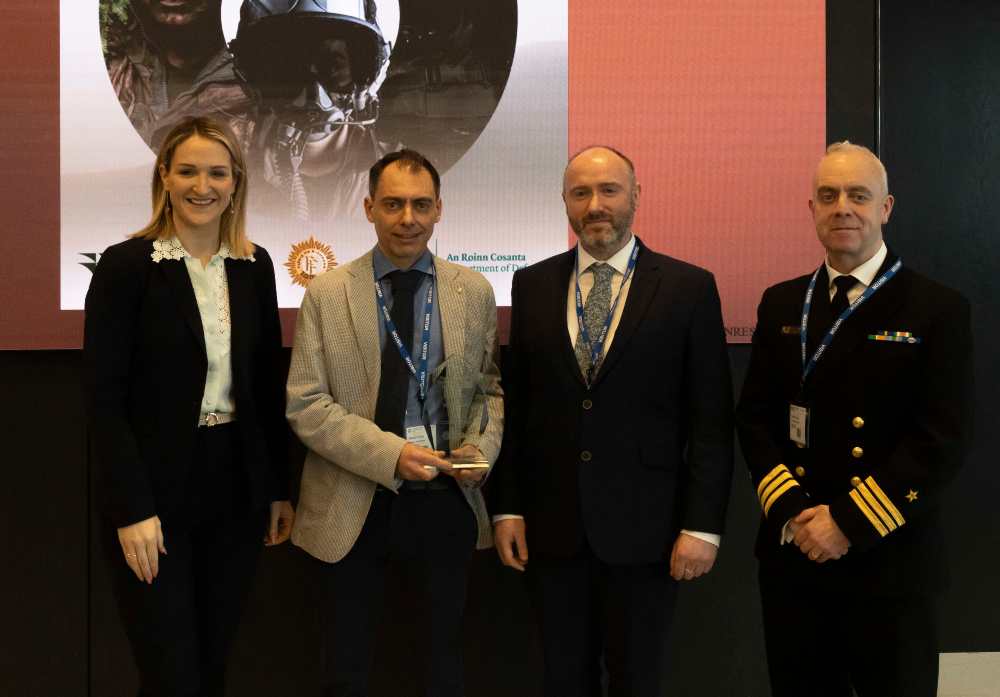
Top image: Dr Diarmuid O’Brien, CEO Research Ireland; James Lawless TD, Minister for Further and Higher Education, Research, Innovation and Science; Olivia Watters, Head of Research Impact at ADAPT Research Ireland Centre for AI-driven Digital Content Technology; and Taoiseach Micheál Martin TD. Photo: Jason Clarke
-
Bank of Ireland is welcoming new customers every day – funding investments, working capital and expansions across multiple sectors. To learn more, click here
-
For support in challenging times, click here
-
Listen to the ThinkBusiness Podcast for business insights and inspiration. Latest episodes are here. You can also listen to the Podcast on:
-
Spotify
-
SoundCloud
-
Apple