Ireland’s next FDI chapter hinges on faster delivery of housing, energy, infrastructure, AI and skills, business and investment leaders say.
Ireland has built one of Europe’s strongest records in attracting international investment, but the next phase will depend on execution across housing, energy, infrastructure, skills and artificial intelligence.
That was the message from business, banking, education and investment leaders gathered in Dublin to examine what Ireland must do to secure the next generation of foreign direct investment.
The discussion took place at Bank of Ireland’s inaugural FDI Breakfast Briefing at the Euronext Irish Stock Exchange in Dublin, bringing together IDA Ireland, multinational companies, professional advisers and businesses from across the investment ecosystem.
Its focus was firmly on the future. The panel, titled “Future Ready Ireland: Driving Global Investment”, examined investment, talent, banking, innovation and the infrastructure required to establish and scale international businesses in Ireland.
Investment is a long-term act of trust
John Feeney, CEO of Corporate & Commercial Banking at Bank of Ireland, told the gathering that a decision to invest in a country represents something much bigger than an immediate financial calculation.
“It is very much about not just the monetary decision, but the long-term support the companies get, and the nation’s commitment over time to ensure that it remains a very, very attractive place for companies to grow and thrive.”
He said that relationship starts with the practical requirements of entering a new country, from banking and payments to pensions and personal financial needs for employees. As businesses become established and expand, their requirements become more sophisticated.
👉 No tech background needed to bring your business into the AI age! Secure your Google AI Professional Certificate to complete the certification at no cost. Apply now and get started!
Feeney also identified housing and infrastructure as central to Ireland’s ability to sustain investment.
“We hear this again and again from our customers that they love operating in Ireland. They have great success in the subsidiaries that they set up here on the island, but they are concerned about the future of housing.”
Infrastructure presents a similar challenge. Investment in transport, renewable energy, ports, housing and the electricity system has consequences for companies considering their long-term presence in Ireland.
“Investing in a country is a long-term act of trust. It’s a long-term decision to believe in that country, not just at the moment of investment, but over time that that country will continue to win investment.”
Competition for FDI is becoming fiercer
Michael Lohan, CEO of IDA Ireland, placed the challenge within an increasingly competitive international investment market.
For international companies considering their next move, the central issue is whether a location can support the initial operation and its future development.
At IDA Ireland, Lohan said the proposition rests on three connected areas: people and place, the wider ecosystem and environment, and stability and security. Talent remains pivotal, alongside the research, business and institutional networks that have grown around Ireland’s major industries.
“Jobs are important, but FDI is actually more involved. It’s about the amount of impact in communities. It’s about the clear road to spend the money for that. It’s about global services and suppliers that supports. It’s about capital investment that happens.”
Ireland’s investment proposition now operates in a market shaped by geopolitical uncertainty, trade tensions, supply-chain disruption, AI and the energy transition.
Lohan said international investors were seeking stability, access to markets, strong institutions and skilled workforces. Ireland’s existing strengths fit those priorities, while the pace of investment elsewhere means the country has to keep strengthening its proposition.
“Other countries are moving quicker. They are investing in infrastructure, they are investing in renewables, and they are heavily pushing incentives to attract investment these years into your jurisdictions.”
Delivery will therefore become a defining measure of Ireland’s competitiveness.
“We must continue to deliver at pace on housing, on infrastructure, on energy, and critically on the cost of energy, which is so important.”
He pointed top Ireland’s prowess as a stable location for FDI investment, citing the longevity of some of the country’s longest investors. For example Siemens has been an investor in Ireland for more than 90 years and Abbott Laboratories for more than 80 years. Coca-Cola, IBM and Ericsson have been investors in Ireland for more than 70 years while Pfizer has been an investor here for more than 50 years.
That momentum is continuing with a new generation of businesses that include OpenAI and Stripe, a business founded in San Francisco by two Irish brothers, John and Patrick Collison.
“It is important that we continue this momentum.”
Finding the next generation of global companies
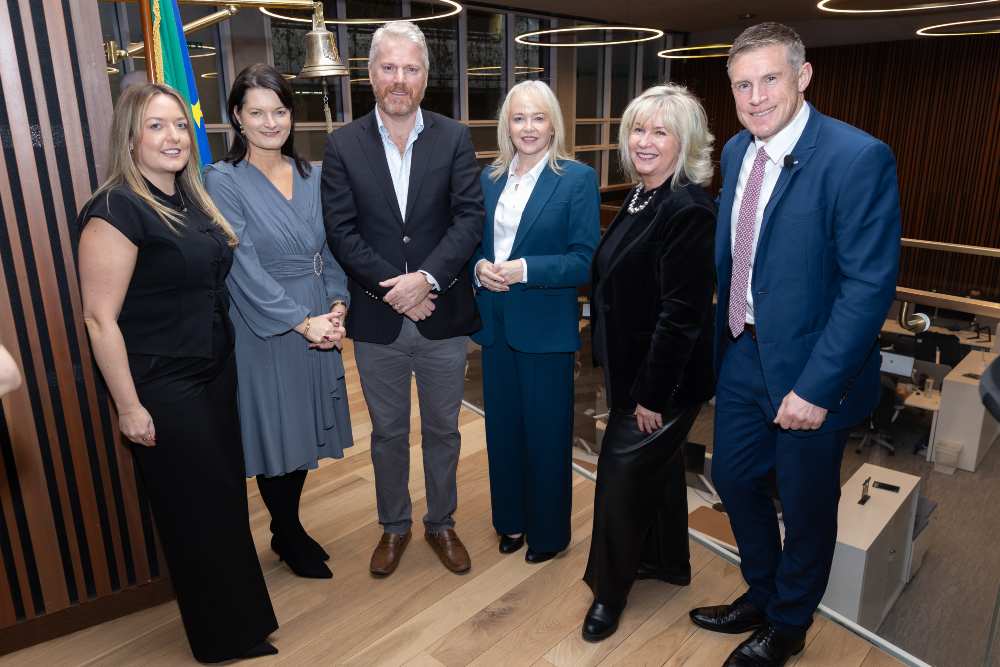
From left: Clare McKeveney, Senior Vice President and Head of FDI for North America & UK at Bank of Ireland; Anne-Marie Tierney Le-Roux, Executive Vice President and Divisional Manager for Technology, Consumer, Content & Business Services at IDA Ireland; James Lloyd, Senior Director, International at JUSPAY; June Butler, Head of Corporate & SME Banking at Bank of Ireland; Dr Deirdre Giblin, Director of Development & External Engagement at National College of Ireland; and Philip Healy, Senior Vice President and Head of FDI for Europe & Asia Pacific at Bank of Ireland
For Anne-Marie Tierney Le-Roux, Executive Vice President and Divisional Manager for Technology, Consumer, Content & Business Services at IDA Ireland, international competition is already changing the job of winning investment.
“The competitiveness of Ireland within Europe and through the other European locations, in the first instance, has definitely gone up several levels. We’re also competing more with other jurisdictions globally across the board,” she said.
That means identifying emerging companies earlier and convincing businesses without an established Irish connection that the country makes strategic and commercial sense.
“I think it’s reinvention. It’s remaining relevant, and I think it’s ensuring that Ireland is strategically significant to the company that’s living in setting up.”
IDA Ireland is also looking beyond traditional sources of investment, with greater emphasis on attracting companies from Asia, the UK and elsewhere in Europe.
Tierney Le-Roux sees Ireland’s membership of the European Union as an increasingly important part of that proposition.
“The role that Ireland can play in Europe and strengthening Europe’s position is a new card that I think we need to strategically leverage more.”
The view from an international company
James Lloyd, Senior Director, International at JUSPAY, provided the perspective of a technology business establishing operations in Ireland.
Lloyd returned to Dublin in 2023 after more than a decade in Hong Kong. His experience includes senior roles at Citigroup and EY.
When JUSPAY began looking at establishing a European presence, Amsterdam was initially under consideration. Lloyd made the case for Ireland and subsequently found himself navigating the practical work of establishing the company locally.
“All of that actually was probably more straightforward than I would have anticipated,” he said of the process of finding the professional and business support required to set up.
His experience also highlighted a challenge for Ireland: the country’s investment story is well understood in some markets and has an opportunity to build greater recognition further afield.
“We’re very well known in the UK, Europe, and the US. I think sometimes we underappreciate how little we are in parts of Asia, for example.”
AI raises the stakes for infrastructure
Artificial intelligence ran through much of the discussion, encompassing the companies Ireland hopes to attract, the people it needs to train and the physical infrastructure required to support future investment.
Lloyd said AI would affect existing jobs while creating opportunities to move towards higher-value activities.
“There will absolutely be an impact on jobs, like job attrition as consequences of AI.”
For Ireland, that makes investment in people and technology increasingly interconnected. It also places energy firmly at the centre of the debate.
Lloyd argued that demand from AI and other energy-intensive industries could be linked with greater renewable generation and energy security, provided Ireland moves from policy frameworks to implementation.
“We have become very good at building frameworks and building plans, but I think we’re less good at actually delivering this.”
The window for demonstrating those benefits may also be relatively short.
“We need to yield results soon before the tide turns,” he said.
Turning Ireland into an AI training hub
For IDA Ireland, the AI opportunity involves upgrading the capabilities of companies already operating here and securing new investment.
Tierney Le-Roux said businesses across Ireland’s existing FDI base were investing substantially in developing employees’ AI capabilities.
“We’re also positioning Ireland’s location for global training centers of excellence for AI,” she said.
The ambition extends into AI research and strategically important operations.
“We want Ireland to be home to the strategic elements of the AI investment.”
The investment landscape is moving quickly, demanding that Ireland continually adjusts its proposition.
“Every day the AI narrative is changing, and every day we wake up and look at what’s happened to the stock markets overnight and how is that going to impact and influence what’s happening in Ireland.”
Skills must move at the speed of business
Dr Deirdre Giblin, Director of Development & External Engagement at National College of Ireland, focused on another piece of economic infrastructure: education.
Ireland, she said, has built a highly educated workforce. Maintaining that advantage requires education and training systems that can respond much faster to technological change.
“What we are moving to, and we need to move a little bit more quicker towards, is an adaptive, responsive education that is all about the workforce.”
That increasingly means shorter programmes and microcredentials designed around people already in employment.
“Everything’s about micro credentials, five or six week qualifications, turning things around quickly.”
The relationship between employers and education has also developed considerably through apprenticeships and industry involvement in programme design.
“We’ve gone beyond. Honest. We are already in that space, so we’ve gone from employers being collaborators and consultants on the side of the programs.”
Giblin also highlighted widening access to AI skills and the risks of some groups being left behind as technology changes employment.
“That is really important. That we realise that AI can push people further out into the margins.”
Banking the FDI ecosystem
June Butler, Head of Corporate & SME Banking at Bank of Ireland, said supporting foreign investors begins with basic banking requirements and develops as companies grow.
Support can progress from operational accounts into cash management, foreign exchange, wealth management and pensions. Longstanding involvement with FDI also gives the bank connections across professional services and the wider business network.
“We invest heavily in building relationships early, so that we can support a business as they grow, and we take that very much as a lifetime commitment,” Butler said.
The financing of infrastructure represents another part of that relationship with Ireland’s investment economy.
“We are again, as a national champion bank, we take that role very seriously of supporting that infrastructure development and providing the balance of capital that’s required for that.”
Regional development also matters. Butler pointed to Bank of Ireland’s nationwide network as a means of supporting international businesses and the local ecosystem around them.
Competitiveness becomes a collective task
Philip Healy, Senior Vice President and Head of FDI for Europe & Asia Pacific at Bank of Ireland highlighted that Ireland’s FDI ecosystem and service network is about much more than attracting investment. “Its real strength lies in the depth of the financial, professional and institutional expertise that helps international businesses establish, scale and invest for the long term.”
Indeed, the thread running through the event was that FDI touches multiple areas of economic development. Housing affects the ability to recruit. Energy influences the economics of AI and advanced manufacturing. Education determines whether businesses can adapt. Infrastructure affects operational decisions. Banking, professional services and investment agencies shape how quickly companies can establish themselves and grow.
In her closing remarks, Clare McKeveney, Senior Vice President and Head of FDI for North America & UK at Bank of Ireland, brought those strands together.
“We’ve heard about talent and skills, AI and innovation. We’ve heard about energy and infrastructure. But importantly, we’ve heard that all of these things don’t sit in isolation.”
Her conclusion placed responsibility for Ireland’s next chapter of investment across the wider business ecosystem. Ireland already has multinational clusters, an experienced investment agency, a highly educated workforce and decades of accumulated international investment.
McKeveney said the work now centres on turning those foundations into faster delivery across the physical and human infrastructure required by the next generation of global companies.
“I think Ireland’s future competitiveness will really depend on how we all work together.”
Image at top: IDA Ireland chief executive Michael Lohan and John Feeney, chief executive of Corporate & Commercial Banking, Bank of Ireland
👉 No tech background needed to bring your business into the AI age! Secure your Google AI Professional Certificate to complete the certification at no cost. Apply now and get started!
-
Bank of Ireland is welcoming new customers every day – funding investments, working capital and expansions across multiple sectors. To learn more, click here
-
For support in challenging times, click here
-
Listen to the ThinkBusiness Podcast for business insights and inspiration. All episodes are here. You can also listen to the Podcast on:
-
Spotify
-
SoundCloud
-
Apple
Image at top: Photo by Marek Studzinski on Unsplash