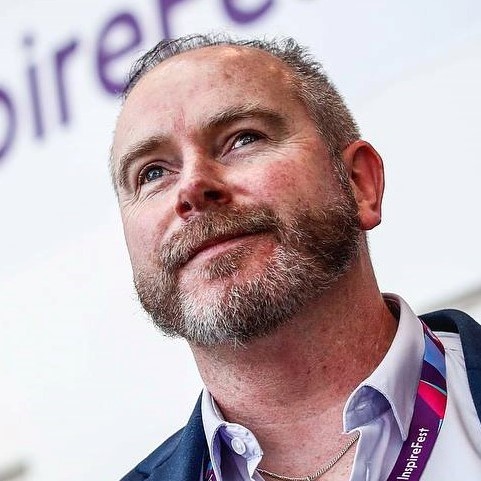
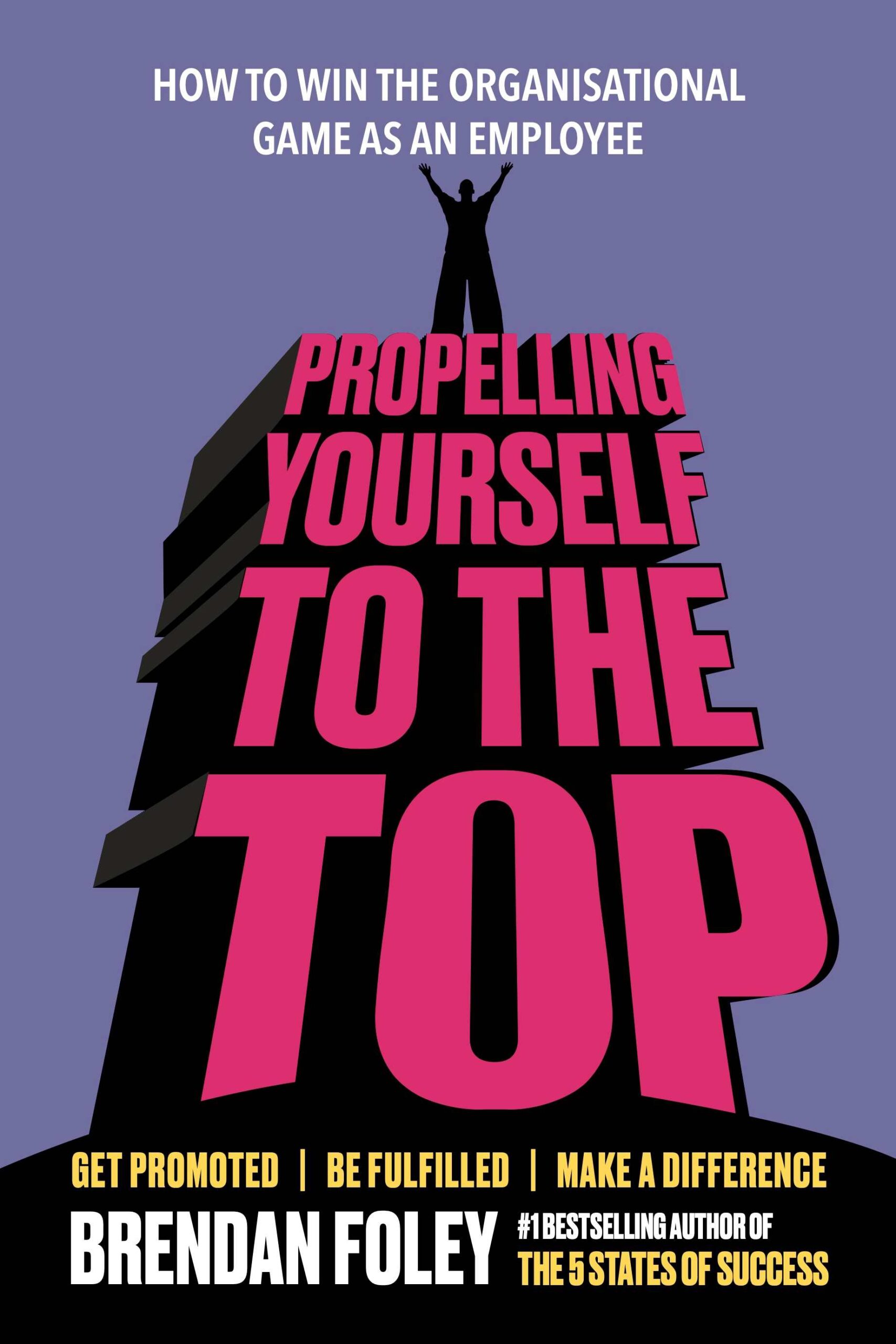
Podcast Ep 316: Business coach Brendan Foley reveals the unspoken dynamics that determine who rises through the ranks in his new book Propelling Yourself to the Top which is all about navigating organisational politics.
I was once told I was terrible at office politics. The reality was I was far too busy helping building a business to be playing such childish games. But the ‘game’ if you call it that, is actually more nuanced.
The sad truth is that most employees believe that working hard and keeping their heads down will eventually lead to recognition and promotion. According to business coach Brendan Foley, this conventional wisdom represents only half the equation for career success.
“Almost unanimously, energy was the main thing that people were hired on for the next role up”
“Keep your head down, work hard, and the rest will follow. Turns out, that’s good advice, but it’s not the full picture,” says Foley, whose latest book ‘Propelling Yourself to the Top: How to Win the Organisational Game as an Employee’ challenges workers to think more strategically about their careers.
Foley’s revelation came during a training session with middle managers at a large insurance company. As he explained how business strategy flows from board level down through executive teams to employees, he noticed blank stares around the room.
“I realised, oh no, I have just done what I’ve told people never to do, to assume. I made that massive assumption that everybody knew how business worked, that everybody knew where they would fit in,” he recalls.
The four enemies of results
That moment of recognition led Foley to identify what he calls the “four enemies of results” that prevent employees from advancing: confusion, overwhelm, distraction, and ignorance. The last, he argues, represents the greatest barrier to success.
“What’s the opposite of ignorance? It’s context that you understand, the context of your industry, the business you’re in, your career, and all of a sudden things start to make sense. Why are some people getting promoted?” Foley explains.
The middle managers he encountered were technically competent professionals in their 30s and early 40s with substantial experience. Yet despite their qualifications and even MBA credentials, they lacked understanding of organisational dynamics.
“These were middle managers in extremely large insurance firms. They were very good technically at what they did. They just didn’t have that wider understanding,” Foley notes.
The invisible contract
Central to Foley’s philosophy is what he terms “the invisible contract” – unwritten expectations that govern workplace success. The first rule, he says, is deceptively simple: “Make your boss look good.”
He explains: “Most people don’t see that. Who’s going to be giving you the promotion? Who’s got access to the resources? You got to make your boss look good. You need to start thinking like your boss. You need to understand what’s your boss’s boss measuring them on, and all of a sudden it starts to become clearer how you get ahead.”
This systemic thinking requires employees to consider multiple organisational levels simultaneously. “You’re taking nearly two or three levels up. What you realise is you’re in a system,” Foley says.
The BRAVE framework
To help employees navigate these dynamics, Foley developed the BRAVE framework: Brand, Results, Ability, Visibility, and Energy. Each element addresses a different aspect of career development.
Personal brand, in this context, extends beyond social media presence. “Your personal brand in work is what are people saying about you when you’re not in the room. It’s your reputation,” Foley explains. “If there are three adjectives used about you in the business, what are they? Are they positive? Are they negative?”
Results, meanwhile, represent the ultimate measure of success. “Nobody, but nobody rewards effort,” Foley states bluntly. “Business is a game of results. It’s what’s on the scoreboard at the end of the match.”
Energy trumps results
Perhaps surprisingly, when Foley surveyed CEOs and C-suite executives about promotion criteria, energy ranked higher than results. “Almost unanimously, energy was the main thing that people were hired on for the next role up,” he reports.
Energy, in this context, means attitude rather than mere productivity. Foley breaks this down using another acronym, THRIVE: Thinking possibility, Higher standards, Resilience, Inspiring others, Values-driven behaviour, and Engagement with life.
“There’s a beautiful phrase that I heard before, which is there is no such thing as a safe place. There are only safe people,” Foley reflects. “Safe people are people who understand their values, are aligned to their values, because we feel more sure around those people.”
Building networks that matter
Visibility requires what Foley calls being “networked and known.” He defines networking not as collecting contacts but as helping others. “The more people I help, the wider my network is, the more that people will be positively disposed towards me,” he says.
This extends beyond internal relationships. “Who knows the organisation could be bought tomorrow, they do a restructure, and suddenly I’m looking for a job. Have I got a network outside of the organisation, because that’s probably where you’re going to get your next job from.”
Foley has witnessed the consequences of failing to build external networks. “They sit on my couch, they’re chatting to me, and I go, ‘Where do I go next? What do I do? I’ve invested everything in this business, but I’ve nothing outside of it,’ and they’re lost. And my heart genuinely breaks for them.”
Future-proofing careers
The ability component of BRAVE focuses on future skills rather than current competencies. With artificial intelligence and automation reshaping industries, Foley emphasises the importance of developing relevant capabilities.
“Skills such as change management, emotional intelligence, prompt programming in terms of AI, robotics, machine learning, those type of skills are going to be in very, very high demand,” he predicts.
Foley’s approach combines practical career advice with broader life philosophy. Having spent his formative years sailing competitively for Ireland, he draws on maritime metaphors to illustrate business challenges.
“Everything’s fine when everything’s fine. But how do you act when that storm hits you, when that unexpected breakage happens, when a competitor boat does something you weren’t expecting and you’re caught out?” he asks.
The sea taught him that success requires both preparation and adaptability. “Sometimes people are trying to trim the sails, but there’s a hole in the boat. Often when I’m talking to leadership teams, I say, ‘We got to fix the hole in the boat, rather than trimming the sails.’“
For employees feeling frustrated by lack of recognition, Foley advocates channelling that energy constructively. “What I would really passionately love people to do is channel that frustration into action, but action without knowledge or context or clarity is going to be hard to achieve.”
His ultimate message centres on taking ownership of one’s career trajectory. “Sometimes we got to go through things that are really hard. We got to push ourselves. We got to go through that fear, because on the far side of that fear is opportunity, is success.”
-
Bank of Ireland is welcoming new customers every day – funding investments, working capital and expansions across multiple sectors. To learn more, click here
-
For support in challenging times, click here
-
Listen to the ThinkBusiness Podcast for business insights and inspiration. Latest episodes are here. You can also listen to the Podcast on:
-
Spotify
-
SoundCloud
-
Apple