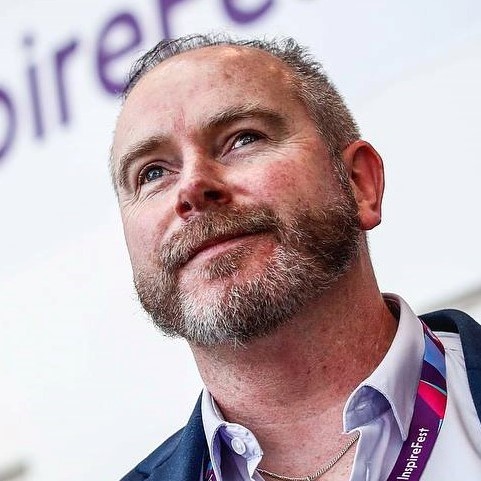
Podcast 307: Duncan Graham has navigated three decades of retail upheaval from Marks & Spencer to Specsavers. Now, at the helm of Hidden Hearing in Ireland he is applying his expertise to a growing challenge: the nation’s hearing health crisis among young people.
Duncan Graham’s journey through retail reads like a timeline of industry transformation. After nearly 30 years in Ireland, the Hidden Hearing general manager has witnessed firsthand how consumer behaviour has evolved from simple transactions to complex omnichannel experiences.
“I’ve always regarded it as a people business,” Graham explains. “If you’re somebody who prefers to be sitting in front of spreadsheets and locked away in a corner, which is certainly not me, then retail is not for you.”
“On average, it takes between five and seven years for somebody that started to experience hearing loss to actually do something about it”
His career trajectory took him from traditional department stores like Brown Thomas to Specsavers, where he spent eight and a half years as one of three retail directors across the UK, Ireland, and Spain. The transition to Hidden Hearing in September 2023 marked his entry into what he calls “medical retail” – a sector combining healthcare expertise with consumer-facing service.
“The people that work in this [field] are very much people who want to care for others,” Graham notes. “I’ve got 70 fantastic audiologists across the country whose primary focus is providing life-changing hearing solutions.”
The death of retail is greatly exaggerated in the age of digital
-
You can also listen to the Podcast on:
-
Spotify
-
SoundCloud
-
Apple
Graham’s tenure as CEO of Retail Excellence during the Covid-19 pandemic provided a unique vantage point on retail’s supposed demise. The lobby group represented independent retailers across Ireland during some of the sector’s darkest days.
“Those messages around retail is dead were very prevalent during those Covid years,” he recalls. “Nobody thought we were ever going to come back to shopping in shops.”
The reality proved different. Graham argues that successful retailers adapted by embracing what he terms “theatrical or experiential” retail – creating destinations rather than mere transaction points.
“You go in for that experience. You might spend quite a bit of time there, stop for food, go to cinema at the end of the day,” he explains. “You might not actually spend any money because you’ll spend the money when you get home sitting in front of Coronation Street at night on your phone.”
This fusion of physical and digital retail has become particularly relevant for Hidden Hearing, which operates 85 clinics across Ireland.
Graham is deliberately positioning new locations in accessible retail environments rather than tucked away in GP surgeries.
“Older people in particular want good accessibility, to drive into a car park in a place they know, not have to walk too far,” he says.
Ireland’s hidden hearing crisis
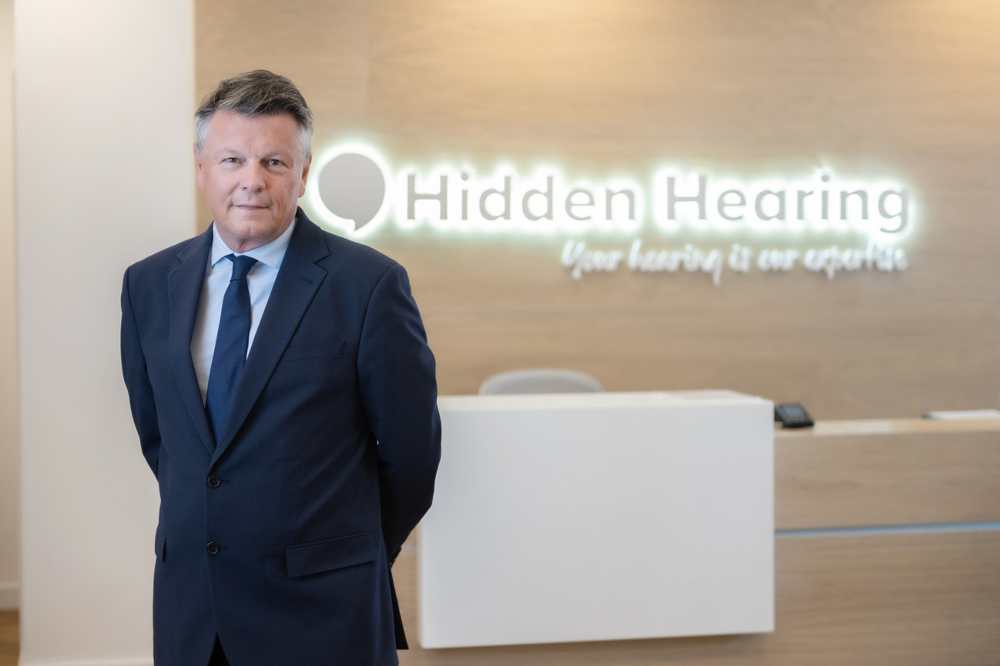
The numbers behind Ireland’s hearing health challenge are stark. Graham estimates that 50% of the 1m people over 60 in Ireland will experience hearing loss, while globally, one billion young people are at risk of hearing damage.
The culprit is increasingly familiar: technology itself. “If you think about where we spend most of our life, it’s with ear pods in our ears, listening to loud music,” Graham observes. “We never had that before.”
This shift is creating a younger demographic of hearing aid users, coinciding with technological advances that are making devices smaller and more sophisticated.
Hidden Hearing is preparing to launch the Oticon Zeal, described as the first “inside the ear” device that sits virtually unseen while offering full AI integration and rechargeable capability.
“The technological developments are enormous,” Graham says. “It’s incredible, especially using AI.”
Breaking the stigma barrier
Despite technological advances, Graham acknowledges that stigma remains a significant barrier. “On average, it takes between five and seven years for somebody that started to experience hearing loss to actually do something about it,” he explains.
The consequences extend beyond simple inconvenience. Graham points to established links between untreated hearing loss and social isolation, with potential connections to dementia and other health conditions.
“People start withdrawing from society simply because you won’t go to the pub in the evening with your friends because you can’t hear them,” he notes. “Yet they could be enjoying life to the full simply by getting assistance through a hearing aid or hearing device.”
To address this, Hidden Hearing has introduced innovative outreach programs, including a mobile clinic that has screened thousands of people across Ireland this year, often in partnership with the Irish Heart Foundation.
Lessons from a retail lifer
Graham’s approach to business challenges reflects hard-earned retail wisdom. He operates by three principles: “Mess up, fess up and dress up” – acknowledging that mistakes are inevitable but recovery is crucial.
“Nine times out of 10, the mistake you make you did in the best interest of the business,” he explains. “The important bit is to admit it, and then go that extra mile to recover it, particularly where customer service is concerned.”
This philosophy has served him well across multiple retail transformations, from the rise of e-commerce to the pandemic’s acceleration of digital adoption. As Hidden Hearing expands its retail footprint and introduces new technologies, Graham remains focused on the fundamental retail principle that has guided his career.
“At the end of the day, knowing your customer is really, really vital,” he says. “Whether you’re selling food in Marks and Spencer at Christmas or hearing aids to somebody – you’re selling to a person.”
As Ireland’s population ages and younger generations face new hearing challenges, Graham’s blend of retail expertise and healthcare focus positions Hidden Hearing to address a growing national health issue through the lens of customer service excellence.
-
Bank of Ireland is welcoming new customers every day – funding investments, working capital and expansions across multiple sectors. To learn more, click here
-
For support in challenging times, click here
-
Listen to the ThinkBusiness Podcast for business insights and inspiration. All episodes are here. You can also listen to the Podcast on:
-
Spotify
-
SoundCloud
-
Apple