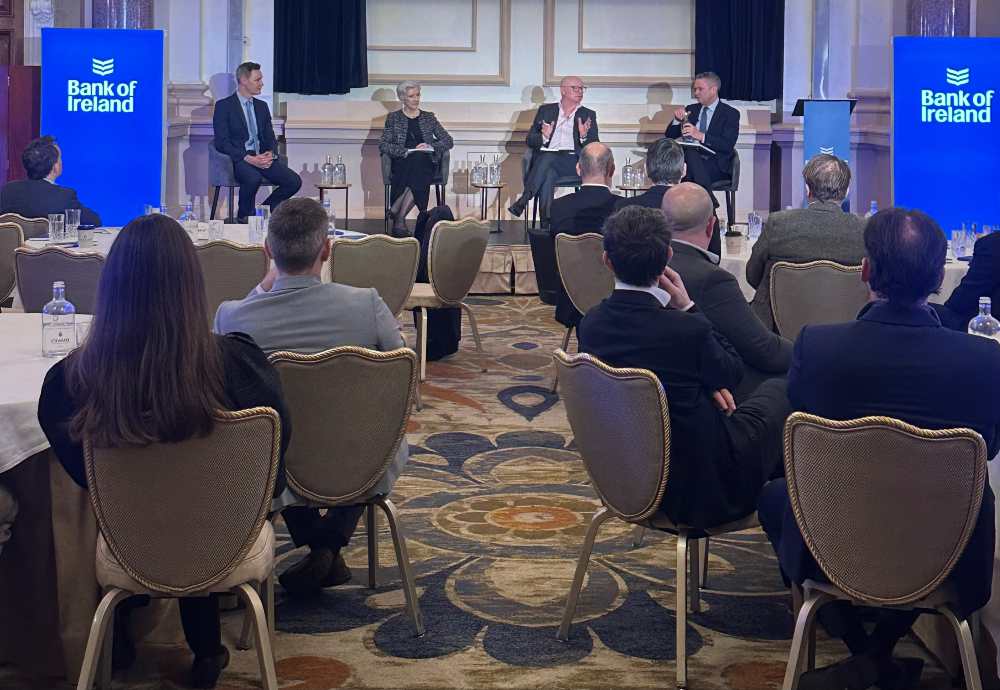

Bank of Ireland economists expect domestic demand to underpin expansion as export surge fades and public spending rises.
Bank of Ireland expects the Irish economy to settle into a steadier pace of growth in 2026 after an exceptional export-driven surge last year, with domestic demand and public investment taking a larger role in sustaining activity.
The Bank said on Tuesday (27 January) that gross domestic product is forecast to grow by 2.8% in 2026, down from an estimated 11.2% in 2025.
“Given volatile US policy making, there is still a clear risk of further trade disruption”
The slowdown reflects the fading of a sharp rise in exports to the United States last year, when companies accelerated shipments ahead of potential tariffs and new pharmaceutical production came on stream.
Even so, the lender said the underlying outlook remains robust. Modified domestic demand, a measure that strips out the distorting effects of multinational activity, is expected to grow by 2.3% in 2026, supported by consumer spending, government outlays and a recovery in construction.
Sustainable growth pace
“Our forecasts point to the Irish economy easing into a more sustainable but still solid pace of growth,” said Conall Mac Coille, group chief economist at Bank of Ireland.
“We expect GDP to rise by 2.8% in 2026 supported by a 2.3% expansion in modified domestic demand. Even as employment growth moderates towards 1.5%, momentum in construction and public investment is encouraging.”
The Bank slightly upgraded its estimate for 2025 GDP growth to 11.2%, from 10.7% previously, citing stronger than expected exports. Irish goods exports to the US rose by about 60% last year, driven by new pharmaceutical capacity, including weight loss drugs, and by firms bringing forward shipments in anticipation of trade restrictions.
Bank of Ireland cautioned that the true strength of the export sector remains difficult to assess. If exports to the US were to fall back more sharply than expected, negative GDP growth in 2026 could not be ruled out. New pharmaceutical facilities coming on stream, however, are expected to provide a lasting uplift to output.
Stepping away from volatile GDP figures, the Bank said domestic indicators point to continued expansion. Consumer spending is forecast to rise by 2.3% in 2026, helped by employment growth of 1.5% and annual pay increases of about 4%. Government spending is expected to increase by 4%, while construction output is forecast to grow by 6.6%.
Public finances are set to play a central role. Budget 2026 outlined an 8% rise in public spending to €118bn, which Bank of Ireland estimates will account for roughly one third of the growth in modified domestic demand next year. Capital spending is planned to rise by 12% to €19bn, supporting infrastructure and investment under the National Development Plan.
“Budget 2026 provided an important boost through higher capital spending, which will offset the impact of heightened uncertainty on investment,” Mac Coille said.
The labour market is expected to cool gradually. Employment growth is forecast at 1.5% this year, with the unemployment rate edging up towards 5% by 2027. Bank of Ireland noted signs that job creation has slowed, particularly in consumer-facing sectors such as retail and hospitality, which it linked to rising wage costs and weaker sentiment.
House price inflation is forecast to slow to 4% in 2026, down from mid-single-digit rates in late 2025. The Bank said stretched affordability and slower income growth should temper price rises, though the chronic shortage of housing supply continues to pose upside risks if demand strengthens again.
External risks remain a prominent feature of the outlook. Bank of Ireland pointed to geopolitical tensions, volatile US trade policy, elevated equity market valuations and concerns about US fiscal sustainability and central bank independence.
It noted that US threats to impose tariffs on certain EU countries appear to have eased, and that pharmaceuticals remain exempt following agreements between multinational drugmakers and the White House.
“Given volatile US policy making, there is still a clear risk of further trade disruption,” Mac Coille said.
Domestically, the Bank highlighted competitiveness pressures and infrastructure constraints as growing challenges. It said effective delivery of the government’s Accelerating Infrastructure Report and Action Plan will be critical to ensuring the successful rollout of the €106bn National Development Plan.
The rebound in non-residential construction in 2025, the first expansion in five years, was cited as a positive sign that the sector is adjusting to higher build costs. Bank of Ireland expects this recovery to continue through 2026 as public and private investment projects progress.
IDA Ireland figures showing a 1.5% rise in multinational employment to 312,000 in 2025 also offered reassurance, Mac Coille said, that many firms are continuing to invest in Ireland despite a more uncertain global environment.
-
Bank of Ireland is welcoming new customers every day – funding investments, working capital and expansions across multiple sectors. To learn more, click here
-
For support in challenging times, click here
-
Listen to the ThinkBusiness Podcast for business insights and inspiration. All episodes are here. You can also listen to the Podcast on:
-
Spotify
-
SoundCloud
-
Apple