
Dr Feena May, whose book The Power of a Lollipop won at this year’s Business Book Awards, on how to tell what kind of decision you are facing, and how to make the next right answer.
At the barrier
There was shooting on the front line that day. It was 1992, in the former Yugoslavia, and I was leading a convoy of four Land Cruisers full of children. We were taking them home to parents they had not seen for more than a year, and we were caught in the crossfire.
I always carried a giant bag of lollipops behind my seat. When the shooting quietened, I got out and walked slowly towards the soldiers at the barrier, holding the bag in front of me almost like a white flag. I offered them a lollipop. The guns were lowered, grown men took their time choosing a colour, and someone cracked a joke.
“Anyone can write a vision statement. Sensemaking shares a vision of positive impact so that everyone understands the journey, and it is done when everyone tells the same story”
The soldiers on the other side had been watching. As one side lowered its guns, the other did the same, and I walked across to them with the bag. After a while, they let us pass.
I had just turned twenty-four, six months into my first real job, with the International Committee of the Red Cross. Looking back, that walk was a decision. I had no data, no precedent and no certainty about how it would end. I chose a direction, watched the soldiers as I walked, and waited for the commander’s nod before I crossed.
In that first job I travelled a country at war, and I saw some people lead from hope and others through fear. I wondered why we used the same word for both. It took me years to find the answer, and the answer became my book, The Power of a Lollipop. An act of good leadership has five elements: Presence, Relating, Sensemaking, Action and Service. This article is about the third, the one leaders often find the most difficult, and what has to happen next.
Sensemaking in a warehouse
In 1994 I was in Ruhengeri, in the northwest of Rwanda, in the wake of the genocide. We ran a relief operation feeding about one hundred thousand people a month from one huge warehouse. It was working. We were just not sure it was working as well as it could.
So one day nearly seventy of us, team leaders and off-loaders, shifted the 50 kg bags and the pallets out of the way so everyone could sit together, and asked whether we were serving people as well as we could. Then the stories came: runaway chickens, wives who could carry more than their husbands, older people struggling with their loads, bored teenagers hanging around.
We changed the vision, from running a good warehouse to the impact we wanted on the people we served. In two days the team redefined the operation from the bottom up. We started a wheelbarrow programme, so the teenagers had jobs and the older people had someone to carry their load. At the team’s own request, pay moved from time worked to work done. Within a few weeks the warehouse’s real capacity had doubled.
This is sensemaking. Anyone can write a vision statement. Sensemaking shares a vision of positive impact so that everyone understands the journey, and it is done when everyone tells the same story.
Then someone has to decide
I remember a session with the wonderful Pablo Suarez on leading in the emerging future. He showed a cartoon of a fortune teller looking into her crystal ball and saying to a man in a suit, “You have all the data; just do something!” Everyone laughed that painful laugh of recognition. Most organisations have more data than ever, and decisions are getting neither better nor quicker.
Part of the trouble is that we treat every decision the same. A tool I have used for years, adapted from the work of Ralph Stacey, places any situation on two lines. The first is certainty. Put a capsule in a coffee machine and you know what you will get. A firefighter walking into a fire does not. The second is agreement. In accounting everyone agrees where expenses and income go. Far from agreement is ten people in a room with twelve opinions.
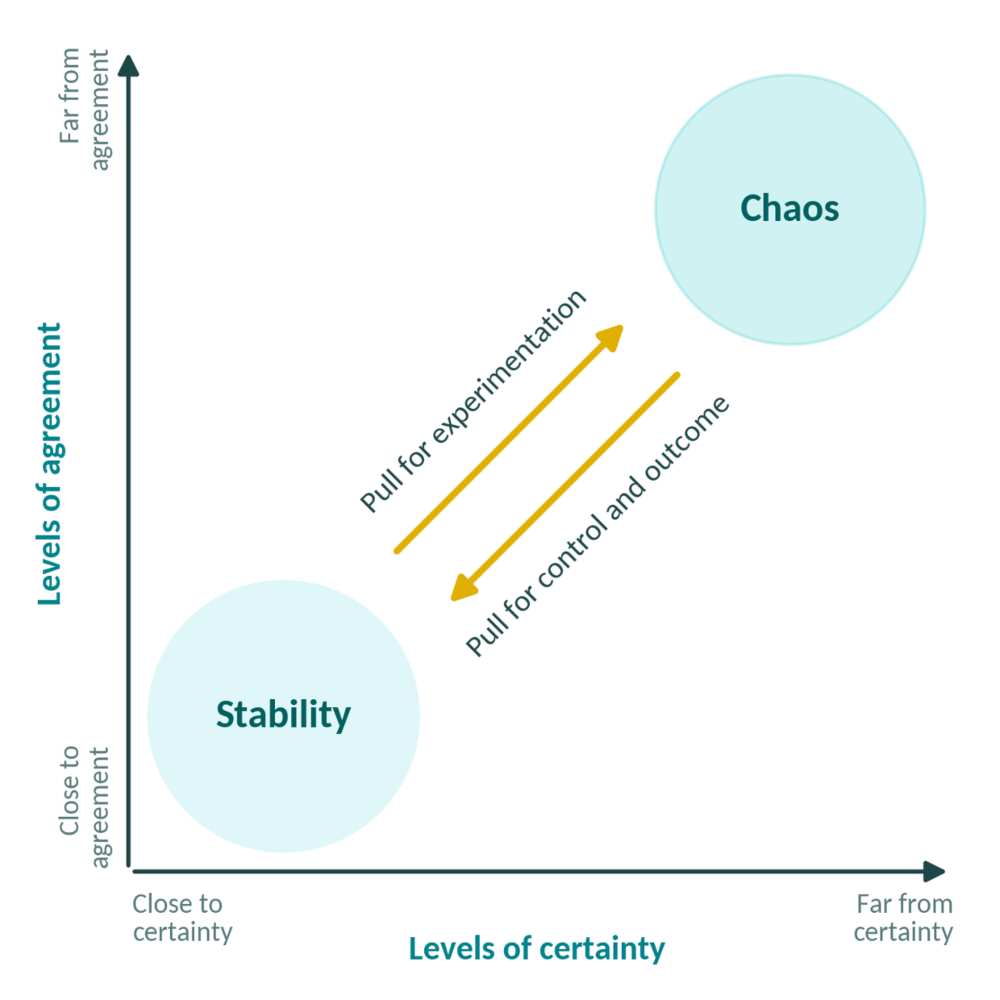
The Stacey Matrix, adapted from the work of Ralph Stacey. From The Power of a Lollipop (Girl Friday Productions, 2025)
Close to both is stability, where I wear my managerial hat and run the processes and systems that deliver. Far from both is chaos, where I put on my leadership hat, because nobody yet knows the right answer. That was the barrier at the frontline. My job there was to sense the possible next right answer, and to bring enough agreement and certainty to make something real. Nobody holds the whole picture alone, so that is work done round the table, in conversation. That path from chaos to stability is sensemaking. It is what we did in the warehouse, and it is what makes a decision possible.
First, see where you are. Frontline operations are close to agreement and far from certainty. Managers who all want a new policy, but each want a different one, are close to certainty and far from agreement. Searching for a new product line is far from both, and anything could be the next right answer.
No perfect decision
Sitting on a decision is also a decision. There is no perfect decision; only hindsight will tell you whether you were right. What you can make is the next right answer, by doing the work of deciding honestly, getting things moving, and building a feedback loop so you can hear, in real time, what an old Irish tale from Fionn MacCumhaill called the finest music in the world: not the cuckoo, not the stag belling across the water, but the music of what is., and adjust.
Try this
Pick one decision you have been sitting on. Before you decide, do what we did in Ruhengeri: move the pallets, sit down with the people doing the work, and listen. Then place what you have heard on the matrix. It will tell you how close you are to agreement and to certainty, and so which hat to wear. If you are in stability, run the process. If you are in chaos, sense the next right answer, take the decision, get moving, and keep listening.
Leadership does not have to be complicated, and it does not have to be heavy. Keep it simple, keep it human, and let there be some fun in it.
Top image:
Frequently Asked Questions
What does sensemaking mean in leadership?
Sensemaking means sharing a vision of positive impact so that everyone understands the journey. Dr Feena May says the process is complete when everyone can tell the same story about where they are going and why.
What is the Stacey Matrix used for?
The Stacey Matrix helps leaders understand the type of decision they are facing by considering two factors: the level of certainty and the level of agreement around a situation.
How should leaders make decisions in uncertain situations?
When a situation is far from both certainty and agreement, Dr Feena May describes it as chaos. The leader’s role is to sense the possible next right answer, build enough agreement and certainty to act, then keep listening and adjusting.
Is there such a thing as a perfect decision?
No. The article argues that there is no perfect decision, because only hindsight will reveal whether a choice was right. Instead, leaders can focus on making the “next right answer”, taking action and creating a feedback loop that allows them to adjust in real time.
How can leaders apply the “next right answer” approach?
Start with a decision that has been sitting unresolved. Listen to the people doing the work, assess the situation according to certainty and agreement, and decide which approach is required. In stability, run the process. In chaos, sense the next right answer, make the decision, move forward and keep listening.